 Stone-Ideas.com


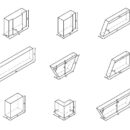
Examples of stone in load-bearing use were shown at the Stone+tec trade fair
Natural stone as a building material of the future and not only just as a decorative material as in the present was the topic on the first day of the congress at the Stone+tec trade fair in Nuremberg in 2024 (June 19th – 21st). This means that stone is used as a load-bearing material and not only just as a beautiful cladding for facades, walls, or floors. Such use could have great potential for conflict within the natural stone sector, as some dealers and entire countries have established the idea of marble as a symbol of luxury as their product brand.
During the panel discussion at the end of the first day of the congress, the potential conflict was heard between the lines when the topic was broken down into a few terms: on the one hand “bearing and boring,“ on the other “luxury and abundance.“
However, this does not necessarily have to become a controversial issue. Because: Even on a facade made of load-bearing stones, the high design value of the material is retained.
In other words: Stone cannot be reduced to its mere function as a building material. Our photos above show that.
The first congress lecture was about the energy balance of solid stone construction. Hans Peters from the Institute for Building and Environment (IBU), an independent consultancy institute on environmental aspects of construction, stated: “In the future, it will be increasingly important for builders and architects that a building uses as little energy as possible, and therefore the importance of grey energy is becoming ever greater.“ Grey energy refers to the amount of energy that has to be used to produce a building material.
Natural stone is very well positioned here, says Peters, because: “Stone is there by nature.“
EPDs (Environmental Product Declarations) exist to ensure comparability. The natural stone associations in numerous countries have now drawn up such balances for their materials. These enable a general comparison with other materials. Individual companies are in the process of creating very precise EPDs for their own products and their specific circumstances.
This means costs for the companies, and Peters brushed aside the companies’ complaints about these new costs: “In the future, an EPD will be required for all building products in the EU.“
There was no opposition. The vast majority of the approximately 80 guests were architects who see solid stone construction as a field for themselves and wanted to get some ideas.
Anne Hangebruch, architect and junior professor at the Technical University of Dortmund, began by giving an overview of the 1960s, when stone was still used in many places in Europe – in individual cases – to bear loads.
She wants today’s architects to rediscover this promising material and is developing ideas for this with her students. One is a pavilion that will soon be built on the university’s West Campus. The material comes from the company Bamberger Natursteinwerk, which is one of the leading companies in this field in Germany.

 A stone pavilion in the middle of a campus in the usual post-war dreariness of German universities?
At this point we return to the debate about commodity vs. luxury mentioned at the beginning: What if this natural stone vault were to turn into a design and ecological gem for universities across the country?
One of the core goals of Anne Hangebruch’s research is to take natural stone out of the niche of luxury buildings and “to fully exploit its potential,“ as she put it in her lecture. This also involves inexpensive (social) housing with stone in the form of modular and serial elements and in combination with other suitable building materials.

 The third lecture was given by Steve Webb from the engineering firm Webb Yates in London. It has 75 employees and is often consulted worldwide for tricky construction questions. “Ten percent of our projects involve stone,“ said the company founder in the lecture, and he himself seems to have a soft spot for the material.
He made a cost calculation for taxing energy and labor and recommended taxing energy consumption and CO2 emissions more heavily: “If labor becomes cheaper this way, more jobs will be created.“ At the same time, climate goals could be better achieved.
In passing, he dismissed orthodox natural stone lobbyists who want to elevate stone to the highest altar with solid construction. He is a big fan of combining stone with materials that also have a low carbon footprint, for example in the form of elements in which wood and stone oder steel and stone work together.
In his presentation, he showed Webb Yates’ latest development: a rod made of stone and stainless steel, where stone tubes are tensioned using steel and can be screwed together to form a structure.

 The fourth speaker, Carlos Oliver from the Instituto Balear de la Vivienda (IBAVI), began by describing the general conditions on the Balearic Islands of Mallorca and Menorca. The aim there is to use the thermal properties of the stone in such a way that the coolness of the night is stored in the building and the heat of the day is kept out. This has to be achieved with the sandstone available on the islands, which is very soft but once was the building material there.
By the way: the ancients also used seaweed (Posidonia) on many occasions.
Oliver, an architect at IBAVI, showed numerous projects from the institute, some of which involved apartments for low rents.
The walls of the buildings are very thick, thus compensating for the low load-bearing capacity of the stone and at the same time making use of its thermal inertia, i.e. the storage capacity for cold, for example.
Dried seaweed is used in IBAVI projects for fill under the roof for thermal insulation.
The design of the facades lets as much light as possible into the building but still reserves a large area for the thick walls.
In his opening statement, Carlos Olivier argued for taking into account the real costs of building materials mined elsewhere and delivered from there and called for “Global Social Justice.“
“We have to think about building,“ he said, referring to the IBAVI guideline, and gave the following reason: “The world population is growing, and if we continue to build for it as we have done so far, that will mean two degrees more global warming.“
To clarify: this frequently cited temperature figure refers to the difference between the ice age and the warm period – which is only four degrees on average.
Institut für Bauen und Umwelt e.V. (IBU)
TU Dortmund, Anne Hangebruch (German)
Instituto Balear de la Vivienda (IBAVI) Spanish
See also:
(15.07.2024, USA: 07.15.2024)