 Stone-Ideas.com


The surfing competitions as part of the 2024 Olympic Games in France will be held on Tahiti in the Pacific. This is partly because French Polynesia is part of the territory of the Paris Republic and because France, for its part, does not have waves on the Atlantic that meet the requirements of the professionals, let alone on the Mediterranean.
But on Tahiti, about 75 km from the capital Papeete, there is the beach Teahupo’o with the wave of the same name, and both are famous in the surfing community. In winter, huge waves of nine meters and more rise up with great reliability.
The professionals then drive on jet skis to the formation zone near the beach and demonstrate surfing tricks on their boards.
The IOC describes the competition as follows: “Surfers perform manoeuvres and tricks on a wave that are scored by five judges based on the variety, type and difficulty of the tricks. Surfers are also judged on their speed, power and flow (the way in which a surfer seamlessly connects their moves from one to the next). Shortboards are the surfboards of choice for the Olympics. Smaller than longboards, shortboards are faster and more manoeuvrable, which makes them the ideal board for performing spectacular tricks.”
This is a dangerous business, as with many modern sports. That’s why surfers wear special safety vests – if the wave crashes over them, this airbag suddenly inflates with compressed air and brings the person out of the wild water back to the surface.
Surfing is an Olympic discipline for the second time. The number of competitors is now 48, eight more than in Tokyo in 2020.
Like a Mexican wave in a stadium
You can imagine a wave in the ocean like a Mexican wave in a stadium: the water particles swing up and down, just as the spectators stand up and sit down without leaving their seats. The difference is that the particles in the sea pass on energy as they swing, such as that of the wind above the surface or that of a seaquake in the depths.
On the beach, the wave has to rear up because there are no longer as many particles on top of each other as in the open ocean.
There is a geological peculiarity off Teahupo’o: it is a reef that rises almost vertically from a depth of around 80 m to just below the surface. Together with the wind from the right direction, this creates the spectacle of monster waves.
These are completely normal processes in nature – the reefs act as breakwaters and protect the coast.
However, it is questionable how the situation will change as sea levels rise as a result of climate change.
That is why a team of researchers from France, Germany and Australia have scientifically studied the situation there. One of the findings is that only intact reefs can really take on the protective function. “If the coral reef is healthy and has a complex structure, the rise in sea level has less impact. The reef can continue to perform its protective function and less wave energy hits the shore.” is one of the key sentences in the publication, which can be downloaded.
Back to Europe. The best surfing ground is in Portugal off the Atlantic coast of Nazaré. The world’s elite surfers meet there in October and November. The highest wave recorded there is said to have been 30 m high, ten stories high.
It is created by a channel on the seabed running towards the coast, from which the water rises to sensational heights.
Finally: For all those who love waves but prefer them to be less wild, the editors of Stone-Ideas.com recommend:
* Firstly, a real monster wave made of stone, or more precisely: a rock formation. It is called “Wave Rock,“ is around 15 m high, 110 m long and is located in Western Australia (see photo above).
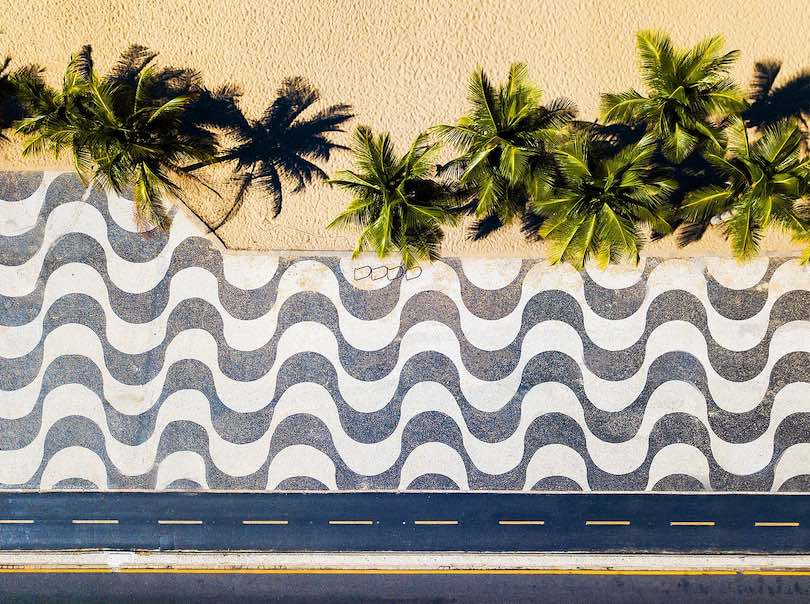 * Secondly, the Calçada Portuguesa (Portuguese Paving) with its black and white lines. They are famous on the Copacabana in Rio or in numerous squares in Portugal.
 * Thirdly, in the US state of Arizona there is “The Wave” made of sandstone.
Research on reefs as breakwaters: Marum, Bremen