 Stone-Ideas.com


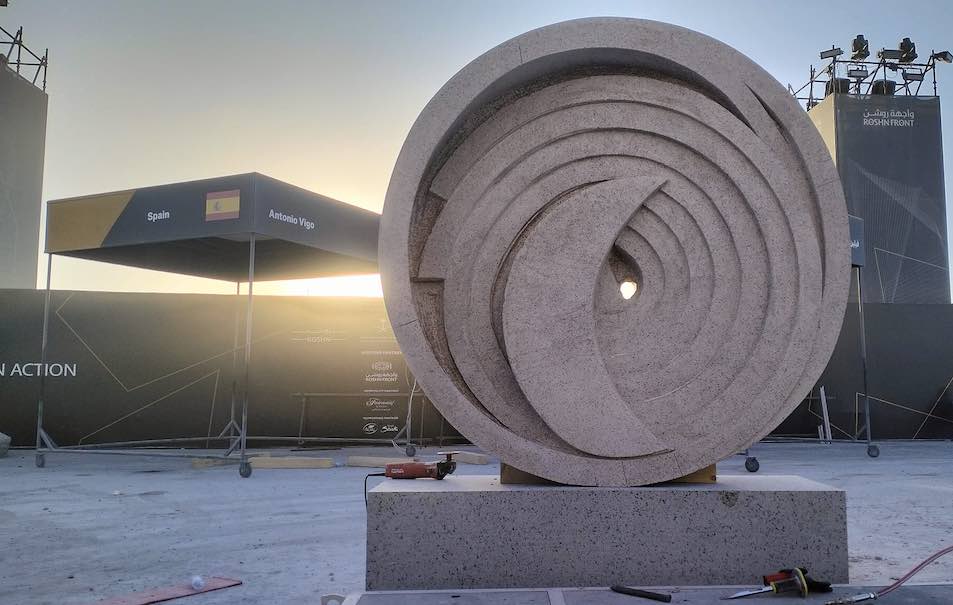
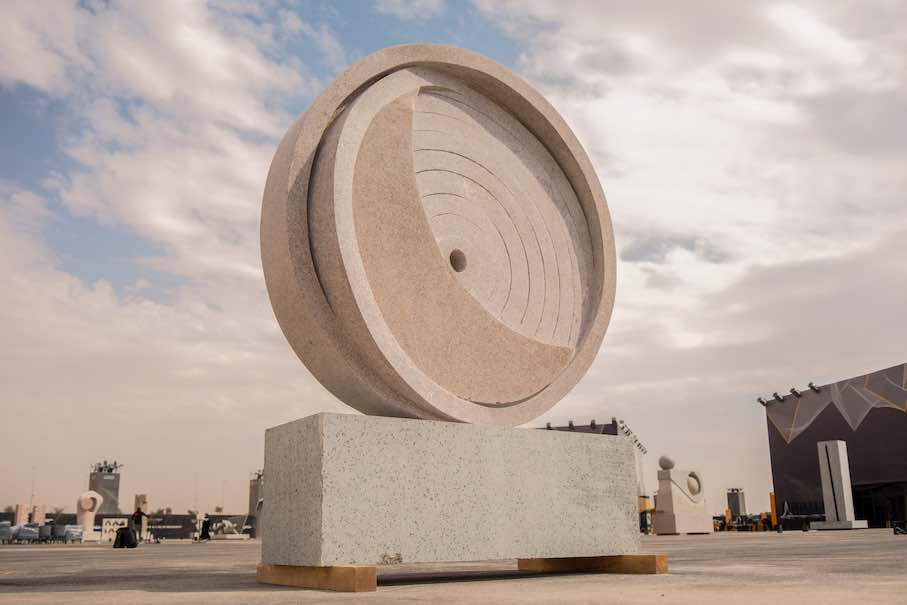
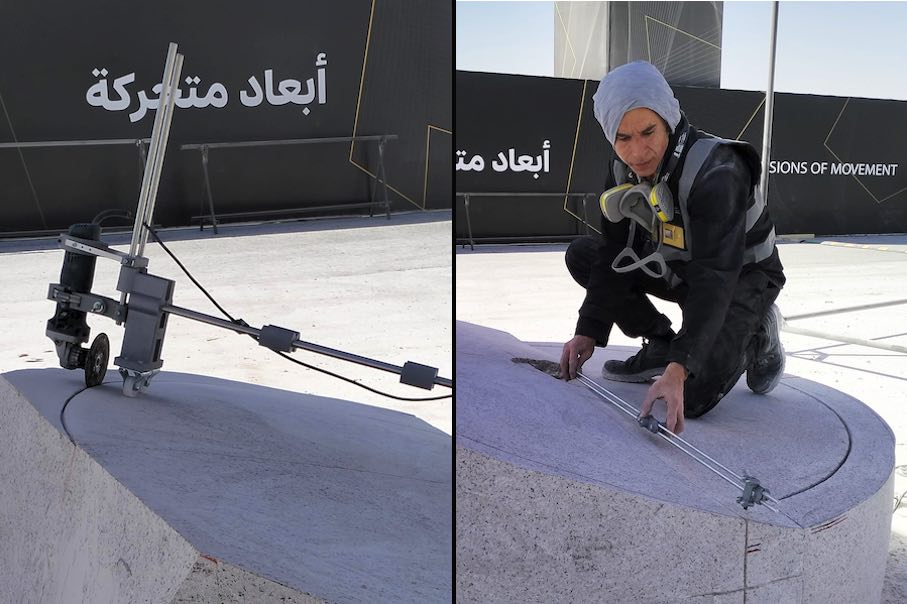
Without fear of crossing boundaries, he developed his own tool for this
To describe Antonio Vigo as a stone sculptor is too simplistic, even though most of his works are monumental sculptures in marble or granite. The Spanish artist’s focus is on the three-dimensional space.
And, last but not least: Vigo is also a kind of artistic engineer, because he even developed his own tool for his latest work “Unlimited Dreams“ at the Tuwaiq Sculpture Symposium 2024 in the Saudi capital Riyadh.
To describe his life’s journey, we simply reproduce a section from his website: “Antonio Vigo (b.1972) is a sculptor and professor of Fine Arts at the Rey Juan Carlos University in Spain. He attended the School of Arts and Crafts in 1992 and obtained a Fine Arts degree from the Complutense University of Madrid in 1999, where he also earned his PhD with an Extraordinary Prize in 2010. Vigo is also a researcher with a strong focus on visual arts and three-dimensional projects.”
His works not in stone include, for example, the installation “Mareas y Destierroz” (Tides and Expulsion, 2019): These are columns of letters that are thrown onto house walls and from which Spanish words emerge. With them, Vigo addressed the migration from Africa across the Mediterranean and its representation in the media.
A similar example of a visual work that takes place in an open space was “La piel de la piedra” (The Skin of the Stone) in 2018: For this, he had projectors project geometric outlines onto the walls in a quarry in Seravezza, not far from Carrara, so that parts of the stone repeatedly emerged from the surface or disappeared into it.
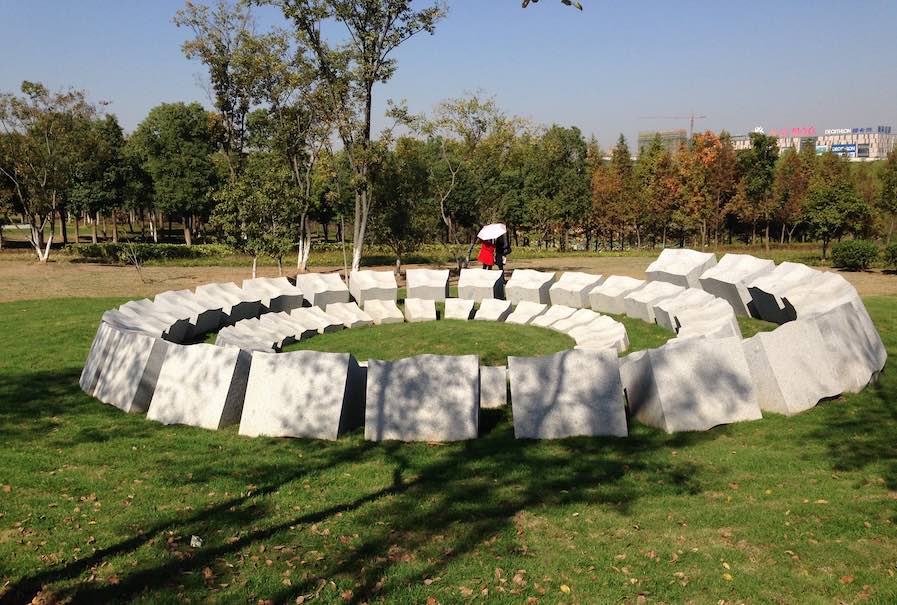
It is important to him that his works always have a concrete reference to the location and the time of their creation.
“Unlimited Dreams“ for the Tuwaiq Symposium was about the cycles that determine both the nature and the thinking of many cultures: The work “symbolizes the infinite and the perpetual motion, inspired by the concept of eternal circle, which, in turn, represents a society, which, for its traditions and customs, balances a rich culture with dynamic progress,” he is quoted on a website of his university.
One could also put it more simply: For the deeply religious host country, he has translated the religion and its recurring rituals into the millions of years old granite from Saudi Arabia.
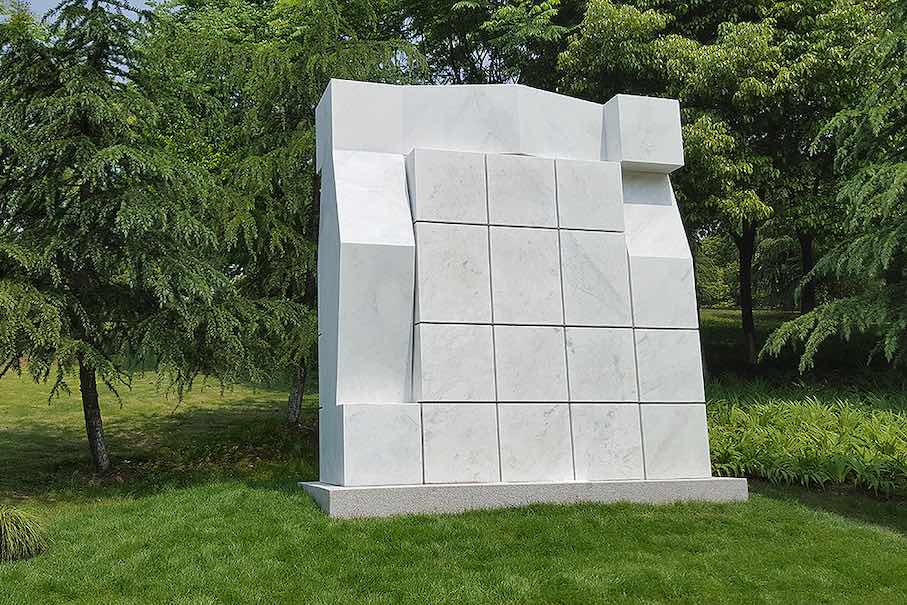
All of Vigo’s works in stone are characterized by the precision of the geometric form. In this case, it was about the orbits of the celestial bodies, embedded in two plates that are slightly offset against each other.
Achieving this on site in the limited time of the symposium of 4 weeks was the special challenge of this work. Normally, you would have a CNC machine with a robot arm and grinding tool do it. But that was not possible at the symposium.
Despite all the immaterial work, Vigo is still a sculptor at heart who likes to hold the tool in his hand, so he developed a special guide for the grinding tool himself.
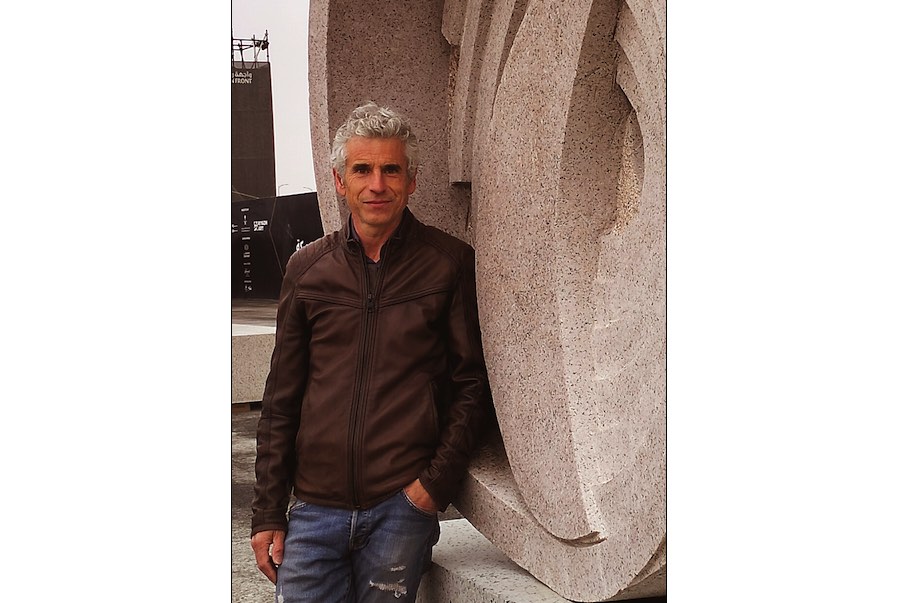
And while he was busy with the technical questions in the run-up to the symposium, he got into the realm of philosophy: “The fundamental challenge for this project was to realize the implementation of an idea in material, and in the end the entire work of art is no different.“
He ends his email reply to our questions with the following comment: “I find this part of my work fascinating, and I consider it an element of the creative process that I use, so I am very grateful to have had the opportunity to put it into practice in the city of Riyadh. ”
See also:
(22.07.2024, USA: 07.22.2024)