 Stone-Ideas.com


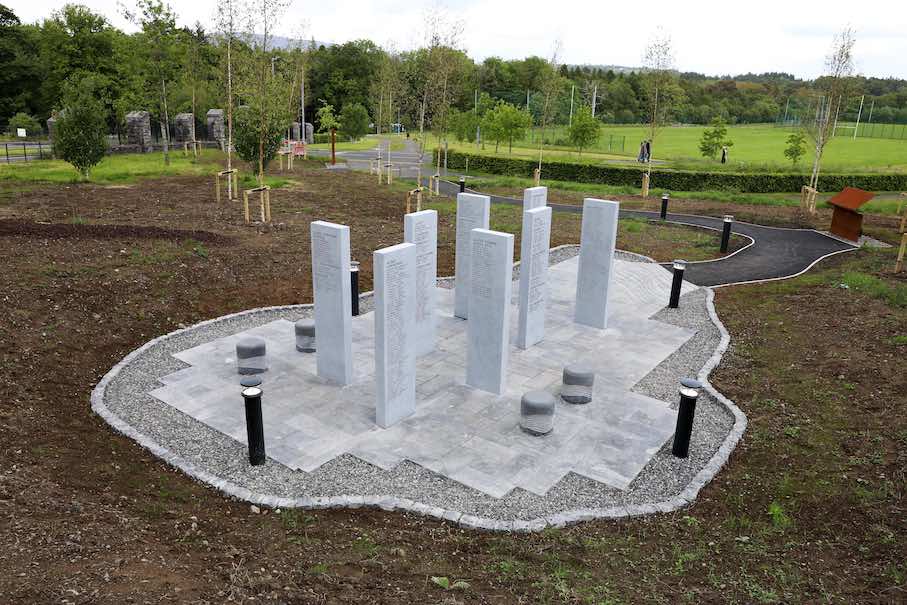
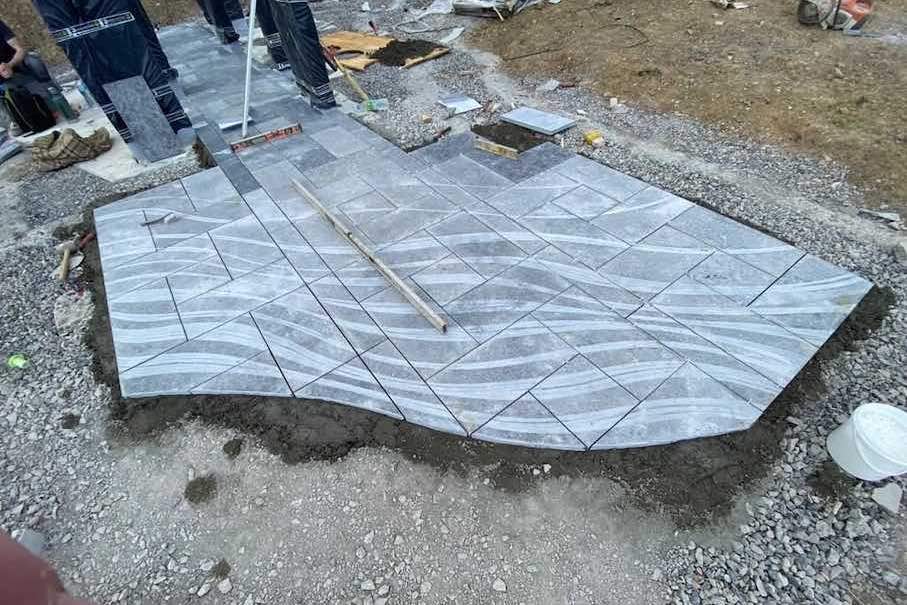
The sculptor Martha Quinn designed the County Sligo Great War Memorial Garden, which was completed in 2022
“Key to this project was remembering and acknowledging those who had died in the war, to remember them, to name them and places where they came from without getting into any commentary about politics or military discussion, a monument to people, not ideology.”
This is what Irish sculptor Martha Quinn wrote to us about her concept for the County Sligo Great War Memorial Garden, which commemorates the dead soldiers from Ireland in World War I. She designed the memorial. It was opened to the public in autumn 2022.
We asked the renowned artist about the concept because there are wars again in Europe and in the Middle East on the edge of the continent, and because the warmongers are again looking for justifications for the violence and damage.
But how can one artistically pay respect to people when their individual motives lie somewhere between “military tradition, sense of duty, adventure, religion, politics, peer pressure and unemployment,” as it says on the memorial’s website?
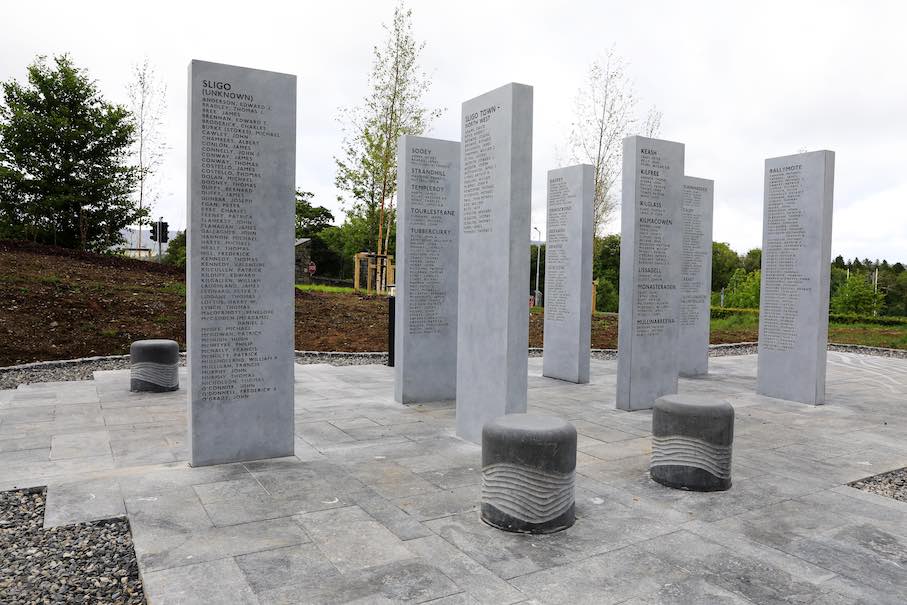
Martha Quinn has chosen a symbolic representation: wavy lines run across the stone floor and many datails of the memorial – we know them from many other situations, such as fleeting squiggles in the sand on a beach, temporary contour lines on a map, or, from a human perspective, eternal veins in a stone.
The artist wants the lines to entice visitors to pause. “This is particularly relevant and important within the context of our Irish heritage and history, to be sensitive and considerate of our collective relationship with our colonial past,” she writes.
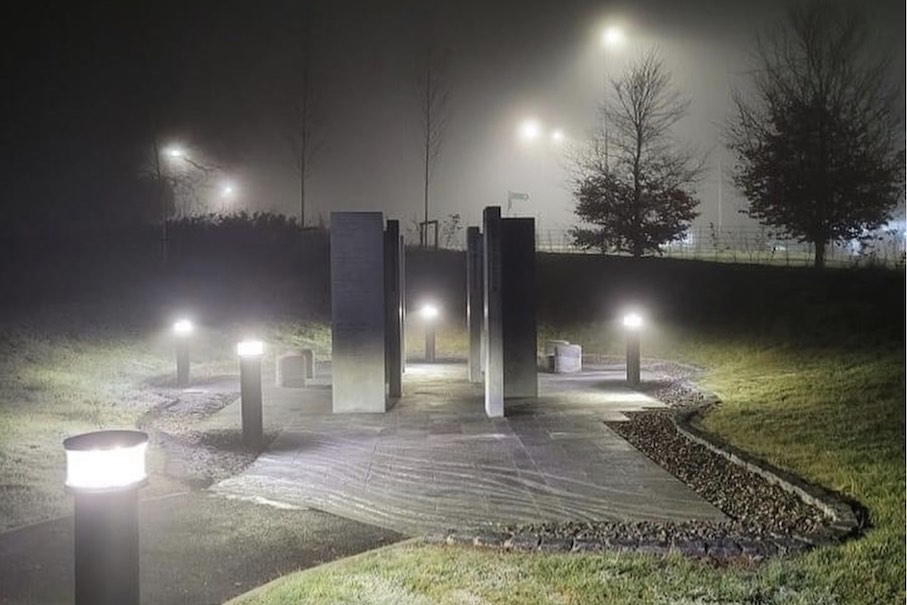
The steles – called “Sentinels” – bear the names of the 621 war victims (including four women) and the towns in County Sligo from which they came. It is estimated that a total of 200,000 Irish volunteers fought in World War I and that 50,000 of them were killed.
The memorial was created on the initiative of the Lest Sligo Forgets association. The architects were David Lalor of Hamilton Young architects based in Dublin. Various Irish national symbols are incorporated, such as St. Brigid’s Cross, which can be seen in the arrangement of the sentinels from a bird’s eye view.
The distinctive material is Kilkenny Limestone, which characterizes the villages on the island and which adds an additional level of observation by “gently weathering in the wet West of Ireland climate,” as Martha Quinn writes.
The memorial is located in Cleveragh Regional Park.
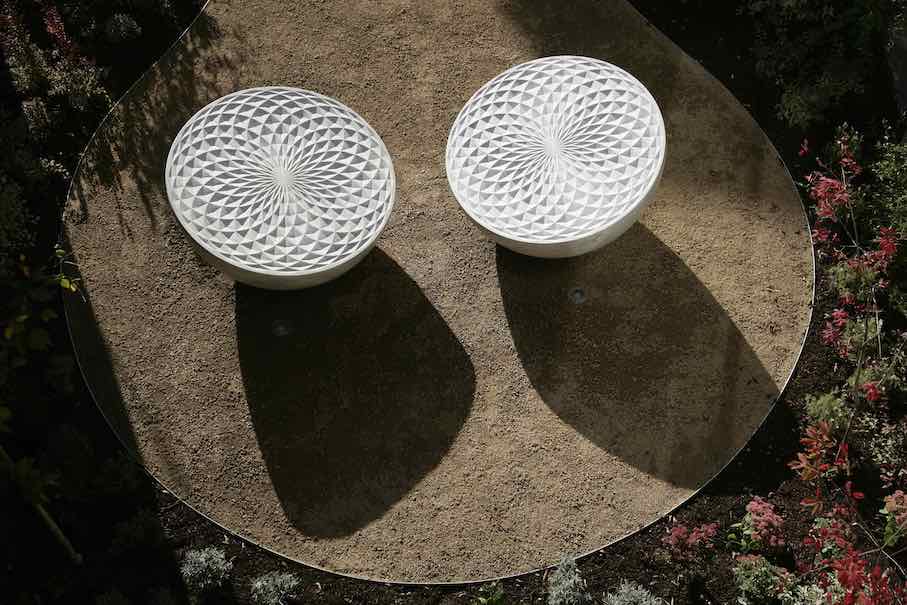
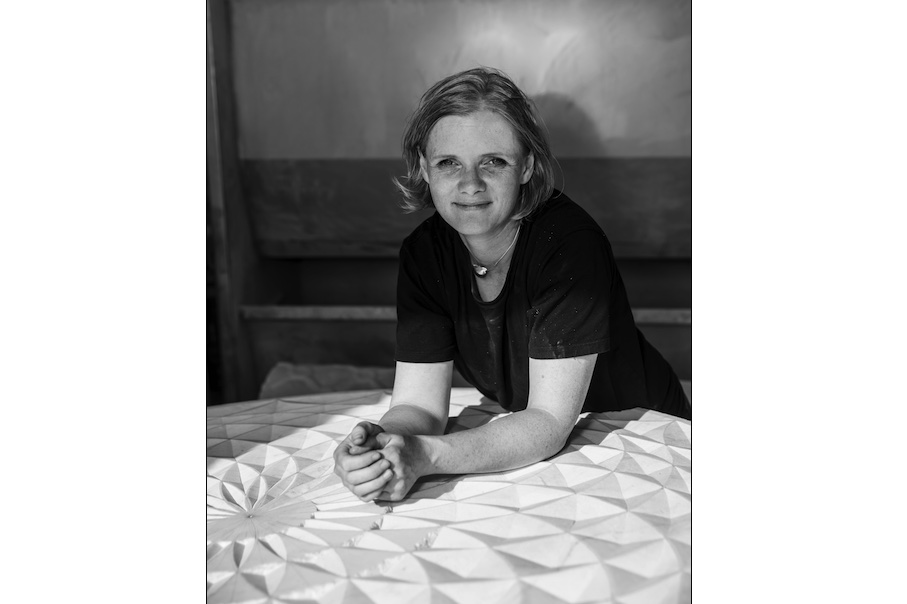
Martha Quinn has made a name for herself with very different stonework. There are geometric sculptures where mathematical precision seems to be the main focus. But from our email exchange, you can see her grin when she notes that while precision is important to her, it should not be the primary goal of the work.
Rather, she sees these works as studies of how a work that is originally a two-dimensional drawing on paper suddenly takes on its own expression as a three-dimensional sculpture made of stone.
Here, too, as with the World War I Memorial, she wants to trigger thoughts in the minds of visitors.
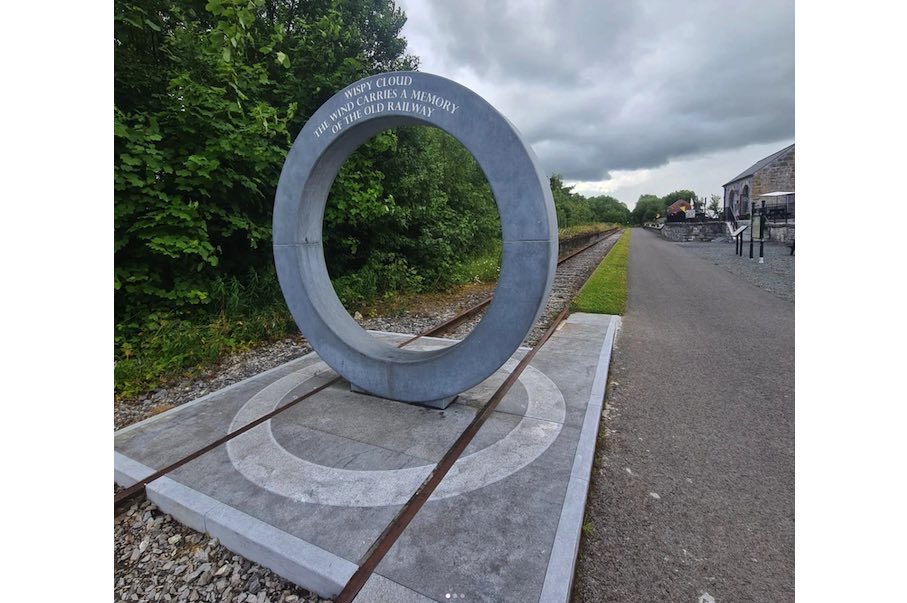
Her works in public spaces therefore always include the surroundings. For example, her concept for the Old Rail Trail Cycleway in the province of Westmeath: there she developed several works of art along a former railway line, which together bear the title “Turning Cycles”: In one place, images of the respective flora and fauna are engraved in the stone, in another it is about cultural heritage, and then of course also about the role of the railway. “A number of sculptures include stone elements with poems etched on their surfaces which can be actually turned by hand, due to a specially designed bearing mechanism and housing system, and that have been likened to Tibetan prayer scrolls.”
Incorporating the environment is becoming increasingly important to her, she muses on her website, adding the old saying “a painting is nothing without a frame”. In the case of the work “Sun seeds” for the Royal Hospital Donnybrook, the commission therefore included not only the sculpture, but also the design of the park around it.
The fact that stone is her favourite material is probably related to her mother – she was a glacial geologist. Martha Quinn was drawn to art by the fact that all her aunts went to art schools.
But she herself was not initially keen on this type of training, she writes without resentment. Then came the sculptor Fred Conlon, who accepted her as his assistant and opened up the art world to her.
She has taken part in numerous sculpture symposia and has works on display also in the USA. She remarks with a loud laugh between the lines: “But now that my children have all nearly flown the nest, I can set my radius wider. I look forward to looking at the listings for opportunities in Europe and further afield.”
County Sligo Great War Memorial Garden
Photos: Martha Quinn / Lest Sligo Forgets
(11.10.2024, USA: 10.11.2024)