 Stone-Ideas.com


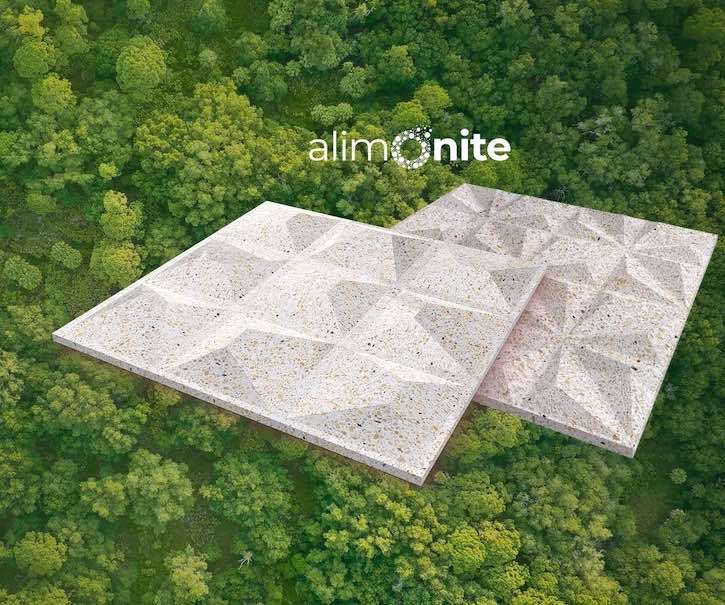
The material is, according to the firm, produced without the addition of energy and can be an effective competitor to engineered stones
The name leaves no doubt that it is a material from the wide world of stones: Alimonite consists of 80% stone powder or small pieces of broken stone from the extraction of travertine and marble. It was presented to the public for the first time by the Turkish company Alimoğlu at the trade fair in Izmir 2024.
The Turkish company is thus facing the competition from engineered stones in a completely new way: Alimonite is also man-made, but retains the positive effects of natural stones. These are:
* No gray energy (heat or pressure) is used for production;
* its ingredients are 100% natural.
The fact that it also consists of residual materials from natural stone processing helps to conserve resources.
It is important to know that Turkey’s stone sector – like other marble countries – has a problem when it comes to waste. In an interview with the magazine Turkish Stone World, junior manager Burak Alimoğlu provides an insight: Due to the nature of the deposits, only one to three % of the material mined can be used for stone products – over the years, “mountains of residue have accumulated that spoil the landscape,“ he said.
And further: “ In our quarries, around 2.5 million tons of marble or travertine residues are produced every year, plus another 1,500 tons of marble powder from processing.”
In view of the current discussion about climate and resources, it is urgently necessary to find ways to use these waste materials, he points out.
At the core of Alimonite is an innovative binding agent that the company has developed over a year and a half of research. It not only holds the finely ground stone waste together, but also serves as a dryer in a chemical reaction.
The processing takes place via molds: First, the raw material is a paste that is filled into a mold – there the binder ensures that the water is expelled from the mass and after 20 days of hardening, a solid block remains.
This is cut into panels using conventional saws from stone processing.
The panels can currently be used for wall cladding indoors. Alimoğlu is working on making them suitable for outdoor use and as floor coverings.
The size of the panels is determined by the size of the mold: currently they are 3.20 m long, 1.60 m wide and 0.90 m high. This also puts them in competition with the large tiles in the ceramics industry.
According to the current state of affairs, the surfaces of the panels can be polished and also printed. For the 100th anniversary of the Turkish Republic, Alimoğlu produced promotional gifts made of Alimonite with the corresponding lettering.
Depending on the size of the stone pieces added, terrazzo effects can also be achieved.
It is also conceivable that sculptors work their sculpture out of a raw block of Alimonite.
Depending on the nature of the mold, surfaces with a 3D structure can also be produced (see picture). If the molds are small enough, stone bricks can also be created.
”We want to follow the world’s megatrends and prepare our company for the new world,” is Burak Alimoğlu’s conclusion in the interview with Turkish Marble Trend.
The company, which has its headquarters in Izmir, also relies on solar energy at its locations in Denizli and Afyon. Water recycling is another topic.
Digital tracking is used in production and processing to record material flows and avoid waste.
The Alimonite project was funded by the Izmir Development Agency, including with funds from the European Union.
The company is also a member of the Izmir Industrial Symbiosis Project, which is funded by the United Nations Development Programme (UNDP).
Turkish Stone World (Turkish)
(11.12.2024, USA: 12.11.2024)