Stone-Ideas.com


We have already passed the first quarter of a century of the new millennium. At the start of the year, it is a good opportunity to try to make a more ambitious forecast for the future of the natural stone industry, let’s say for the next ten years.
The key issues for the stone sector will be environmentally friendly construction and sustainability.
It is already well positioned here, keyword EPDs (Environmental Product Declarations): they are being created everywhere.
However, a new aspect is coming to the fore – the circular economy. National strategies are being drawn up in the EU countries.
In terms of materials, the stone sector has the best chances. After all, stone is extremely durable, can be reused practically indefinitely, and ultimately returns to the cycles of nature.
Reuse has been common for certain stone products since ancient times:
* The most spectacular are the ancient paving stones;
* buildings or walls of the ancients have always served as a source of material for later generations.
But the current circular economy is about more, namely the reuse of finished products.
Examples are cladding panels on façades or tiles for walls and floors.
In order for there to be a real circular economy for them, two aspects must be considered: waste must be avoided during recycling, and databases are needed to show what is available when and where.
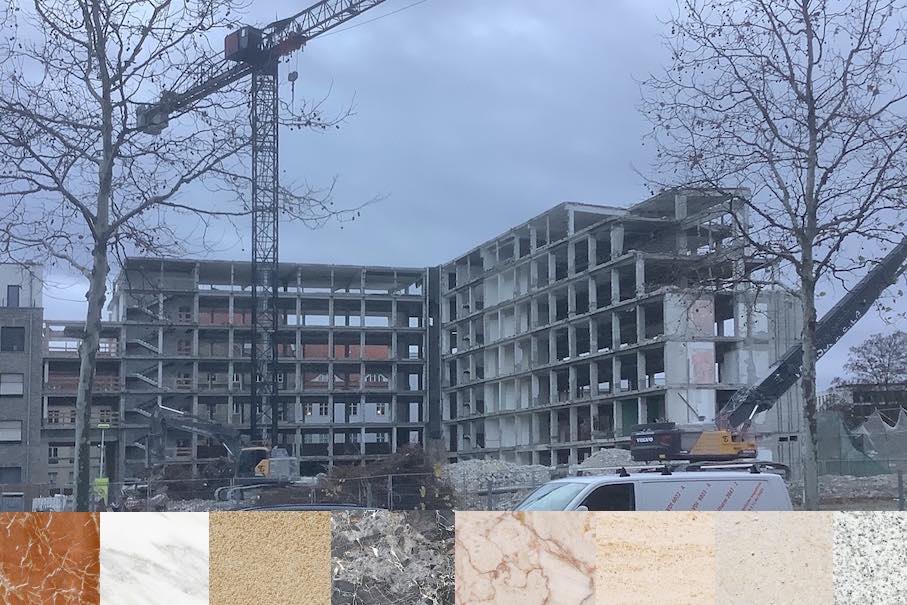
So far, only individual cases have been practiced. Over the course of this year, we described a renovation in London where the building structure was preserved and the stone on the old façade was reused (see links below).
Old building elements, i.e. doors, windows or similar, have already shown that it is possible in principle.
The real challenge for the stone sector, however, is that new types of laying are needed for its tiles, which enable non-destructive dismantling after the first use.
Something like this has already been developed in the ceramics industry: we described dry tile laying without mortar or glue.
But: Wouldn’t reusing natural stone reduce the demand for “new“ material from the quarry?
That is unlikely, because:
* Firstly: As part of sustainable construction, the demand for stone is likely to increase;
* secondly: In the steel sector with more than 90% recycling, iron ore as raw material is still needed, e.g., for high-quality steel for automobiles;
* thirdly: Nowadays, some quarries are fighting to extend their licenses or to obtain new licenses, so reusing can be an innovative business model for them.
However, the circular economy also poses a great risk for the stone industry. This is what a look at engineered stones shows.
Let’s remember: The idea came from the restoration of historic buildings: Since there are often only fragments of the original material left in old quarries, experts set about grinding these waste chunks and making artificial stones from them. Breton, manufacturer of natural stone machines, developed the technology for the artificial stones.
Large investors soon discovered the market potential of the new engineered stones and promoted them as being particularly easy to use, for example as kitchen worktops.
It was only after a while that the natural stone companies began to produce artificial stones themselves and to keep at least part of the business in their own hands.
If development in the case of the circular economy goes better, the stone sector will look different in a decade: In addition to companies with a classic profile (quarry, factory, installation), there will also be companies for reuse (collection, processing, storage).
See also: