Stone-Ideas.com


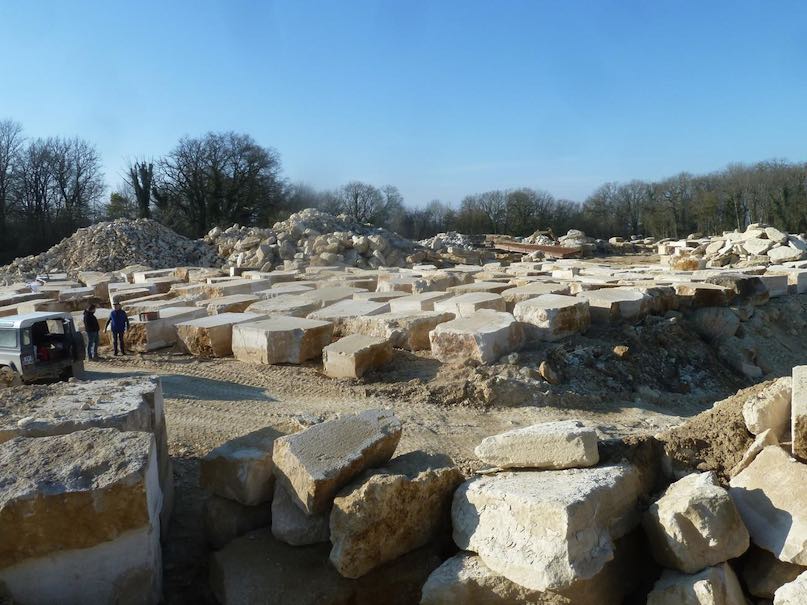
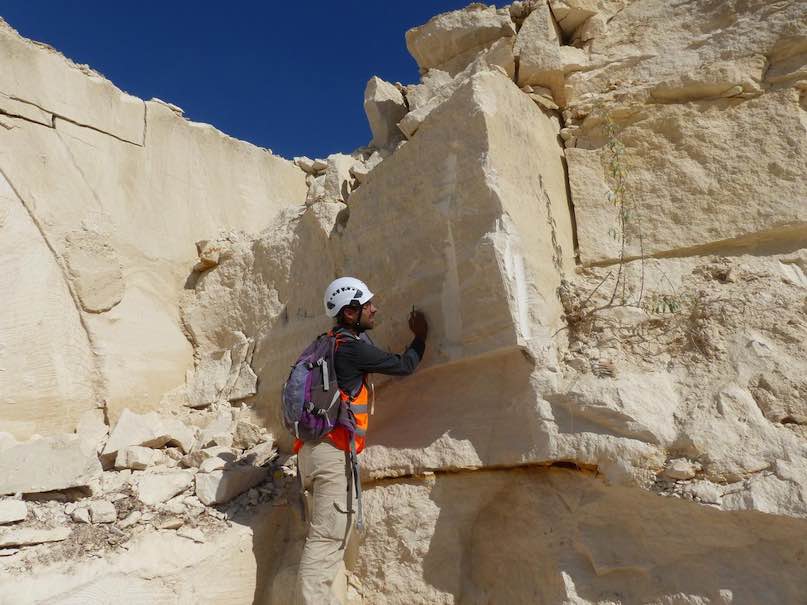
Finding replacements for the stones destroyed in the fire was the first step in the restoration of Notre-Dame Cathedral in Paris. The good and bad news quickly emerged: around 1000 m³ of limestone would be needed – that is undoubtedly a large amount, but not too much considering the mass of the cathedral, which meant that the stone had resisted the flames well. But getting such a volume of replacements was almost utopian: during restorations, the specialists on a construction site only have to deal with quantities of stone of a few dozen m³.
Dr. David Dessandier has described numerous details about this in a report. He is working on the subject at the Bureau de Recherches géologiques et minières (BRGM). In other countries, this state institution is known as the Geological Service.
The challenges mentioned above in procuring the materials were not enough: Stones of the highest quality were needed. After all, on this construction site, the skills of today’s experts were compared to the mastery of medieval planners and craftsmen.
And the time pressure was enormous: President Emmanuel Macron had said that it would take five years for France’s central place of worship and world heritage site to reopen its doors.
On December 08, 2024, the time had come, five and a half years after the fire on the night from April 15 to 16, 2019.
The first task for the stone experts was to find sufficient sources for a limestone that was as close as possible to the original in terms of appearance and mechanics. The stone was formed around 45 million years ago, in the so-called Lutetian period.
The Laboratoire de Recherche des Monuments Historiques (LRMH) took the lead and carried out the analysis of the stones. A peculiarity of Paris: large parts of the city were built with limestone directly from the underground, including Notre-Dame.
In the north-east of the city there are still enough active quarries for the required stone – more precisely: for the soft variant required. This could be used for the destroyed vaults.
But again, bad news: The hard variant was needed for the load-bearing walls, and that for the vast majority of the total quantity, namely exactly 750 m³ (out of 1000 m³). This hard variant was found in the nine quarries that had made it to the very shortlist.
But only in one quarry were the “benches“ (layers) thick enough to enable raw blocks to be cut out in the required dimensions. Some of the bricks are 40 cm high, but they regularly reach 60 cm or even 80 cm.
And there is more bad news: The quarry that was able to deliver was actually unsuitable for the task.
David Dessandier writes: “It was a small company in which the stone was mined in small quantities by a single worker and was only intended for the family’s nearby stonemasonry workshop.“ In other words: The quarry company supplied replacement material for smaller jobs on buildings from the Haussmann era and also took care of the installation.
The text does not go into any further detail about how the parties involved solved the problem. It only says in one place: The Rebatir Notre-Dame department, which was responsible for organizing the reconstruction, concluded a contract with this quarry called Croix-Huyart, located in the village of Bonneuil-en-Valois in the Oise department not far from Paris “to ensure supplies“.
In plain language, this means that the company was practically turned upside down – and the owners obviously played along.
Similar problems arose with other sub-projects. For example, for La Flèche, the pointed needle above the nave, which gives the enormous building a heavenly lightness, oak trunks of more than 20 m in length were needed. These were available in special plantations in the country, but who could saw down such incredibly tall, thin trees? Who could get them out of the forest? Who could take them to the sawmill? Because there was only one factory left in France that can handle trunks of this length.
Back to the stones. Detailed rules with precise responsibilities were drawn up for their extraction and processing. This also included checking the stone again and again for any hidden cracks. David Dessandier describes the approach as “rigorous and innovative“: “Between March 2022 and March 2024, the BRGM carried out almost 90 inspections in quarries, stonemasonry and stone processing plants.“
Finally, the stones in the finished sizes were taken to a special storage area. From there they were installed in the walls or vaults or went to the forecourt of the cathedral, where stone sculptors recreated the destroyed sculptures or decorative elements in an open workshop.
David Dessandier laconically appreciates the encounter of material from different eras of human history: “The cathedral is now decorated with ‘new’ stones that lie next to stones that were installed several centuries ago.“
David Dessandrier: Derrière la reconstruction de Notre-Dame de Paris, un besoin hors norme en pierres bien précises (French)
Bureau de Recherches géologiques et minières (BRGM)
Latest news: The exhibition “Making Stones Speak. Notre Dame’s Medieval Sculptures” in the Musée du Cluny, Paris until March 16, 2025, vows to deepen our knowledge on Notre-Dame’s sculptures by revealing the findings of a major research and restoration programme.
See also: