 Stone-Ideas.com


Twenty years ago, the Oxwatz Park was established in Tekal de Venegas, Yucatán, which is managed by an ecotourism society that, in 2018, allied with an archaeological team made up of specialists from Spain and Mexico to explore and deepen the knowledge of the X’baatún Maya site, whose millenary remains are distributed over 5.5 square kilometers.
With the endorsement of the Ministry of Culture of the Government of Mexico, through the National Institute of Anthropology and History (INAH) and its Archaeology Council, the initiative, led by archaeologists Juan García Targa and Carmen Varela Torrecilla, has carried out six field seasons that have provided information about this ancient settlement, inscribed in the Archaeological Atlas of Yucatán, in 1980.
The co-director of the X’baatún Project, Juan García Targa, explains that the core of the archaeological site, which is delimited by a perimeter wall and next to a watering place, covers about eight hectares “an extension comparable to the Roman Barcelona.
“When we began archaeological work, we started from the data collected between 1994 and 2005 by the Izamal Project, which reported 22 structures in the core area. Our topographic study, which used drones to provide photogrammetric models, has increased that number of buildings.
“The existence of large buildings was determined, the largest of 45 meters per side and 17 meters high. They are palatial structures with rooms on top and living platforms,” says the anthropologist and historian.
The collaborator of the INAH Yucatan Center and the research team, Geiser Gerardo Martin Medina, details that there are between 35 and 40 structures that make up the core of X’baatun; but outside the perimeter wall “there are more housing units.
“We have not determined the total extension of the site. After the core, and approximately 800 meters around, there are other housing structures. We have yet to walk further to the north and east. The surveys have allowed us to correct information; now we know that Kukulá, reported by the Izamal Project as a separate site, is actually an architectural group connected to X’baatún.
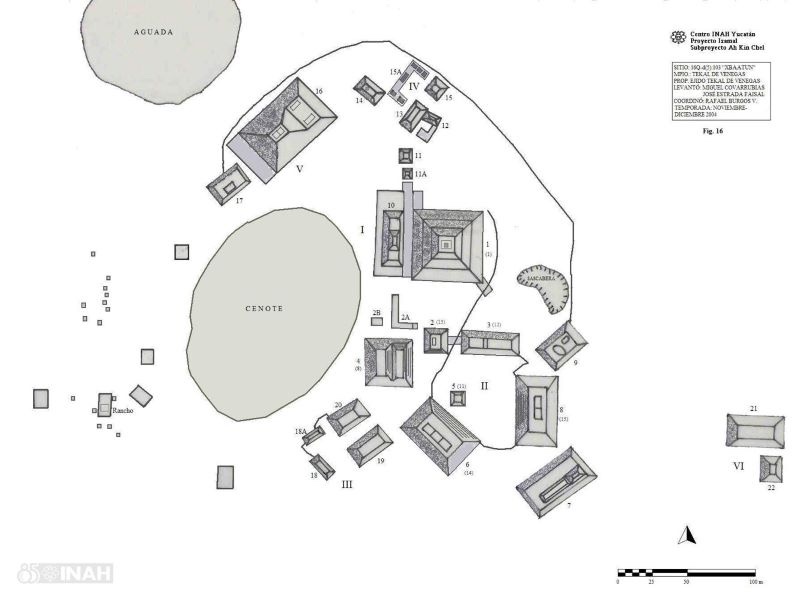
“The project, developed for six years, in addition to recognizing the structures, seeks to expand the entire plan and understand its settlement pattern, materials and chronology. Every season, the ‘Place where water is collected‘ (the meaning of its Mayan toponym), surprises us with new aspects.”
In spite of being located 21 kilometers northeast of Izamal, García Targa and Geiser Martín comment that the architecture of the site keeps tenuous characteristics of the megalithic type (so called because of the use of large carved stones), characteristic of the former regional capital of the center-north of the territory that today occupies Yucatán. Likewise, in vaults, columns and friezes it has features typical of early Puuc architecture, that is, of sites located in the highlands between Campeche and Yucatan.
On the other hand, the small excavations, of 1.5 square meters and 3 by 1.5 meters on each side, plus the preliminary analysis of the ceramic types, have allowed us to recognize that the occupation of X’baatún spanned from the Late Preclassic (300 B.C.-200 A.D.) to the Early Postclassic (1000-1200 A.D.).
Both archaeologists emphasize the good state of conservation of the structures, located in an ecological strip that was spared from the devastation caused by cattle ranching and henequen exploitation, two economic activities that, from the 18th century to the mid-20th century, degraded important areas. The environment is respected by the communities of Tekal de Venegas and Dzoncauich, with whom they work hand in hand.
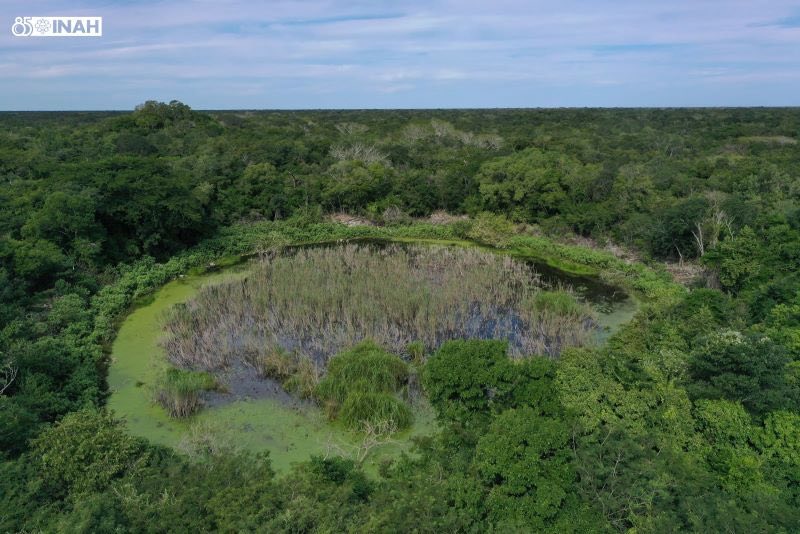
The X’baatún Project also includes ecological and anthropological aspects. With the society that manages the Oxwatz Park, the endemic flora and fauna will be recorded, including tree species such as the tzalam, chakáh, pich and higuerón, as well as birds and animals of its bodies of water, such as crocodiles, turtles, ducks and herons.
It will also collect the memories of those who lived in the huts that are still standing on these lands, which must have been occupied until the 1960s, when the old ranch of the place ceased to operate.
Finally, Juan García Targa acknowledges the support of the Fundació Catalunya-Amèrica and the companies Sunway, Petram and Vioca of Sitges, Gavà and l’Hospitalet, Province of Barcelona; and the universities of Cantabria, in Santander, and Autónoma de Yucatán, through the Faculty of Anthropological Sciences.
Source: National Institute of Anthropology and History (INAH)