 Stone-Ideas.com


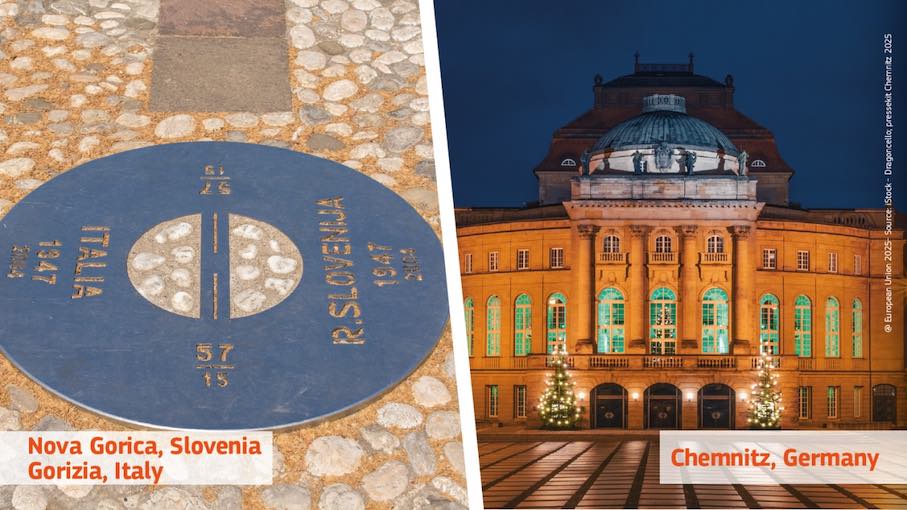
The European Capitals of Culture for 2025 are Nova Gorica, Slovenia and Chemnitz, Germany. As usual, the editors of Stone-Ideas.com searched the internet for natural stone there.
Nova Gorica is located at the westernmost tip of Slovenia, directly on the border with Italy. As the name suggests, it is a newly founded town, namely the small town called Gorizia on the Italian side. This occurred approximately 80 years ago, during the Cold War, which also left its mark on Chemnitz.
The old Gorizia, for its part, exemplified one of the regions in Europe at that time, with a mixture of many ethnic groups. The city had long been part of the Austrian Empire, and Italian, German, and Slovenian were spoken in everyday life. Since Italy and Slovenia are now members of the EU, the former border can only be found in the form of a paving slab in front of the train station in Nova Gorica, where you can stand with one foot in Italy and the other in Slovenia.
“Go! Borderless” is, therefore, the motto of the Capital of Culture there. It goes hand in hand with the theme of “Peace.”
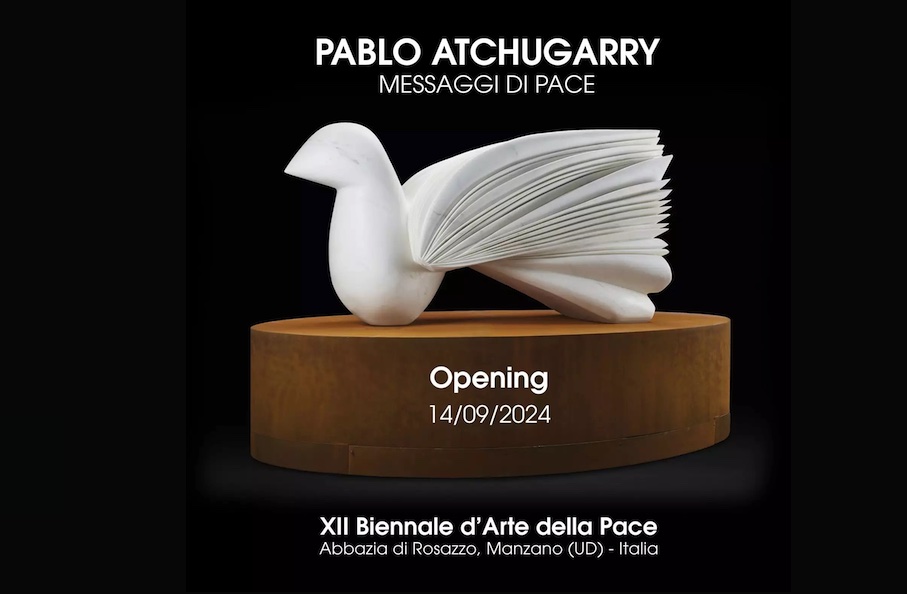
Note: In the run-up to the Capital of Culture year, the XII Biennale of the Art of Peace took place in the Italian city of Udine, located near the border with Slovenia. The solo exhibition “Messages of Peace” by the Uruguayan sculptor Pablo Atchugarry took place in the Abbey Church of Rosazzo. We show the exhibition poster with the Dove of Peace in Marble Statuario from 2023.
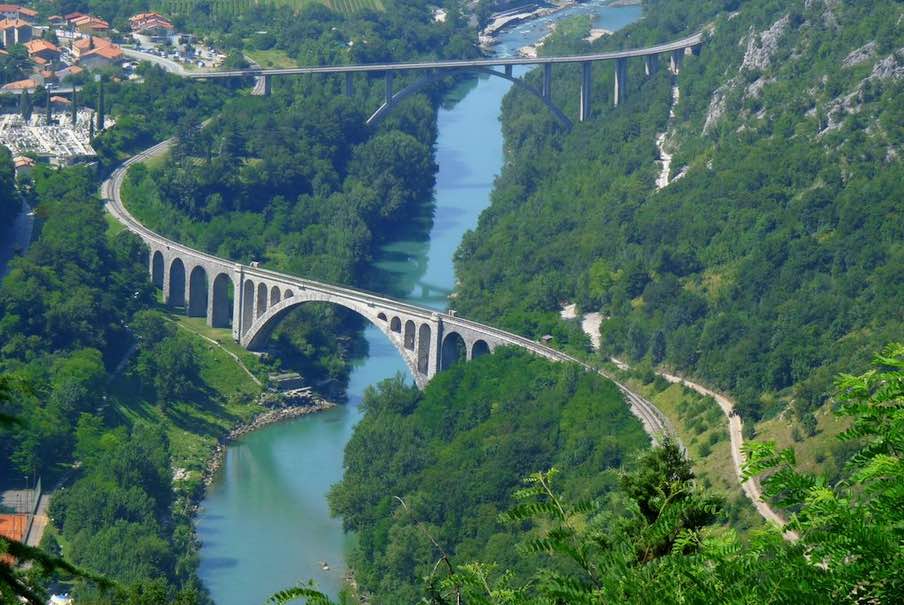
Back to the Capitals of Culture. One of the most notable uses of natural stone in the municipality of Nova Gorica is the Solkan Bridge with the world’s longest stone arch for a railroad bridge. Completed in 1905, the structure not only is a remarkable engineering achievement but also serves as a symbol of solidarity and resilience.
The town hall of Nova Gorica features a striking stone colonnade and a portal made of roughly hewn stone columns. These architectural elements, together with monumental stone sculptures, reflect both the traditional splendor of the city palaces and the modernist, socialist vision that shaped the city’s development after WWII. The use of stone here is a deliberate sign of endurance, strength, and the historical continuity of the region.
The Jewish cemetery, managed by the municipality of Nova Gorica, contains centuries-old gravestones. The preservation and restoration of these stone monuments emphasized the city’s respect for its multicultural past and the enduring heritage of its communities.
Stone can also be found in mosaics and monuments throughout the place, often commemorating significant historical events, such as the national liberation struggle and the turbulent history of the region in the 20th century.
Industrial City of Chemnitz in Saxony
The most striking aspect of the old Saxon industrial city of Chemnitz, in terms of natural stone, also relates to the East-West conflict. It is the 4.5 m high pedestal made of Ukrainian granite for the monument to Karl Marx, a 7.1 m high, 40 t heavy, artistic bronze image of the philosopher consisting of 95 individual parts.
In 1953, the government in what was then East Berlin renamed the city of Chemnitz Karl-Marx-Stadt, and in 1971, the monstrous monument was inaugurated.
After the fall of the Wall, socialism in East Germany came to an end, and the citizens decided to give Karl-Marx-Stadt its old name.
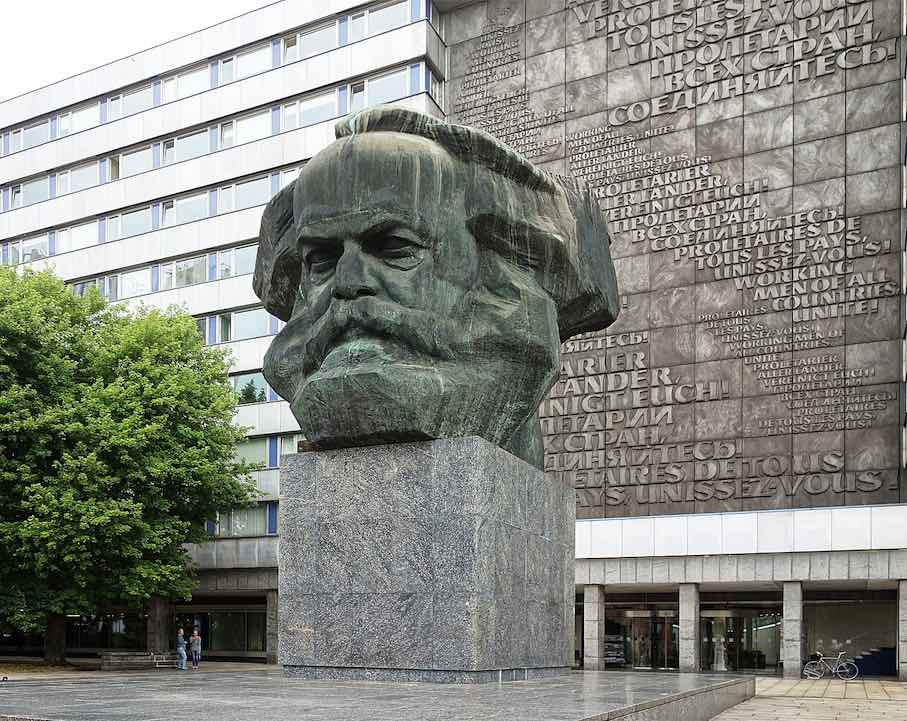
However, there was no majority for the demolition of the monument, created by the Russian artist Lev Kerbel, and so it still stands today in a central location in the city. Behind it on the facade you can find the sentence “Proletarians of the world, unite“ from the Communist Manifesto (Karl Marx and Friedrich Engels, 1848) in German, English, French, and Russian.
Natural stone in a finer setting can be found on Theaterplatz. Since the reconstruction in 1992, the floors in the opera house have been covered with white-gray Carrara marble from Italy. The building with a proud sandstone facade was built in 1909 by Richard Möbius.
Next door, you can find another facade made of sandstone, namely on St. Peter’s Church. It is Elbe sandstone, which has been used in many places in the city.
The area is mountainous, and the natural stone industry flourished around Chemnitz for centuries. Today, porphyry tuff (for example, from Rochlitz) and Mittweida granite are still mined in the immediate vicinity.
There were also once quarries in the city of Chemnitz, and their history begins around 290 million years ago in the Permian period and took place in what is now the Zeisigwald: At some point in time, an inferno must have broken out there when the volcano erupted extremely explosively, setting the surrounding forests on fire. This was followed by the ejection of enormous amounts of ash, which today can be seen in a layer of stone 90 m thick.
It covered everything, so that the remains of the trees turned to silicification. On the one hand, this led to the famous Petrified Forest, parts of which can be seen in the Natural History Museum in Chemnitz. On the other hand, a caldera remained from the volcano.
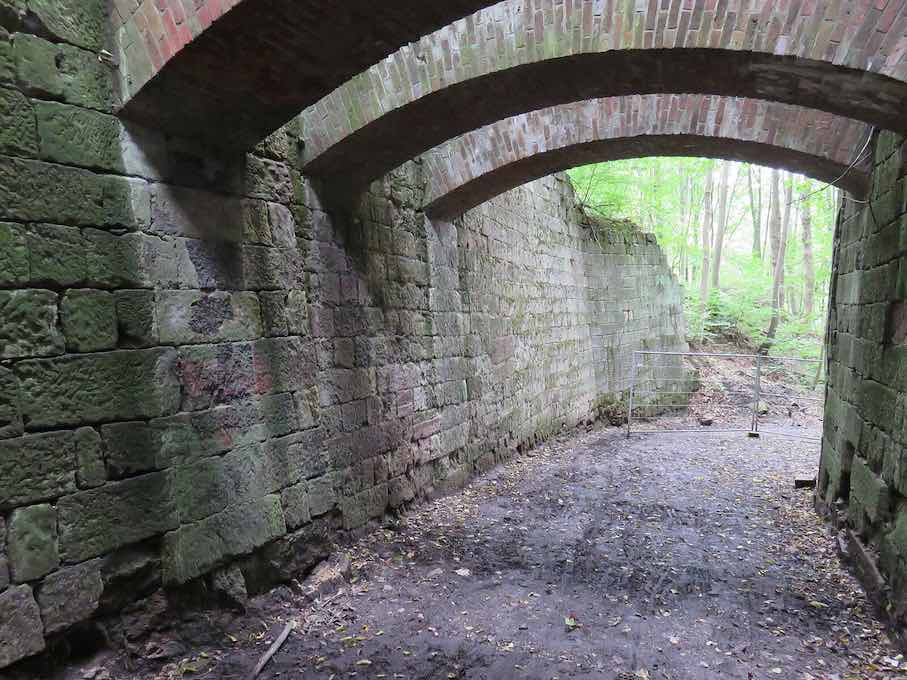
An entertaining place today is the Devil’s Bridges in the Zeisigwald: The name sounds scary, but in reality, the bridges are just supports for the steep walls between which the transport route from the quarry once ran.
A volcano hiking trail (with a volcano playground for children) leads to places worth seeing.
Incidentally, Chemnitz is around 80 km west of Dresden.
European Capital of Culture 2025
Nova Gorica (Slowenian)