 Stone-Ideas.com


From the Tierra Caliente of Michoacán, this monumental sculpture represents a coyote-man seated on a throne. It is a recurring image in Purepecha art, but in this case, it stands out for its natural scale. Carved in basalt, the piece measures 1.08 meters high and 45 centimeters wide, making it one of the largest of its kind, only surpassed by the chacmoles of Ihuatzio.
The coyote-man occupied a prominent place in the symbolic universe of the Purepecha lordship, one of the most powerful civilizations of western Mesoamerica during the Late Postclassic period (1400-1521 A.D.). This culture developed a solid political and religious identity, which rivaled that of the Mexica empire, and had ceremonial centers such as Tzintzuntzan and Ihuatzio, where similar representations of this animal figure are abundant.
Despite this, the precise meaning of this image among the ancient Purepecha remains unknown. Some specialists have suggested that the coyote may be associated with lineage, power, and possibly an ancient lineage of rulers, as it appears as a central figure in various sculptures linked to the Uacúsecha group.
In this context, the repetition of this iconography suggests the existence of a complex ritual system in which the coyote-man acted as a symbol of authority, inheritance, and dynastic legitimacy.
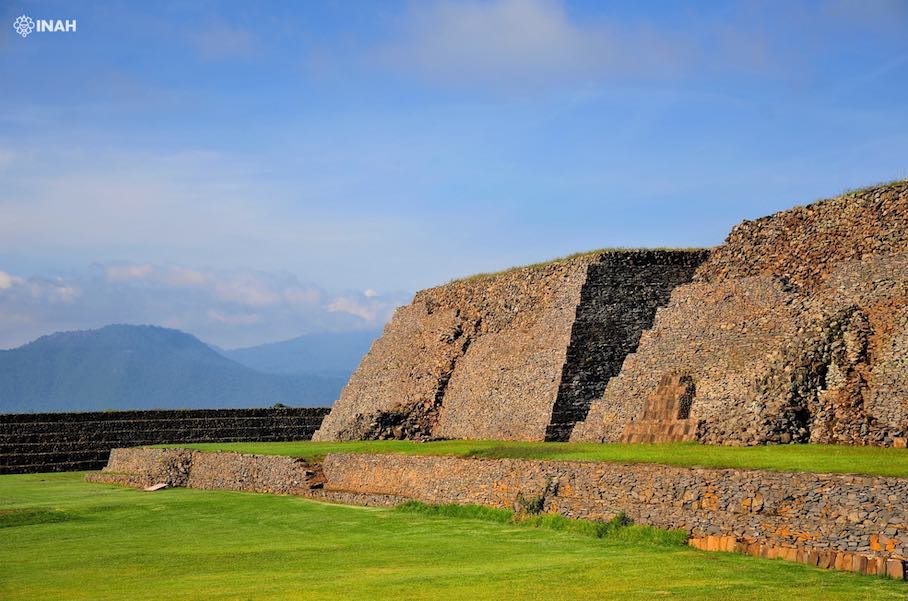
Located to the east of Lake Patzcuaro, the archaeological site of Ihuatzio was one of the three main cities of the Purepecha empire, along with Patzcuaro and Tzintzuntzan. Its name means “place of coyotes“ in the Purepecha language. In addition, the city was an important astronomical and political center, associated with the dynasty of Tariácuri, the legendary ruler who consolidated the Purepecha lordship in the 14th century.
The architecture of the Purepecha (a culture that was never conquered by the Mexica) is one of the most distinctive in Mesoamerica and is present in the three great cities of the empire. It highlights the use of yácatas, structures with mixed floor plans (rectangular and circular) that served as temples and ceremonial bases. It also highlights the use of large open spaces for civic-religious ceremonies with large parts of the population participating.
Source: National Institute of Anthropology and History, Mexico (INAH)