Stone-Ideas.com


It is often the small, tucked-away places in a big city that have the most fascinating stories to tell. Fairchild’s Garden in London’s inner-city district of Shoreditch is a perfect example: the site takes its name from one of England’s foremost gardeners of the early 1700s, and its grounds, set directly along today’s bustling Hackney Road, were recently redesigned in his honor.
The small park is named after Thomas Fairchild (1667–1729), who was widely regarded as one of the foremost gardeners of his era, though he might more accurately be described as a botanist. He authored a seminal work that catalogued the tree species most capable of withstanding the increasingly polluted and desolate conditions of the growing metropolis.

Fairchild’s biological research was groundbreaking for its time. In a series of famous experiments, he manually transferred pollen from one plant to the reproductive organs of another, thereby creating hybrids that would not normally occur in nature. Long before the advent of genetics, this method made it possible to transfer desirable traits from one species to another. He took inspiration from animal breeding, specifically the creation of mules through crossing a male donkey with a female horse, which is why the hybrid plant he produced later came to be known as “Fairchild’s Mule.”
Ironically, although Fairchild achieved fame with this, he was never truly happy – throughout his life, he blamed himself for having interfered with God’s creation. In any case, the annual sermon on “The Wonderful Works of God in Creation“ is still attributed to him und the £25 roaylty he had set.
The newly landscaped park was formerly a cemetery, where Fairchild is also buried. Recently, it had become completely run down; Only drunkards hung around there, according to the district.
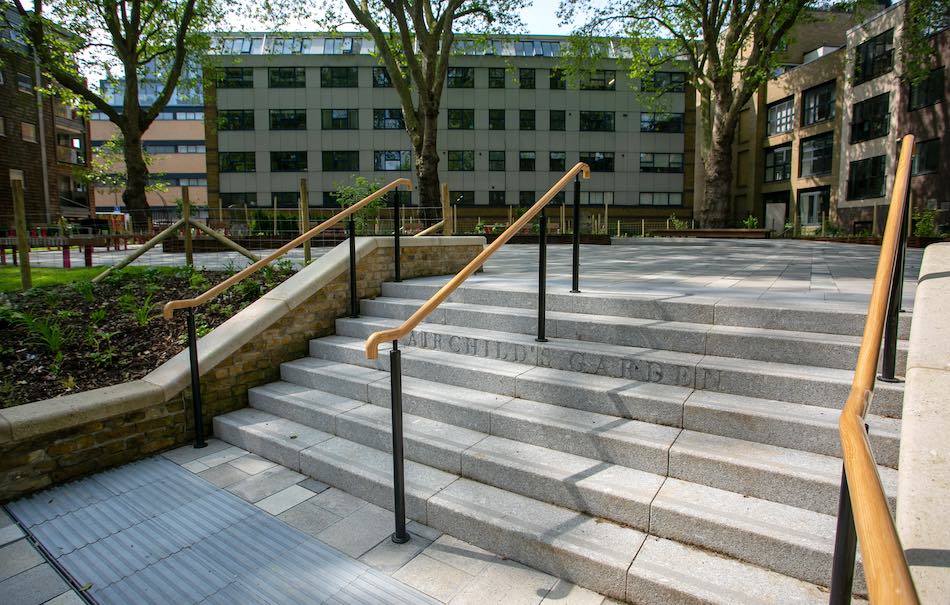
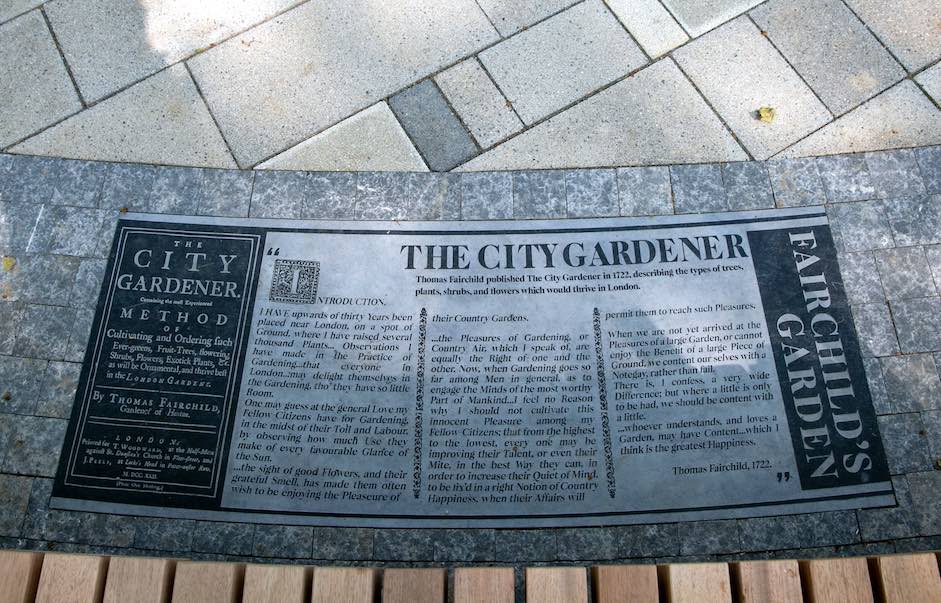
Since the redesign, Fairchild has been commemorated in several places: The park’s name is displayed on the steps leading to the entrance, and granite plaques with information about his work have been laid in front of some benches. The granites used were Carlow Stone (Ireland) and Alpendorada (Portugal).
Hardscape company and its subsidiary Hardscape Surfaces carried out the stonework.
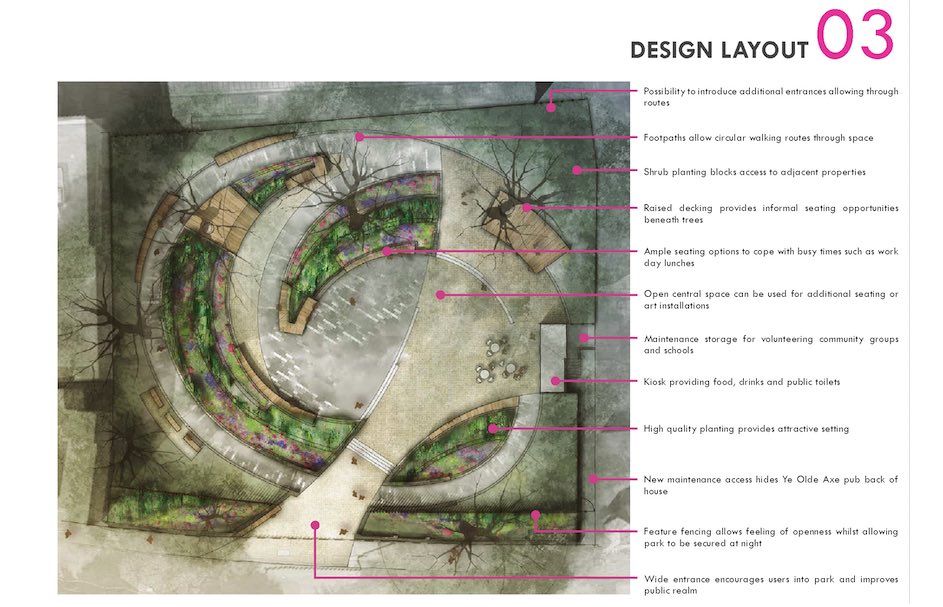
The overall design of the park was the responsibility of Ares Landscape Architects, whose goal was to create “a safe, welcoming, flexible space that meets the needs of the local community.

Among other things, the architects expanded the main entrance to the facility and incorporated a kiosk. New paths with natural stone paving lead through the grounds, and seating arrangements are integrated as invitations to linger.
On their website, the landscape architects write: “The overall outcome is a distinctive, high-quality public space that subtly incorporates the heritage into the fabric of the design.”
Hackney Council, Fairchild’s Garden
Photos: Gary Manhine on behalf of Hackney Council