 Stone-Ideas.com


The government of Mexico declared 2025 as the Year of Indigenous Women, in recognition of the presence and contributions of the native peoples who inhabited its territory and shaped the nation for more than 30 centuries. Indigenous women are a cornerstone, bedrock and backbone of the nation: the guardians of its memory, languages, traditions and ancestral knowledge, which they have preserved, resignified and adapted to modern times.
Part of the commemorations in 2026 is the exhibition “La mitad del mundo. La mujer en el México indígena“ (Half of the World: Women in Indigenous Mexico) focusing on different aspects of the topic. It is held at four locations in Madrid: until February 15, 2026, at the Museo Arqueológico Nacional, the Casa de México, and the Instituto Cervantes, and until March 22, 2026, at the Museo Nacional Thyssen-Bornemisza.
We focus on the exhibition in the Museo Nacional Thyssen-Bornemisza.
Its title is “The Lady Tz’akbu Ajaw, the ‘Red Queen’ of Palenque.” She was an important 7th-century Maya woman who exemplifies the significance and power that came to be wielded by the women of the ruling elites, who expanded the influence of their lineages, played an active role in political and ritual life, and were the custodians of the sacred books.
 Funerary adornments: 1. Headdress: jadeite, limestone and shell; 2. Headband: albite, quartz, jadeite and omphacite; 3. Necklace: jadeite and red limestone; 4. Pectoral greenstone, limestone, shell and obsidian; 5. Bracelets: greenstone; 6. Belt hatchets: limestone; 7. Mask (possibly worn on belt): green and white jadeite, quartz and obsidian; 8. Ankle bracelet beads: jade.
The Maya civilisation flourished from 1500 B.C. in southeast Mexico as well as in Guatemala, Belize, and parts of Honduras and El Salvador. Its calendar and hieroglyphic writing systems, its thorough knowledge of mathematics and astronomy, its monumental architecture, and its refined art attest to its greatness.
But it is not merely a culture of the past: today more than 30 Maya peoples inhabit practically the same ancient territories, speak languages derived from its ancestral common predecessor (Proto-Mayan), and preserve the essence of its customs and beliefs.
Among the ancient Maya cities, Lakamha (now Palenque), stands out as a wonder of archaeological treasures in the Chiapas jungle. Its architecture reveals the power of the dynasty headed by K’inich Janaab Pakal – Pakal ‘the Great’ – who enhanced the city’s artistic and political splendour in the 7th century. His wife governed alongside him: the ‘Red Queen’, Lady Tz’akbu Ajaw, whose story is a testament to the strength and legacy of Maya women.
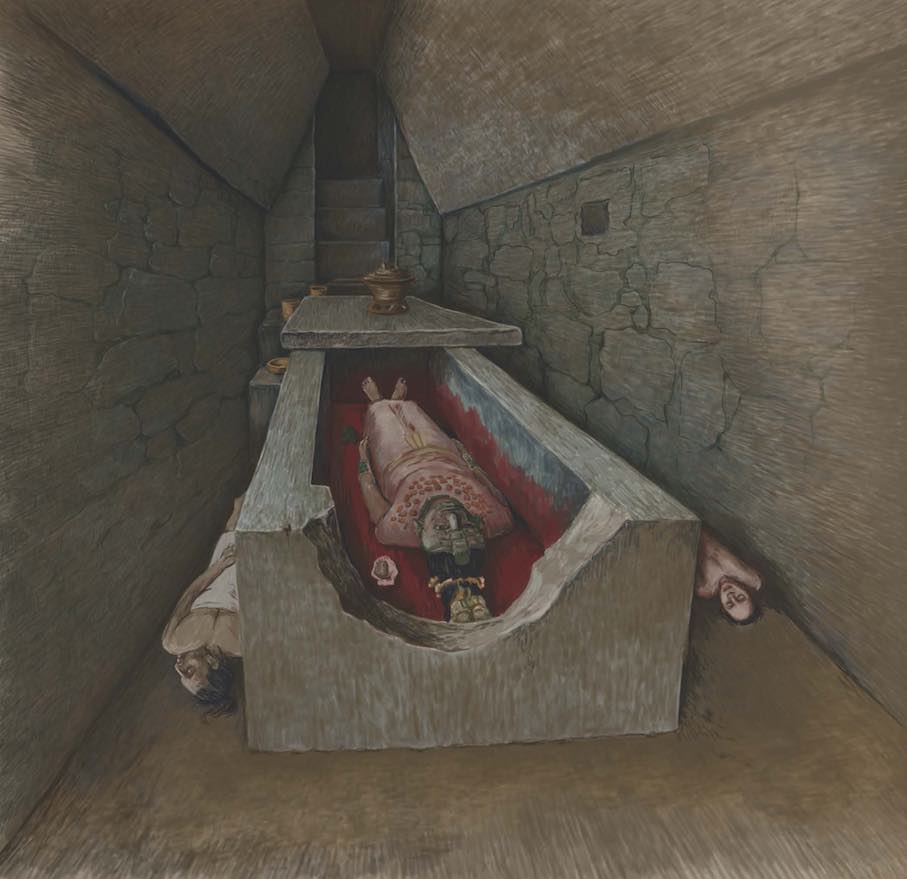 Sacrificing people to accompany the deceased was a practice reserved for the burials of rulers and high-ranking figures. It is likely that the sacrificial victims found with Lady Tz’akbu Ajaw were part of her entourage: a nine-year-old boy who died by decapitation and a woman who may have had her heart removed.
On November 13, 672, aged between 55 and 60, Lady Tz’akbu Ajaw ‘began the journey’ after exhaling her ‘white flower’. Her body was interred in a mortuary chamber in Temple XIII-sub, accompanied by two sacrificial victims. The mukna’ burial ritual had to be performed between two and ten days after she drew her last breath. Her body and monolithic sarcophagus were covered in cinnabar (mercuric sulphide), a prized crimson pigment which had life-giving properties for the Maya.
She was buried with the objects she wore when alive to accompany her on her long journey to the underworld, as well as a mask of malachite tesserae and an elaborate headdress in the manner of a crown ornament or hu’unal (characteristic of the Maya ruling elite) which covered her face, representing the titles – linked to her bloodline and long and distinguished dynastic lineage – that she would retain for the generations to come.
Her body became a relic, a link between her new post-mortem place of abode and the earth, between the living and the dead.
She was born in the second decade of the 7th century into the royal family of Uhx Te’ K’uh. She arrived in Palenque in 626 and married the ruler K’inich Janaab Pakal, strengthening political alliances and ensuring the dynastic continuity of the place. The couple had at least three children, two of whom became rulers: K’inich Kan Bahlam II and K’inich K’an Joy Chitam II. The third, Tiwo’hl Chan Mat, died before coming to power.
Her name means ‘Queen of the Countless Lineages’ or ‘Lady Ruler of Generations’, and she was unquestionably a powerful matriarch who complemented her husband’s role. Various monuments in Palenque display her name and titles, and the iconographic attributes in her portraits suggest that she took part in dynastic ceremonies and legitimation rituals, promoting works of architecture and art, organising banquets and supervising textile production, as well as being involved in matters of politics and war in the city.
Source: Museo Nacional Thyssen-Bornemisza
Photos: Museo Nacional Thyssen-Bornemisza
 This Temple Tablet XIV shows a posthumous scene: K’inich Kan Bahlam performs a dance in front of his mother, Lady Tz’akbu Ajaw, who, according to the inscriptions, personifies the moon goddess. She offers her son the effigy of the god K’awiil, an act that legitimises him as a ruler even after his death.