 Stone-Ideas.com


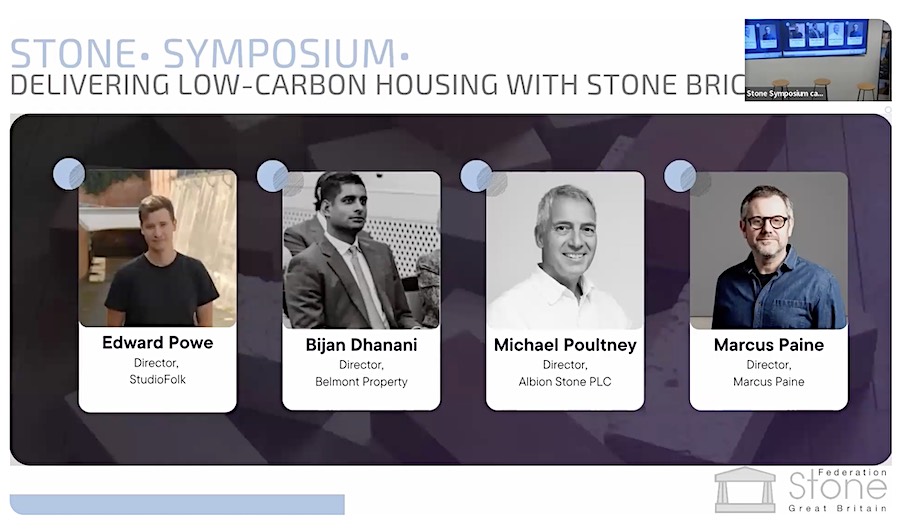
The opportunities that Stonebricks offer builders, architects, and the natural stone sector were one of the topics at the 2nd Stone Symposium of the British Stone Federation GB. In November 2025, experts explored many aspects of the topic – in an in-person panel discussion or via webinar – revealing some unexpected perspectives.
Just as traditional clay bricks were an affordable mass-produced material in past centuries, Stonebricks can assume this role in times of climate protection, said Marcus Paine, CEO of Hutton Stone, a company already on the market with these innovations. He pointed out that while the stone sector has focused on bespoke products or artistic elements in recent decades when it comes to three-dimensional building elements, building with stone previously always and essentially involved the use of standard sizes.
To put it another way: The main part of the walls, even in ancient temples, was built from standard-sized (mini-)blocks – only a few sections were elaborately crafted as decorations. And even then, such ornamental pieces were usually produced in larger numbers.

From the perspective of today’s natural stone sector, stonebricks also represent a shift in thinking regarding the material. While the branch has previously offered its customers, for example, expensive marble as a means of expressing wealth or lifestyle, the material in the case of stonebricks becomes quite ordinary.
The debate about this hasn’t even begun in the sector yet.
We note: A similar debate took place in the book industry from 1930 onwards with the advent of paperbacks, which were launched by the English publisher Penguin Books. Many feared, quite literally, a “dumbing down“ of literature and raised the question of whether one might eventually imagine even the holy books of religions as paperbacks.
Stonebricks also represent a shift in thinking for the sector in that they will no longer be relevant for exporters.
But what are their advantages if they are commonplace and only intended for domestic markets?
First and foremost is its small ecological footprint. Equally important is the material’s beauty: “Customers appreciate the visually appealing product, which is also pleasing to the touch,“ said Edward Powe, director at the architecture firm StudioFolk, at the symposium.
The fact that, maybe, St. Paul’s Cathedral and Buckingham Palace are built from the same material is also appealing to customers.
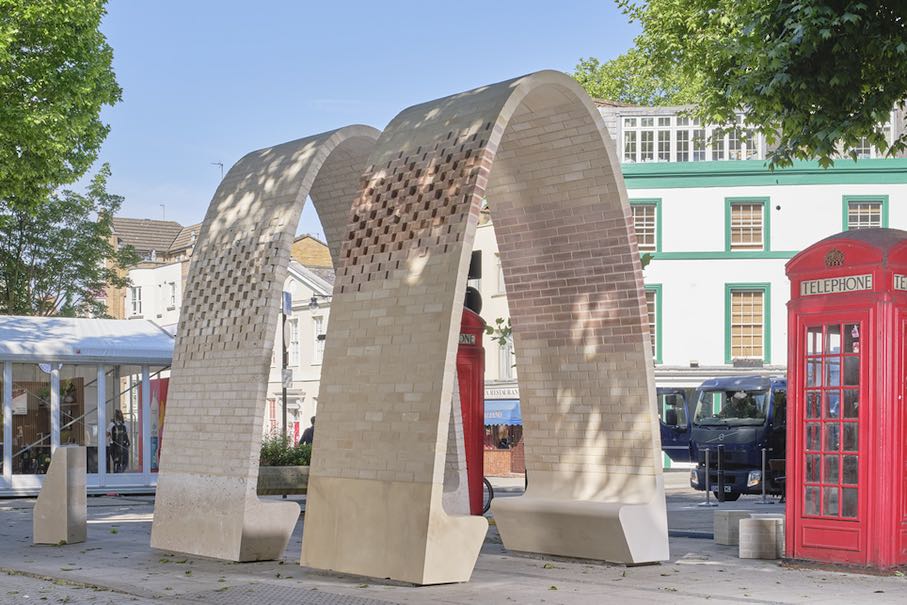
“Stone is an incredible material,“ said Bijan Danini, director at Pelmont Property. As a project developer, he keeps a very close eye on costs. These are only marginally higher than with traditional bricks. However, in his experience, the building acquires a higher value and is therefore easier to market.
Finally, the properties of stone make it conceivable that it can also lead to cost savings. The stone sector needs to demonstrate these possibilities.
Michael Poltney, CEO of Albion Stone, which collaborates with Hutton Stone (sandstonebricks) in marketing its limestonebricks, raised another point: The size of the bricks can be individually determined at the factory for each batch, allowing control over the quantity and total length of the joints and thus the amount of mortar required.
This means that creative architects can experiment with joint patterns and color combinations. Albion and Hutton have already demonstrated this. Below, we show examples from the so called “Brick Expressionism” with traditional bricks.
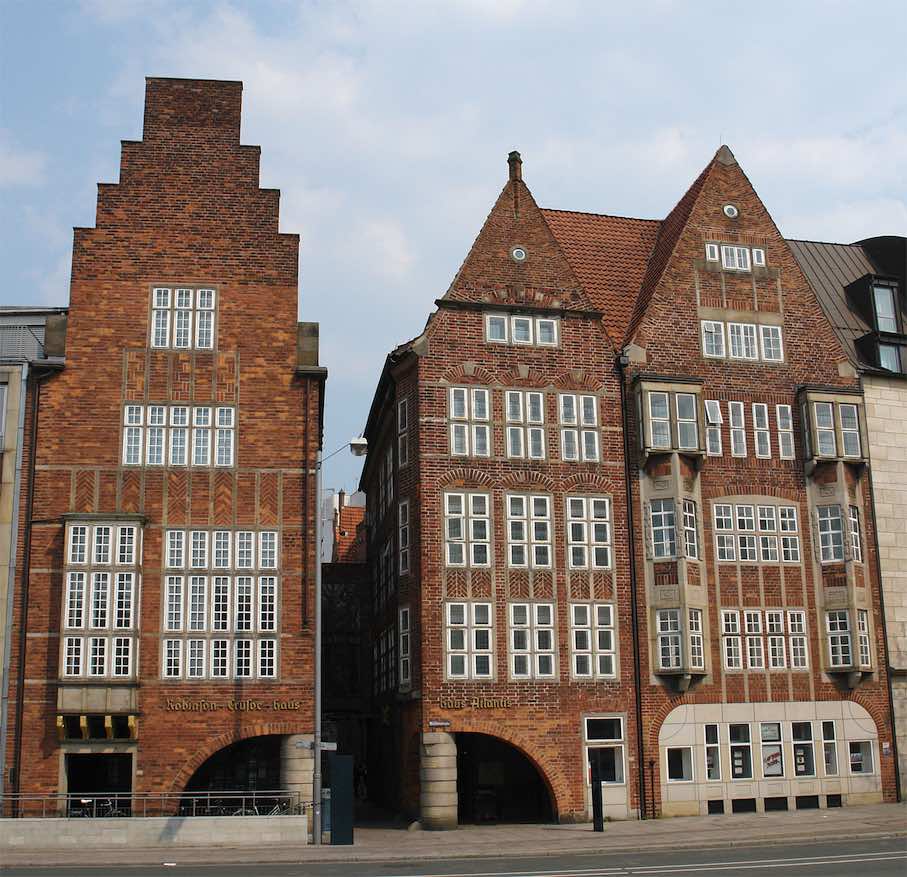
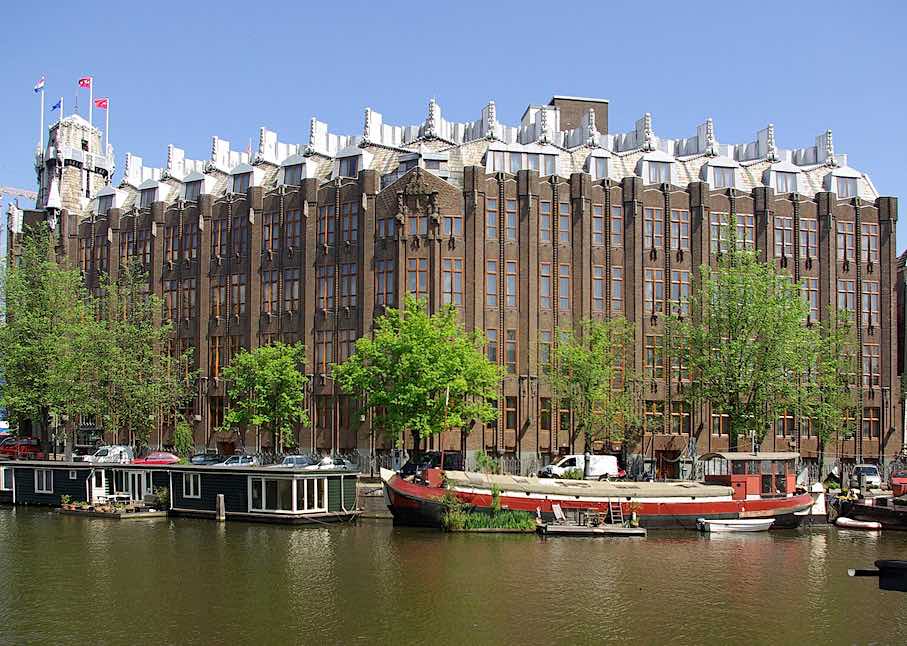

By the way: stonebricks have long since evolved beyond simple rectangular blocks.
The market is certainly promising. After all, according to government statistics, between 1.6 and 2.3 billion bricks are used in construction in Great Britain each year. Of these, around 300 million are imported.
But what about the island’s stone resources and the production capacity of the companies? Albion and Hutton currently have production lines running with a combined annual output of 1 to 1.5 million bricks. Regarding expansion or modifications, Michael Poultney remarked with a smile, “We’re not afraid of demand.“
But wouldn’t producing such quantities of stonebricks require digging enormous holes in the landscape? The response was: Raw materials for tradional clay bricks or for concrete don’t just fall from the sky.
We would add: Everything we use has been either cultivated or mined since time immemorial — a stark assessment of our material world.
2nd Stone Symposium
The Stone Symposium is organized twice a year by the Stone Federation Great Britain. Participation is possible in person in London or online. Topics at the recent 2nd Symposium, in addition to stonebricks, included:
* Reuse, Circular Economy and Natural Stone
* Structural Stone Projects: Case Studies – Finchley Road and Field House
* The Stonut: A Façade for the Future?
* Natural Stone: A Material Agnostic’s Perspective
* A Guide to Structural Stone: An Introduction to the Stone Federation’s Industry Guidance
* Research Driving Change around Structural Stone
* EPD Considerations with Structural Stone
https://www.youtube.com/playlist?list=PLk-8Ug-jHo9FBGQiW6ifjLXfyfethu_A8