 Stone-Ideas.com


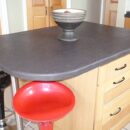
The material has an exceptional hardness and can be processed into large panels for billiard tables
Valentia Slate was added to the list of heritage stones in 2024. It has been mined on the Irish island of Valentia since 1806 and is valued worldwide for its properties. For example, it can be processed into large slabs and is therefore often used as a material for billiard tables. Its hardness is also exceptional, as proven in material tests.
The title Heritage Stone (also: Geoheritage Stone) is awarded by the International Union of Geological Sciences (IUGS) and honors a natural stone that has played and continues to play an important role in culture over the centuries.
The islet of Valentia, about eleven kilometers long and three kilometers wide, just off the Irish coast, is one of the most westerly points in Ireland. It became famous after 1857, when the first transatlantic cable was laid there. However, a really functioning communication connection with America only existed from 1866 on, still with Valentia as the endpoint on the European side.
At that time, however, slate mining there had already seen its best days. It began in 1816 in the north of the island, not far from the town of Dohilla at the Geokaun Mountain. The quality of the very hard material, its uniform purple color, its versatility and, last but not least, the nearby harbor made the Valentia Slate popular.

In 1911 slate production stopped in Dohilla. The main reason was the competition from Wales.
It was not until 1998 that the current company put the old quarry back into operation. Initial demand came primarily from the restoration of old buildings; of late, there has been renewed customer interest in new buildings, garden and landscape design, or interior design.
With the old facilities, a gift fell into the new operator’s lap: Since the quarry had only been operated underground since 1840, the mine now extends around 150 m into the mountain and includes a huge chamber measuring 20 x 20 m a theater hall.
A whiskey distillery will move into this. Tours of the production and tastings are planned for locals and tourists. The former quarry will also be used as a venue for concerts and events. Access to the mine itself is rather inconspicuous.

Slate mining has been going on right next door for several years. Both zones are connected by a tunnel.
Significant scientific work must be undertaken to obtain the title of Geoheritage Stone. They concern both precise analyses of the rock and detailed evidence of its economic and cultural importance. They were carried out by the Trinity research group Stonebuilt Ireland at the Geology in the School of Natural Sciences and led by Professor Patrick Wyse Jackson and Dr Louise Caulfield, in collaboration with colleagues at Valentia Slate Company Ltd and Carrig Conservation Consultants.
Below, we have linked below to a scientific publication in the Irish Journal of Earth Sciences. It says about the petrography of the stone: “Valentia Slate is a penetratively cleaved bioturbated siltstone composed mainly of silt- and clay-grade quartz, phyllosilicates and traces of chlorite and calcite.“
Irish Journal of Earth Sciences (Volume 40, 2022)


See also:
(31.07.2024; USA: 07.31.2024)