 Stone-Ideas.com


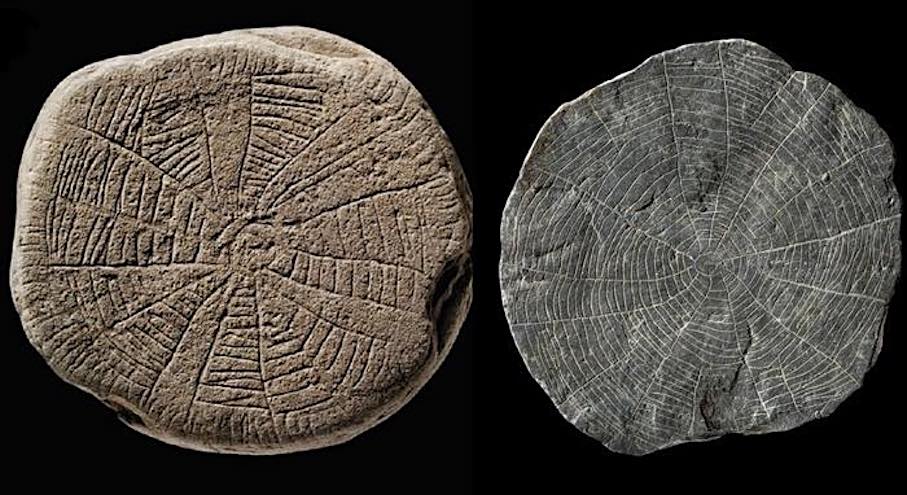
The Stone Age “sunstones“ (Danish: Solsten), which were found only on the Baltic Sea island of Bornholm, but there in large quantities, could be related to a major volcanic explosion around 2900 BC. Researchers suspect that the round slate discs with carvings that can be interpreted as sunbeams were offerings made by people in response to a prolonged period of bad weather or as a thank-you gift after an improvement.
Numerous volcanic explosions with global consequences have been documented throughout human history. Around 43 BC, there was an extreme eruption in Alaska, which released large amounts of sulfur into the stratosphere and was reported in reports of crop failures and famines around the Mediterranean.
The most famous eruption in modern times was the eruption of Tambora on April 10, 1825, which shot an entire mountain of ash and rock dust into the atmosphere. Twelve months later, this mass had circulated the globe, causing the “Year Without a Summer“ in Europe, a lack of monsoons in India, and political repercussions in the USA as well. We commemorated the anniversary of the event (link below).
Researchers from Denmark have now been able to link the event around 2900 BC to the sunstones based on analyses of drill cores from the Greenland ice and other evidence.
The role of the several hundred discs, some five cm in diameter or of other shapes, found at the Vasagård West archaeological site on the island of Bornholm had long been a mystery. According to some theories, they were intended to be counting tools; others saw them as elements of a harvest ritual; and still others interpreted them as amulets or lucky charms. Those discs, which show carvings resembling cobwebs, were interpreted by some as references to the underworld.
Now, it is assumed that an environmental catastrophe could not have left the people of that time unscathed. “We have known for a long time that the sun was the focal point for the early agricultural cultures we know of in Northern Europe. They farmed the land and depended on the sun to bring home the harvest. If the sun almost disappeared due to mist in the stratosphere for longer periods of time, it would have been extremely frightening for them,” says archaeologist Rune Iversen of the University of Copenhagen in a statement from his university. He participated in the excavations under the direction of the Bornholm Museum and the National Museum.
Four of the sun stones from Vasagård are on display in the prehistoric exhibition at the National Museum of Denmark in Copenhagen. They are an early example of a Neolithic sun cult in southern Scandinavia. Later examples date from the Nordic Bronze Age and include objects such as a sun chariot.
Lasse Vilien Sørensen, senior researcher at the National Museum of Denmark and co-author of the research report, goes even further: says archaeologist Rune Iversen of the University of Copenhagen in a statement from his university. He participated in the excavations under the direction of the Bornholm Museum and the National Museum. “The sunstones are completely unique, also in a European context.
The closest we get to a similar sun-cult in the Neolithic is some passage graves in southern Scandinavia or henge structures like Stonehenge in England, which some researchers associate with the sun. With the sun stones, there is in my mind no doubt. It is quite simply an incredible discovery, which demonstrates that depositions honouring the sun is an ancient phenomenon, which we encounter again in South Scandinavia during the weather disaster caused by a volcanic eruption in the year 536 AD, where several large gold hoards were deposited as sacrifices.”

