Stone-Ideas.com


“Dusty Die“ is the title of the first solo exhibition by internationally acclaimed Polish-German artist Alicja Kwade in Belgium through February 22, 2026. M Leuven is the venue, short for Museum Leuven, located in the capital of the province of Flemish Brabant. The show is part of the 600th anniversary celebrations of the Katholieke Universiteit Leuven, the country’s oldest university. The festivities have “Reflection“ as their central topic.
The museum comments on the exhibition: “Kwade’s sculptures and spatial interventions blur the lines between art and science, as well as between intellect and intuition. Through reflections, repetitions, and a blend of natural materials and everyday objects, she invites viewers to examine how they perceive, make sense of, and structure the world. Her work raises profound questions: What is reality? What is time? What does it mean ‘to know’?“
The show provides a curated overview of Kwade’s recent work and features new installations created specifically for Leuven.
The work “Dusty Die“ may cause confusion with two words that reference both matter and fate, according to the museum: “The word ‘dust’ evokes the image of a dust-covered object, frozen and motionless. Dust is also an ancient symbol for transience and the passage of time – ‘ashes to ashes, dust to dust.’ Equally, it plays a crucial role in our view of the universe: without dust particles in the air and microscopic aerosols, there would be no blue sky, just the blackness of space. These particles scatter light, giving the sky its color.
‘Die’ can be interpreted in two ways. As a noun, it refers to a die – an item that evokes ideas about chance, probability, and destiny. In this sense, it resonates with Albert Einstein’s famous statement ‘God does not play dice’, in which he expressed his doubts about pure chance as the guiding principle of the universe.
Together, ‘dust’ and ‘die’ form a title that encompasses both the microscopic and the cosmic: from the dust in our atmosphere to dice as a symbol of fate. It connects our immediate, dusty reality with the space beyond our atmosphere.“
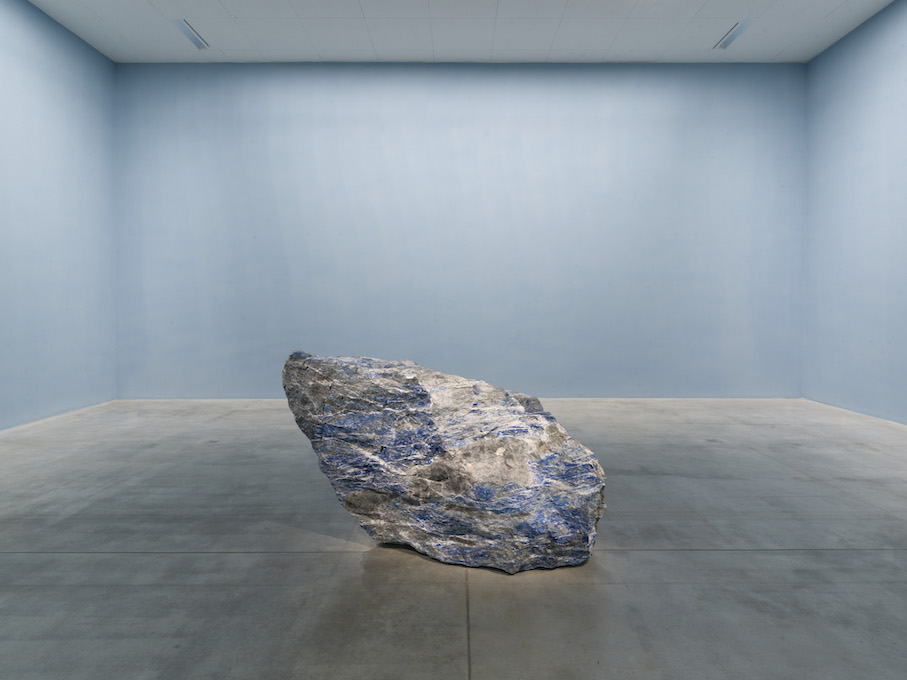
A new work is “Blue Days Dust,“ where she transformed a room into an immersive deep-blue space, using paint mixed with real lapis lazuli. At the center is a block of the mineral weighing more than 2 t. The stone was once a mystical material more valuable than gold, with a colored mineral used for paintings depicting the saints, particularly the cloak of the Virgin Mary. The curators write: “Kwade sees the installation as a time capsule that transports us back to geological processes from millions of years ago. At the same time, she invites reflection on how we assign value to objects and materials such as precious stones. The artist sees this value as culturally determined rather than absolute.“

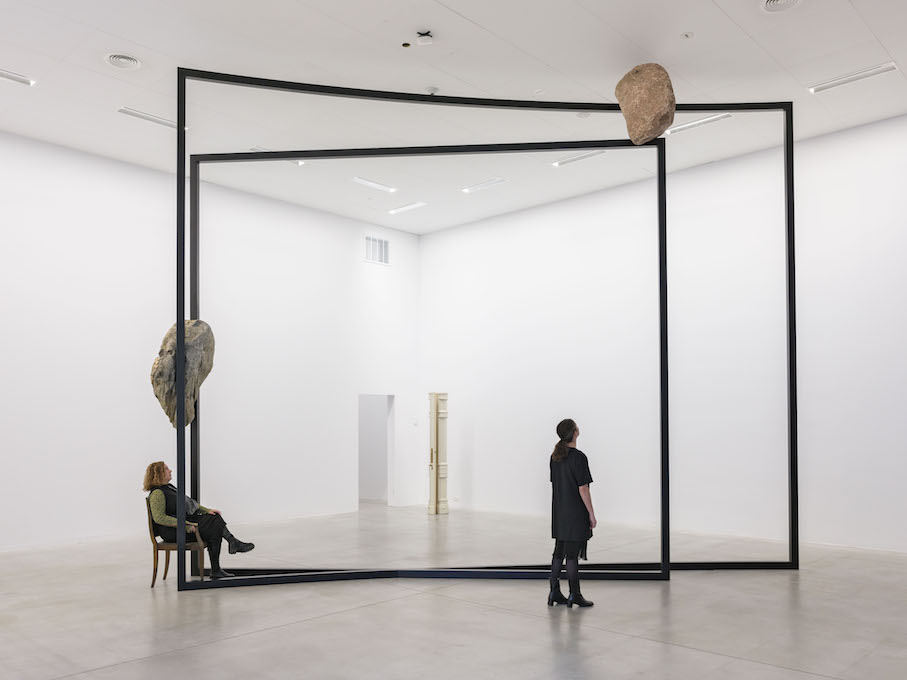
Another new work is “Substance,“ an installation of steel frames with mirrors and diverse objects. This is a variation on the well-known “WeltenLinie,“ which Kwade first presented at the Venice Biennale in 2017.

“Superheavy Skies,“ is also new. Stones of various sizes are suspended from impressive, monumental mobiles. Despite their weight, they seem to hover gently in space.
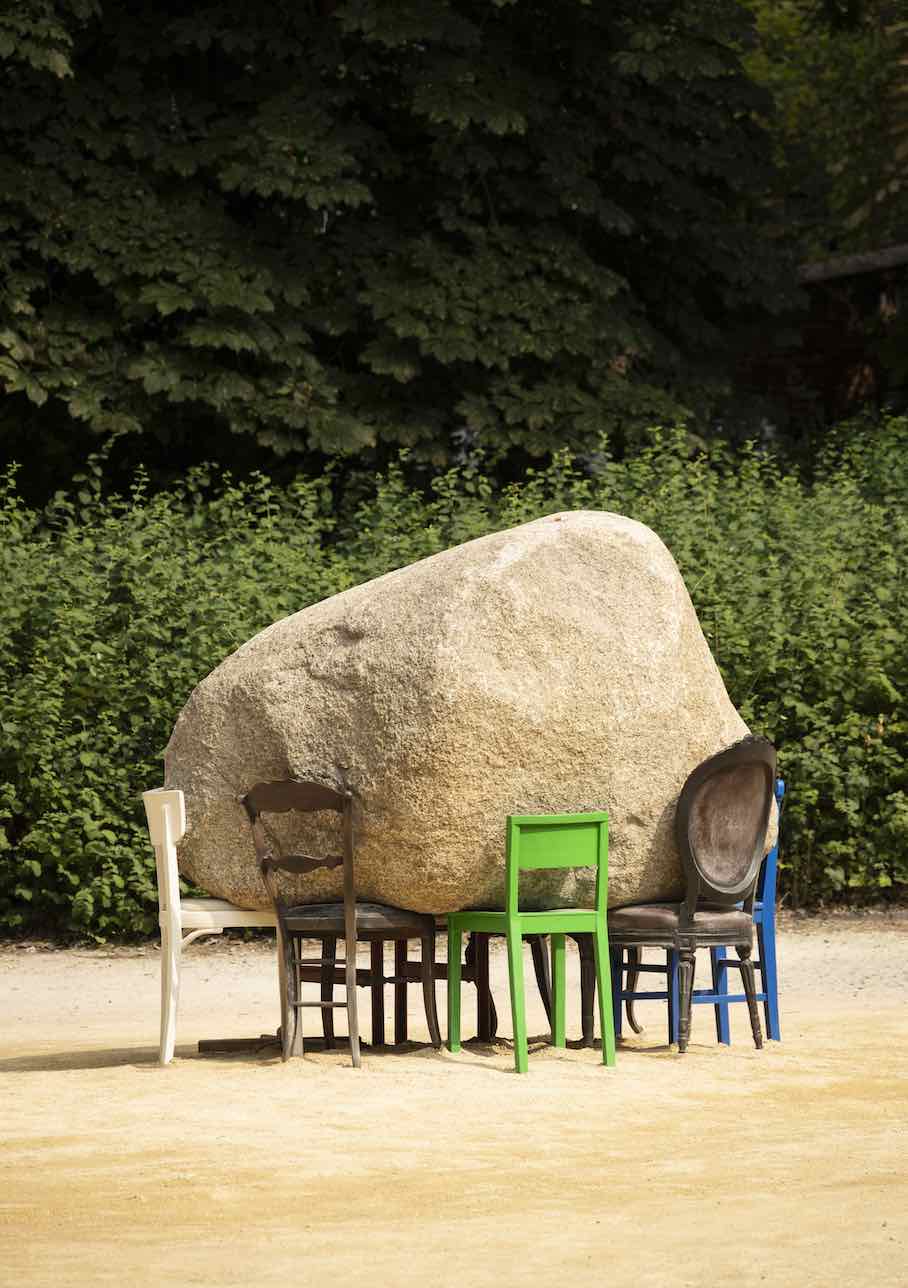
Before the exhibition opening at M, Alicja Kwade installed her new work “Carriers“ in the Leuven city park. It is part of an art project with 16 national and international artists. Kwade‘s work is a monumental sculpture with a boulder supported by a circle of chairs. “In this work, she makes the weight of ‘not knowing’ tangible by visualizing the absence of scientific knowledge as a boulder,“ according to the museum.