Stone-Ideas.com


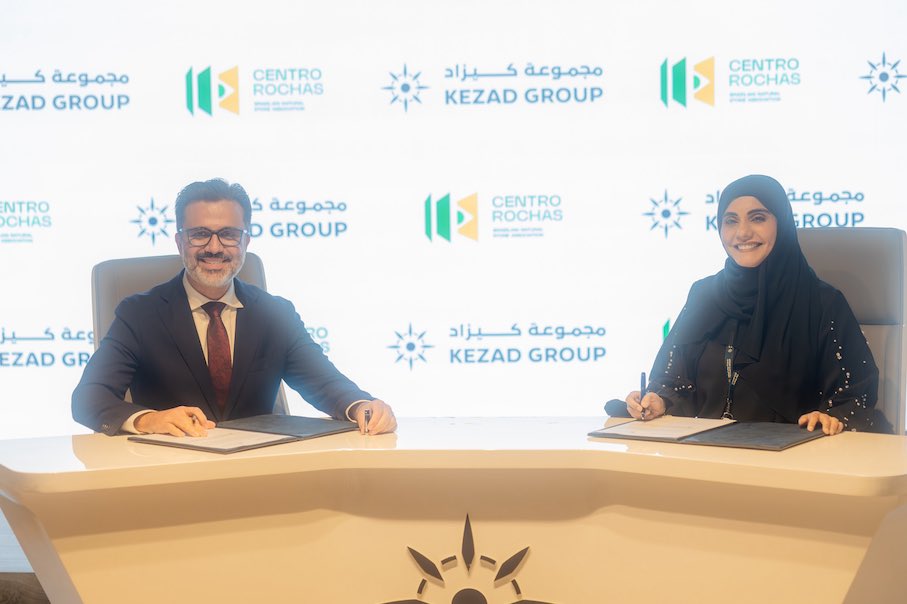
Latest news: At Marmomac Brazil in São Paulo (March 24 – 26, 2026), the booth number of Centrorochas is B22.
Contact for appointments: +55 27 99700-0982, Mail.
Brazil’s exporters seem to have finally found a way to sell their stones themselves in the wealthy countries of the Arabian Peninsula. They had been trying for over two decades, but without notable success. This was evident in the curious situation that while Brazilian “exoticos” – the varieties with unique colors and textures found nowhere else – were used on the floors and walls of shopping malls and hotels in the Gulf, Brazilian companies had never actually sold any of them there themselves.
When asking around there, the response was often simply that the stones didn’t come from Brazil at all, but from China, Italy, or Turkey.
The latest figures now indicate that exporters from Sambalândia have finally made a quantum leap.
The reason for this success can be identified: It is the national association Centrorochas, and in particular its vice president, Fábio Cruz. The support provided by the Brazilian export promotion agency Apex (Agência Brasileira de Promoção de Exportações e Investimentos) should also not be overlooked.
The root cause of this success is undoubtedly, on the one hand, simply the hard work and dedication of those involved. If one had followed the travel activities of Fábio Cruz, association president Tales Machado, and the Centrorochas team over the past few years, one might occasionally wonder, from a distance, whether they had perhaps booked flying carpets for their appointments.
On the other hand, the success stems from sophisticated marketing, including a detailed analysis of the target country and its key contacts.
Recently, in an interview with the Agência de Notícias Brasil-Árabe (Brazilian and Arab News Agency), Fábio Cruz revealed some details about what to consider when selling in the Gulf States.
The gist of the conversation, conducted in Portuguese, was that dealing with businesspeople from that region requires a different approach than dealing with Americans, for example. Brazilians know North Americans very well, as there is their most important market to date.
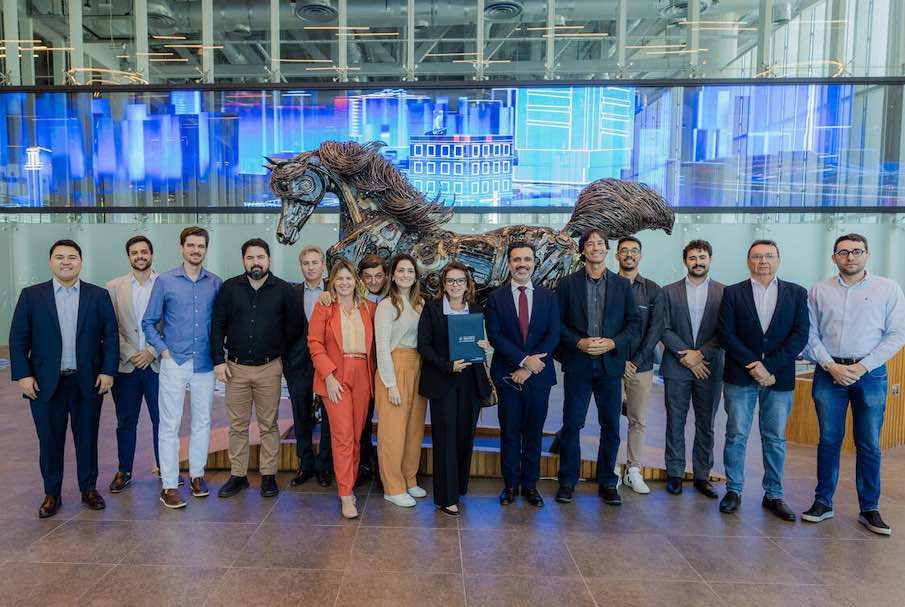
However, people in the Gulf are less direct and straightforward – they approach each other more slowly, Cruz explained in the interview.
To put it figuratively: Trust isn’t built there through a casual, informal approach right at the front door, but rather through many steps in which both parties repeatedly reaffirm their genuine interest in a mutually beneficial deal.
Especially important for business success in the Gulf region, according to Cruz, is giving the product a story. He meant that the seller has to tell the buyer something about their natural stone, not just present the material.
“Why should someone buy our stones?” Cruz posed as the central question – the answer that Brazilian stones are undoubtedly among Mother Nature’s most beautiful creations isn’t enough, in his opinion.
Nor is the mere mention that the stones come from Sambalândia. “Many people don’t even know Brazil – so why should they buy our stones?” he reiterated.
Cruz was alluding to the fact that, like many other emerging economies, Brazilians aren’t truly leveraging their culture for economic gain. In the case of Brazil, people abroad know that it has football and Carnival, but when nothing is happening in those areas, the only news coming out is (bad) political news.
By comparison, Italy not only boasts about the ancient Romans and Michelangelo, but also about its everyday culture, including pizza and piazza. Italian cuisine was recently added to Unesco’s list of Intangible Cultural Heritage. Everyone knows what pizza and piazza mean – even if this means that, for example, a cappuccino at a distant airport often only shares the name with the real thing.
“Brazilians are too focused on expeditions,” was another insight from the interview. In other words, they often haven’t really analyzed the target country and often don’t even have a real strategy; they just try their luck somewhere.
The consequence of this was “a focus on supplying finished products for large-scale projects, positioning Brazil to compete directly with India and China in segments in which the country was not yet competitive, neither in terms of product offering nor logistics.” The quote is not from the interview, and continues: “In other words, the sector was directing its efforts toward an inappropriate market segment, with a value proposition that was incompatible with its structural conditions at that time.”

At the beginning of the reorientation, five years ago, stood “a market study on the United Arab Emirates, commissioned by ApexBrasil and conducted by Euromonitor, which provided essential insights for the strategic opening of the market.” This was followed by the missions on flying carpet, as we wrote above.
Currently, a distribution center (“hub”) is at the heart of Brazil’s efforts on the Arabian Peninsula. Recently, a new direct maritime route between Rio de Janeiro and Abu Dhabi was launched to reduce transport time from 90 to about 30 days.
In light of Brazil’s current export successes, it is important to remember that the country has invested heavily in its development for years, including professional mapping of its geological resources. A major infrastructure program has been launched, encompassing highways, ports, and power grids.
All forecasts predict strong economic growth for the country in the coming years, held back only by high interest rates, which are being maintained to combat inflation.
Agência de Notícias Brasil-Árabe (Portuguese)