 Stone-Ideas.com


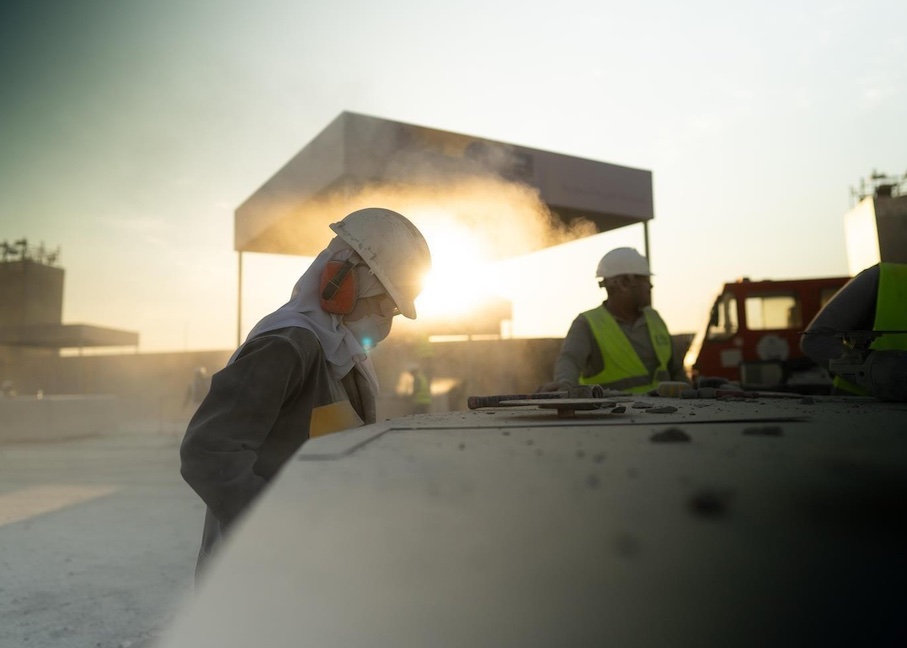
Bitte lesen Sie auch unseren Bericht über das Symposium
Insgesamt 25 Künstler aus 18 Ländern, darunter fünf Saudis, waren für die 7. Ausgabe des Symposiums ausgewählt. Das diesjährige Thema lautete „Traces of What Will Be“ (Spuren dessen, was sein wird) und lud die Teilnehmer ein darüber nachzudenken, wie skulpturale Formen die physischen, kulturellen und konzeptuellen Spuren ausdrücken können, die die Zukunft von Städten und Gemeinschaften prägen werden.
Sarah Alruwayti, Direktorin des Symposiums, sagte: „Für die siebte Ausgabe gingen mehr als 590 Bewerbungen ein, was die kulturelle Vielfalt und das weltweite Interesse an dem Symposium widerspiegelt. Die Auswahl der 25 teilnehmenden Künstler wurde von einer Jury aus Branchenexperten und Fachleuten vorgenommen.“
Die Künstler schufen großformatige Skulpturen aus zwei Materialgruppen: saudischem Granit – wahlweise mit Edelstahlelementen – und Metall aus dem Recycling.
Alle fertigen Skulpturen werden Teil der ständigen Riyadh Art Collection, die an öffentlichen Orten in der ganzen Stadt aufgestellt wird, um zeitgenössische Kunst in das städtische Gefüge zu integrieren.
Wir zitieren und bearbeiten die Beschreibungen der Organisatoren in der Reihenfolge, in der sie präsentiert wurden.
Quelle: Riyadh Art
Fotos: Royal Commission for Riyadh City (RCRC)
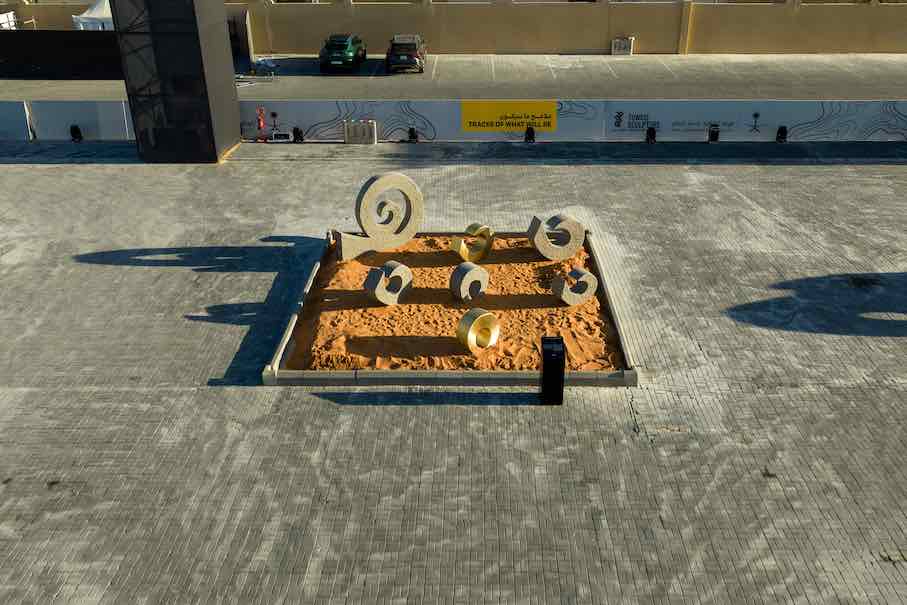
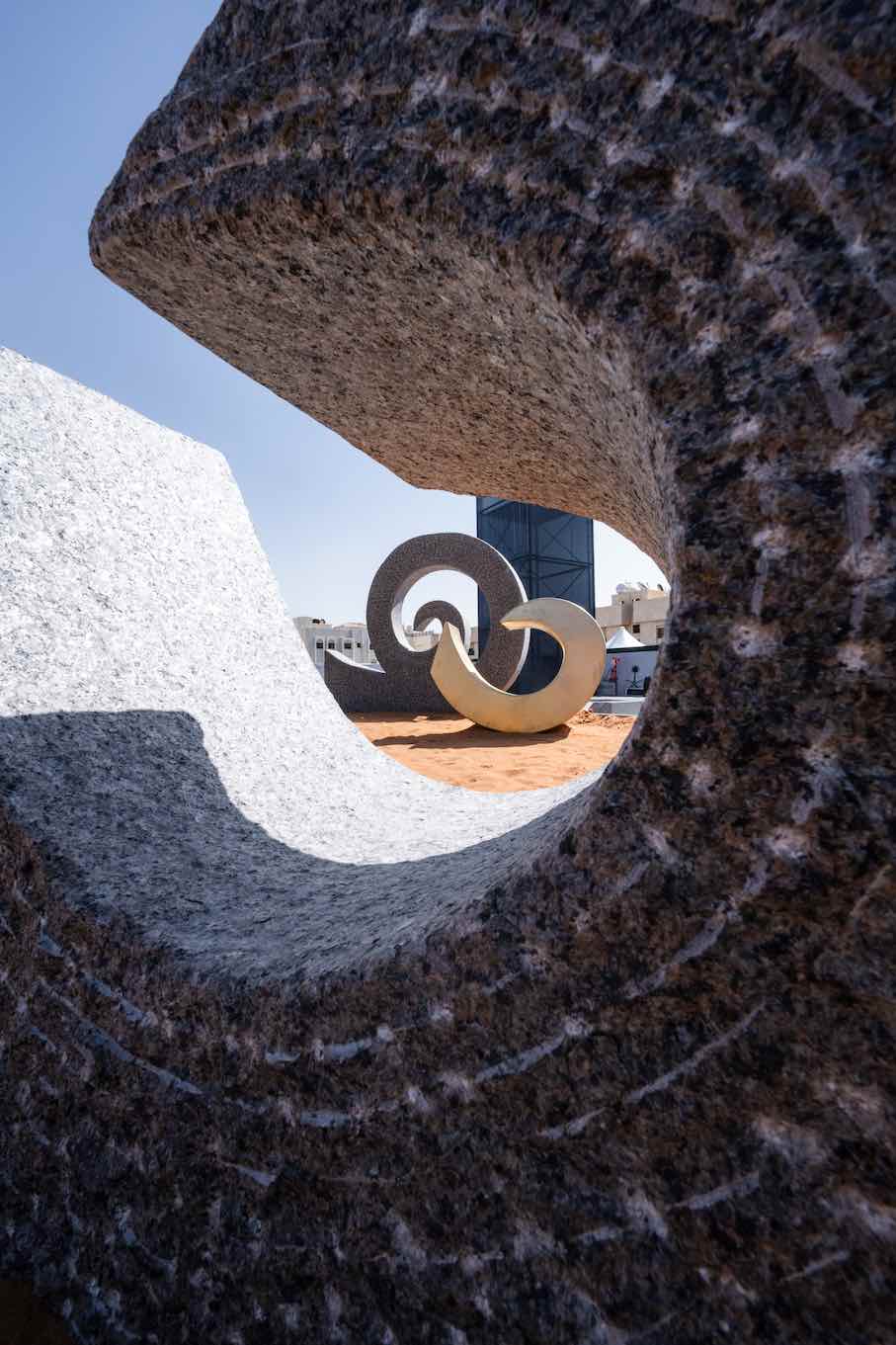 Wafa Hamad Alqunibit: “Emergence“ is a sculpture composed of curved stone forms and copper elements in which movement is held in suspension. The stone carries the temporal logic of the work: it registers continuity without repetition, proposing a kind of memory that does not cycle back to its point of origin but accumulates and shifts. The forms appear as traces of a gesture not yet completed, suspended between a prior state and one that has not yet fully materialized. Copper enters the work as a different kind of material presence, more responsive and more susceptible to the effects of time and atmosphere, and introduces a sense of latent energy, as though something is emerging from within the stone. As light moves across the sculpture throughout the day, shadows extend the forms and alter their perceived weight and direction, creating a temporal dimension in which the sculpture is never entirely fixed.
Wafa Hamad Alqunibit (b.1964, KSA) holds an MFA in Sculpture and Metal Casting from the Savannah College of Art and Design (SCAD) and an MBA from Columbus University. Her practice is shaped by land art and minimalism, working primarily with materials extracted from the earth, which she regards as carriers of geological memory and symbolic significance.
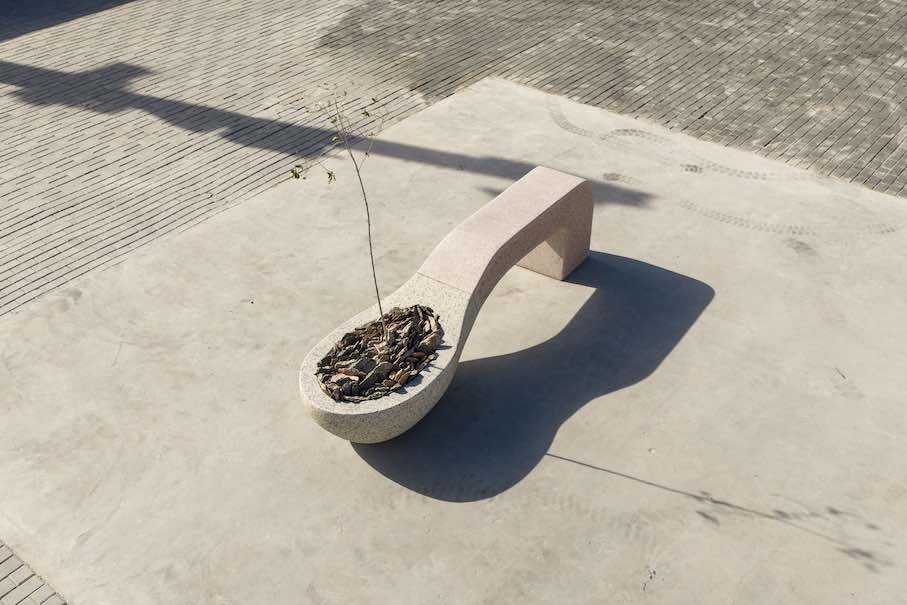
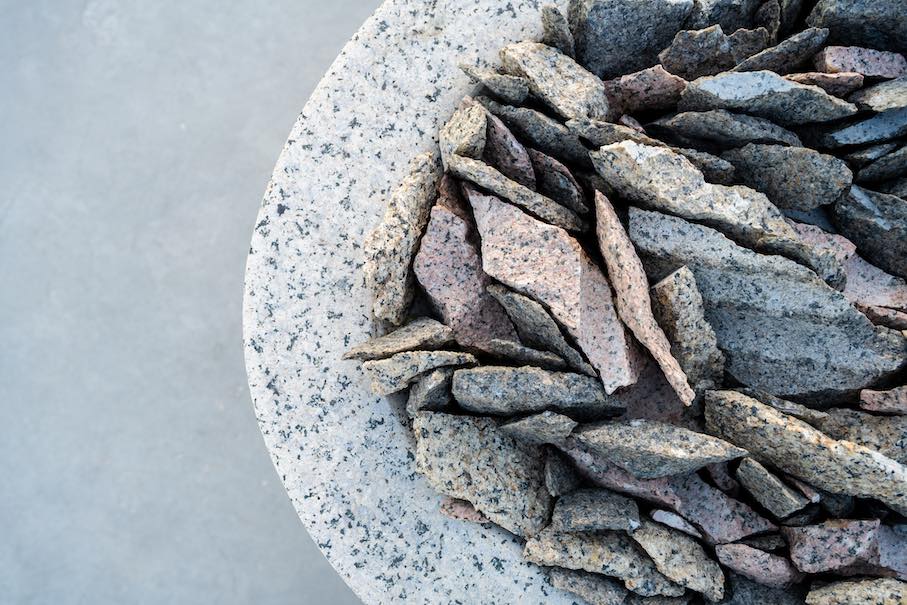 Emanuela Camacci: “R-esistere (Resist)“ is a site-specific work shaped as a monumental spoon. The handle is carved from Royal Rose granite and the bowl from Royal Gold granite, producing a formal distinction that reinforces the object’s dual character as both tool and vessel. The work functions as a seat, inviting pause and direct engagement rather than observing it from a distance. The bowl of the spoon contains an assembly of stone chips gathered from the production offcuts of other sculptors working in the same context, within which a live bronze tree has been embedded. This element is conceptually central to the sculpture’s argument: it references the flora that survives in the rocky, arid conditions of the Tuwaiq Mountains escarpment and proposes a parallel between the biological persistence of plant life and the broader capacity of nature to persist despite scarcity or disruption.
Emanuela Camacci: (b. 1968, Italy) studied sculpture at the Academy of Fine Arts in Rome, where she developed a practice that engages with land art and the relationship between natural geometry, ancient cultural forms, and the built environment.
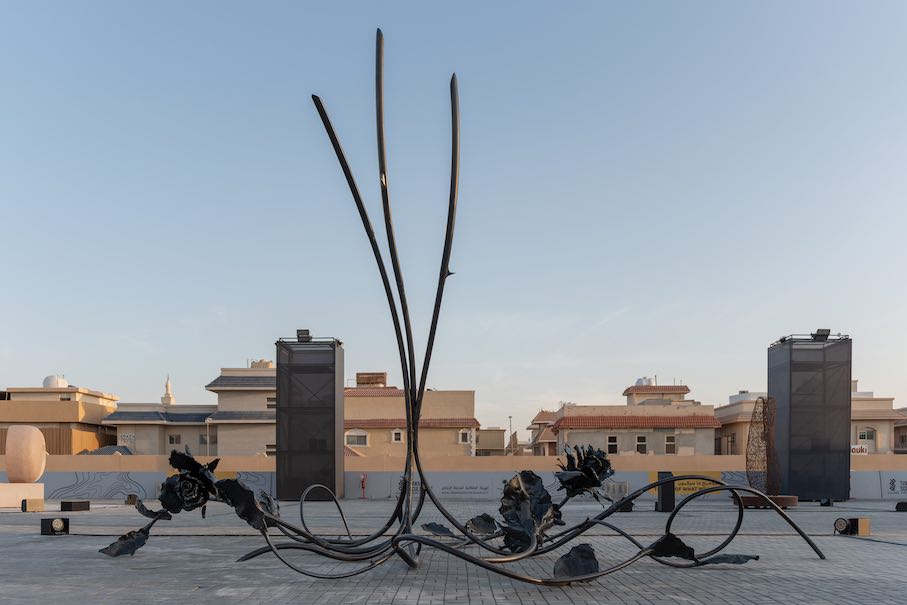
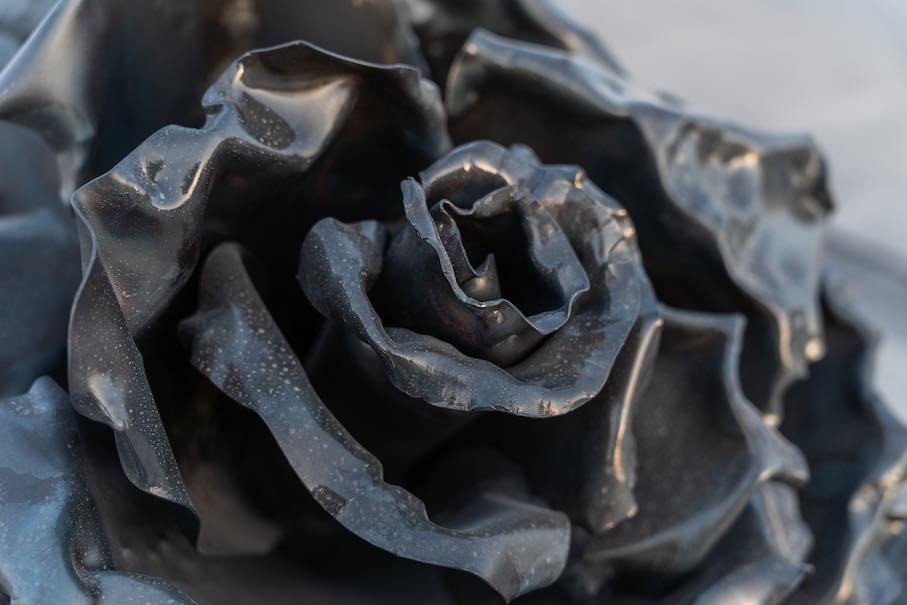 Raya Kassisieh: “Wharda“ is a sculpture constructed from mild steel that explores grief as a condition with spatial and structural dimensions. The work begins at the ground as a dense, vertical spine — a form that echoes the link structure of a chain — before spreading upward and outward into branching, complex forms. This movement from constriction to expansion mirrors the dual qualities of grief that Kassisieh investigates: its heaviness and its generative dimension, its tendency toward enclosure and its capacity to open into new form. Every element of the steel is gathered and shaped by hand, and the material is used in a state that retains the residue and marks of its industrial origin. Kassisieh treats this retention not as a limitation but as a formal and conceptual choice: the scars embedded in the metal are understood as a form of memory, a record of the material’s prior existence that persists through its transformation. This act of reassembly proposes a “post-natural “perspective in which the industrial and the organic are no longer understood as separate categories but as entangled conditions of the contemporary world.
Raya Kassisieh (b. 1991, Jordan) studied textiles and pattern making at Pratt Institute in New York before completing an MA in sculpture at the Royal College of Art in London. She lives and works between Amman and London.
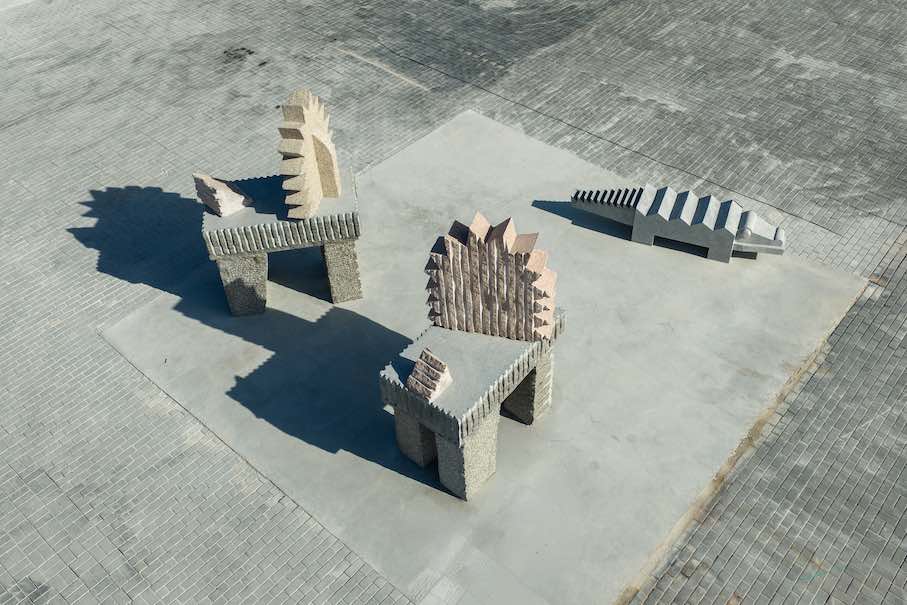
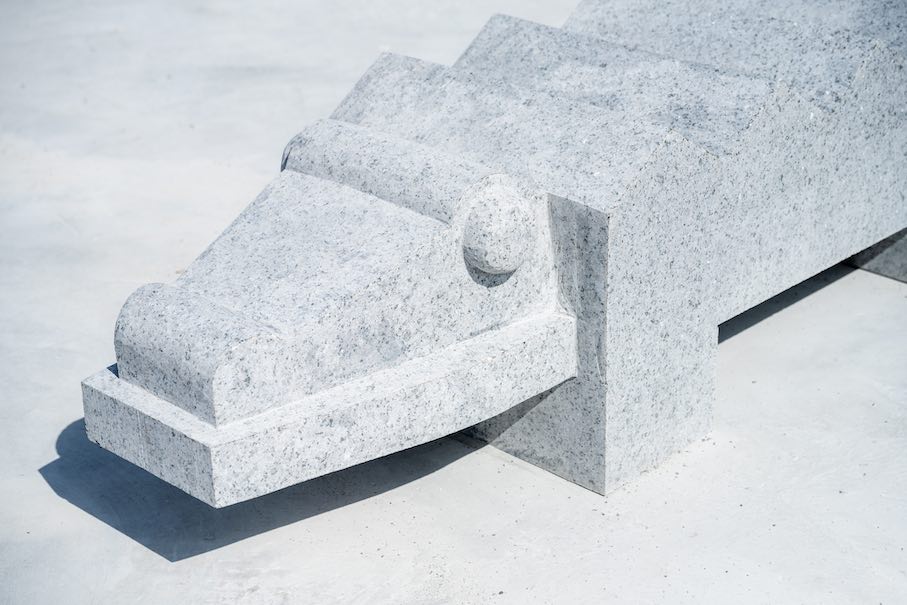 Irena Posner: “Dawn and Dusk“ is a pair of monumental lions carved from granite blocks of varying color and texture, assembled in a manner that recalls the formal logic of megalithic construction: rough, direct, and shaped by the properties of the stone rather than by the conventions of refined figuration. Posner uses this deliberately primitive register as a formal counterpoint to the engineered precision of Riyadh’s contemporary urban infrastructure, a way of measuring the scale of the present against the conditions from which it emerged. Each lion carries a distinct chromatic character: the lion of Dawn is distinguished by pink stone in its mane, representing the quality of light at sunrise; the lion of Dusk by yellow stone, corresponding to the tones of sunset. Both figures are built from darker green granite that anchors their bodies to the ground. These solar associations frame the sculptures as archetypal presences, guardians whose function is not protective in a literal sense but temporal, marking the passage of the day and the cyclical relationship between light, stone, and life. The work draws a connection between its formal approach and the history of desalination: in both, a fundamental substance is transformed through sustained effort into a condition that sustains existence.
Irena Posner (b. 1988, United Kingdom) holds an MA in Sculpture from the Royal College of Art and lives and works between London and Carrara, Italy. Her practice is centered on direct stone carving as both method and mode of thought, developing a formally improvisational approach that is informed by classical and Neoclassical sculptural traditions while maintaining a distinctly contemporary relationship with contingency and material behavior.
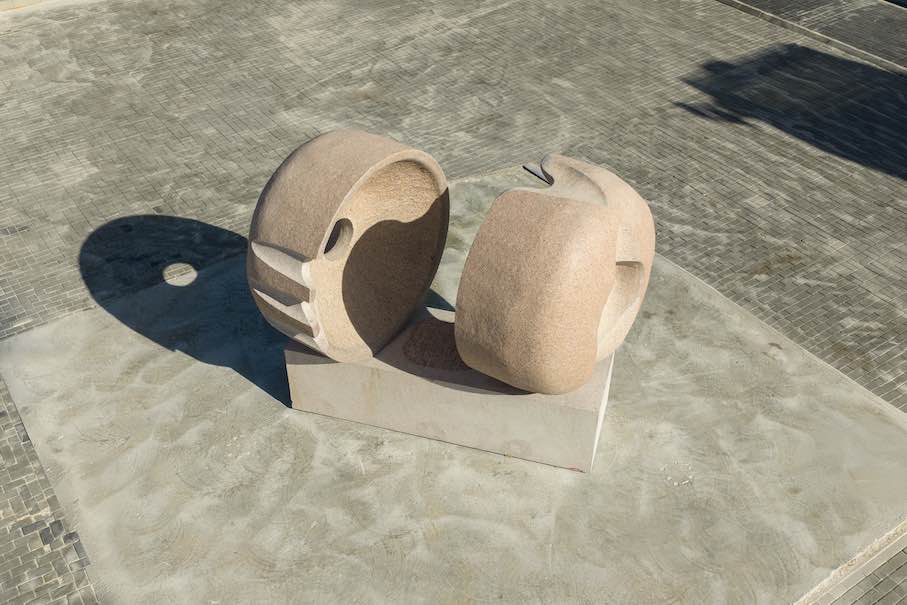
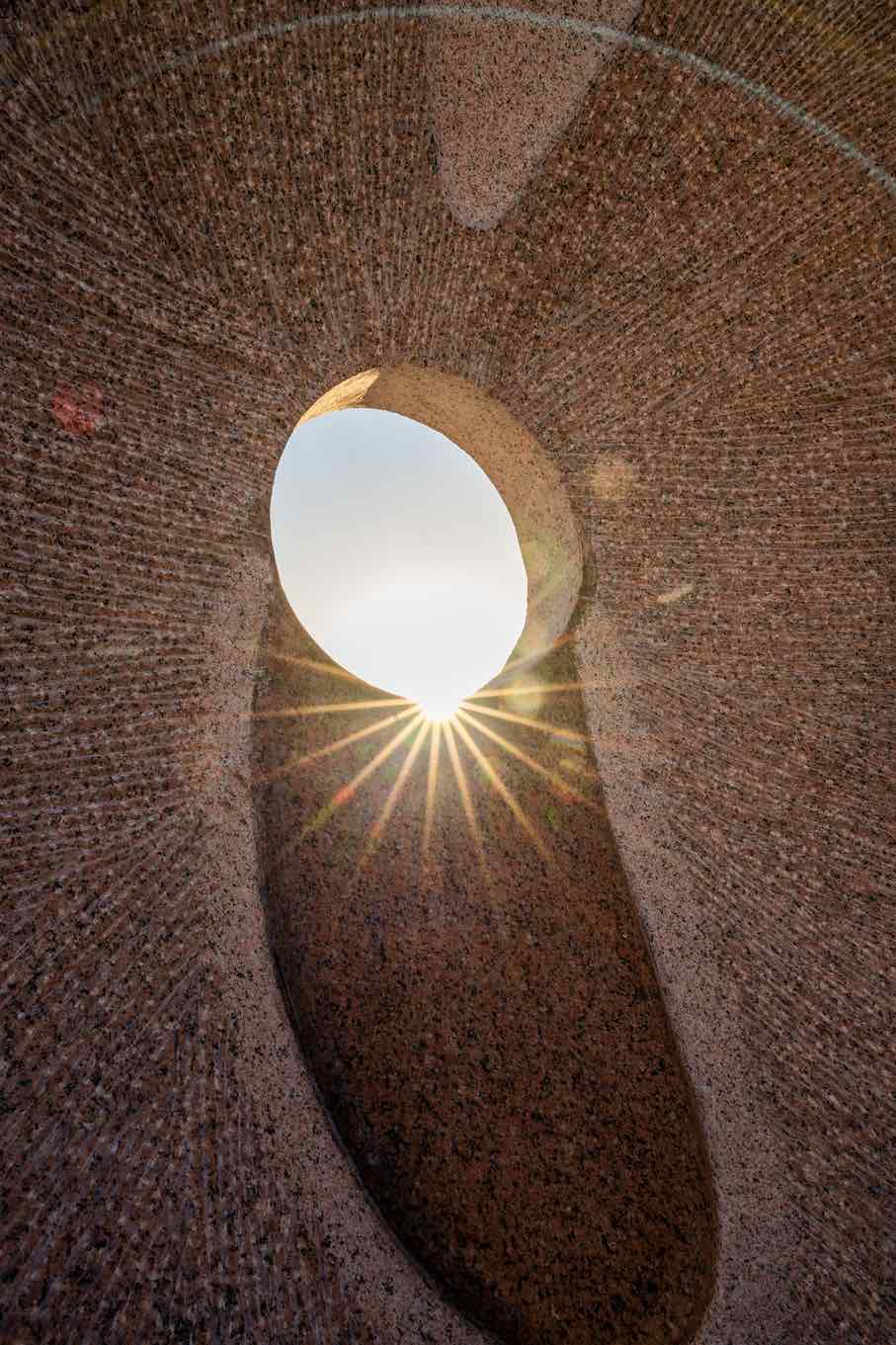 José Cárcamo: “The Alchemy and Transmutation of the Sea“ is a granite sculpture that translates the industrial concept of desalination into a visual and tactile language of movement. Carved from Royal Gold Granite, the work draws on the physical dynamics of erosion and the directional energy of water as it moves through filtration systems. Rather than depicting machinery or process directly, the sculpture captures the essential qualities of that transformation: force, flow, and the conversion of one state into another. The use of granite, shaped by geological pressure and time, reinforces the material logic of the work, linking the permanence of stone with the continuous cycle of water. The sculpture engages with desalination not as a technical achievement alone, but as a condition of sustained life: a process whose outcomes define population growth and the development of communities in arid regions. In solidifying water’s fluidity into durablestone, the work frames human resource management as both a practical necessity anda subject for contemplation.
José Cárcamo (b. 1968, Chile) studied sculpture at the School of Art at the University of Chile. His sculptures are installed in public spaces across Santiago, Quito, La Paz, San Pedro de Atacama, and Ayia Napa, and are held in private collections throughout the Americas and Europe. Carcamo works primarily in stone, such as marble, basalt, and granite, to address the relationship between human beings and their environment.
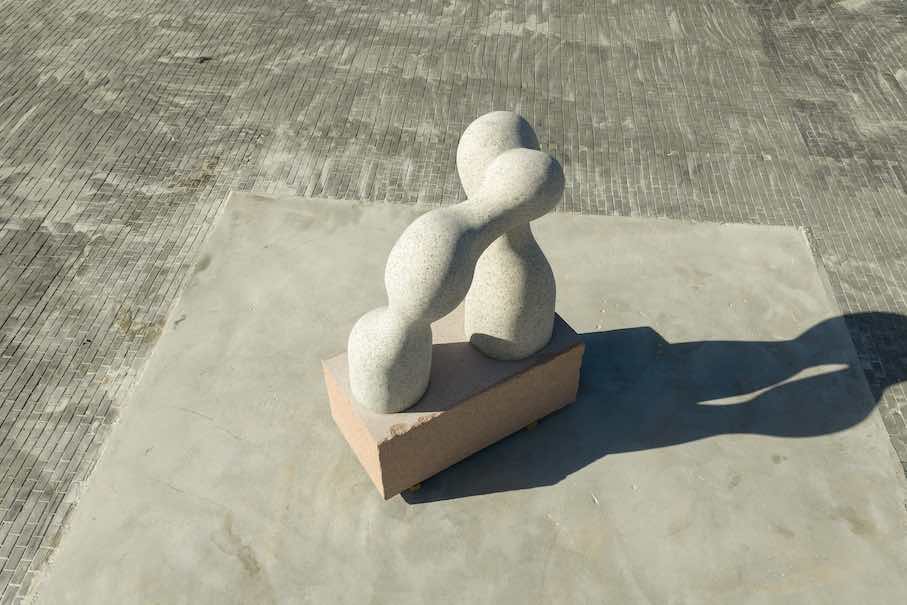
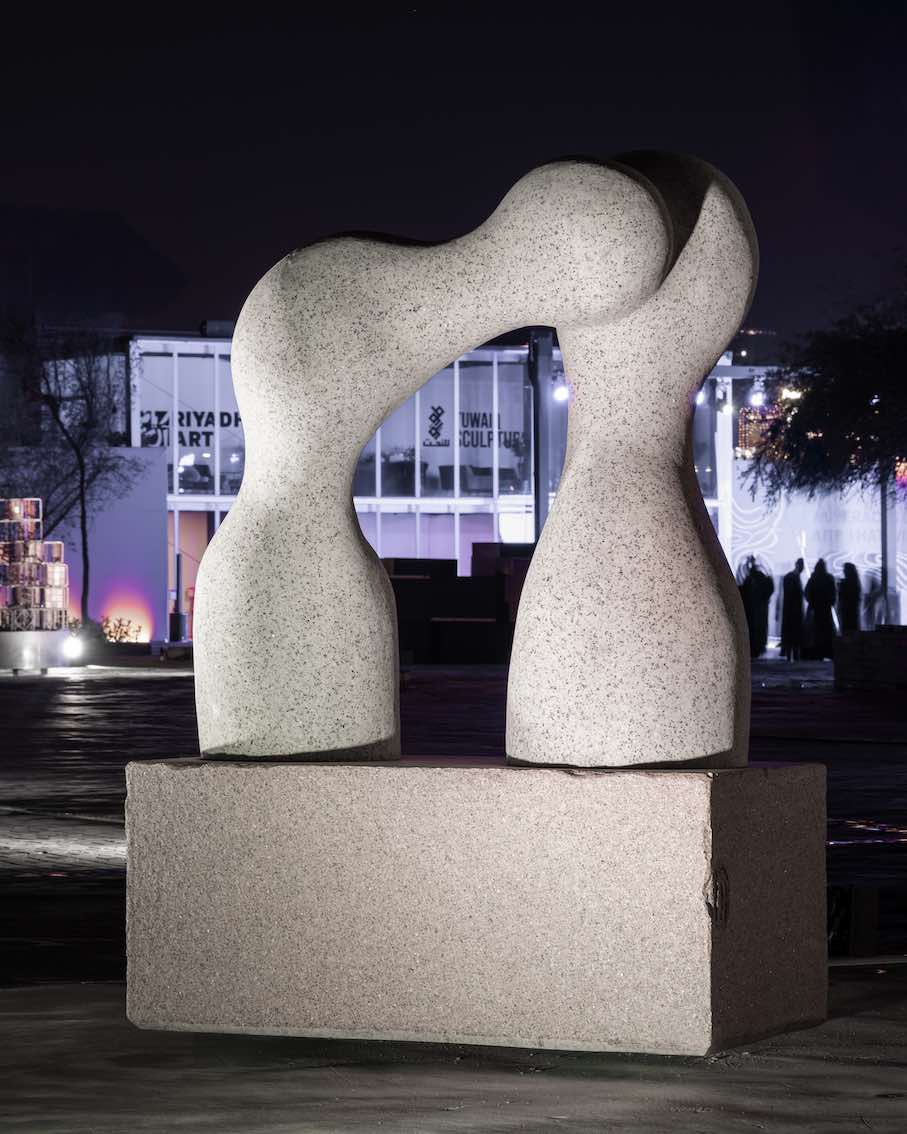 Komlam Samuel Olou: “Nkyekyen a ebeba“ (Trace of what’s to come) is a sculpture carved from Royal Gold granite, conceptually anchored in the Adinkra symbol “Bi Nka Bi”, a Ghanaian emblem of peace and harmony whose literal meaning is “Let no one bite their neighbor.” The work integrates formal influences from the reductive wood sculptures of the Lobi people, translating indigenous visual traditions into a monumental stone form. Olou presents the work as a “universal marker”, a form that acknowledges the diversity of human culture while proposing shared principles as the basis for coexistence. The title’s forward orientation, tracing what is yet to come, frames the sculpture as a meditation on the construction of a future built on justice rather than domination.
Komlam Samuel Olou (b. 1970, Togo and adopted in Ghana) graduated from the Ghanatta College of Art and Design before completing an MA at the National Academy of Arts in Oslo. He now lives and works between Oslo, Accra, and Togo. In 2016, he founded the Kamina Artist and Researcher Platform (KARP) in Togo, an initiative supporting artistic and research exchange across cultural contexts.
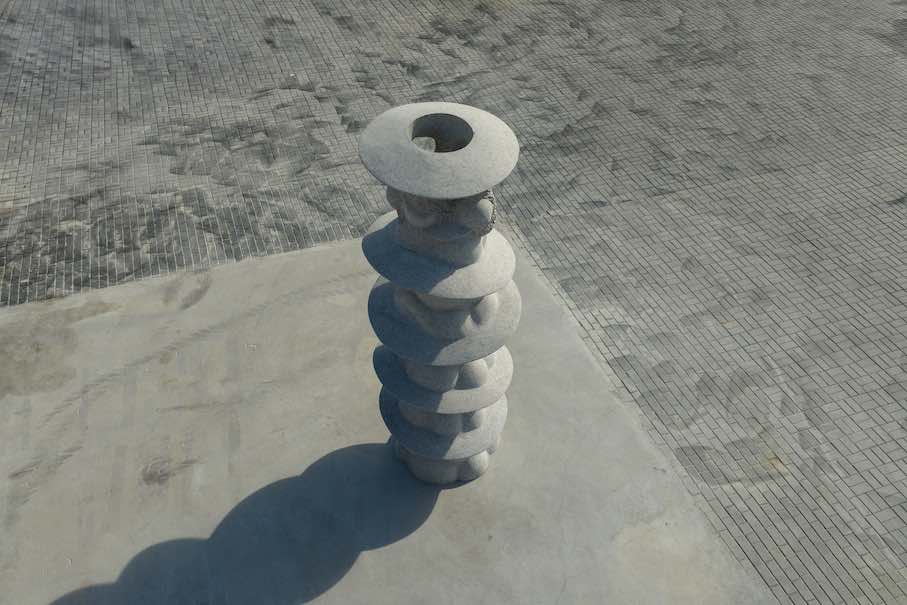
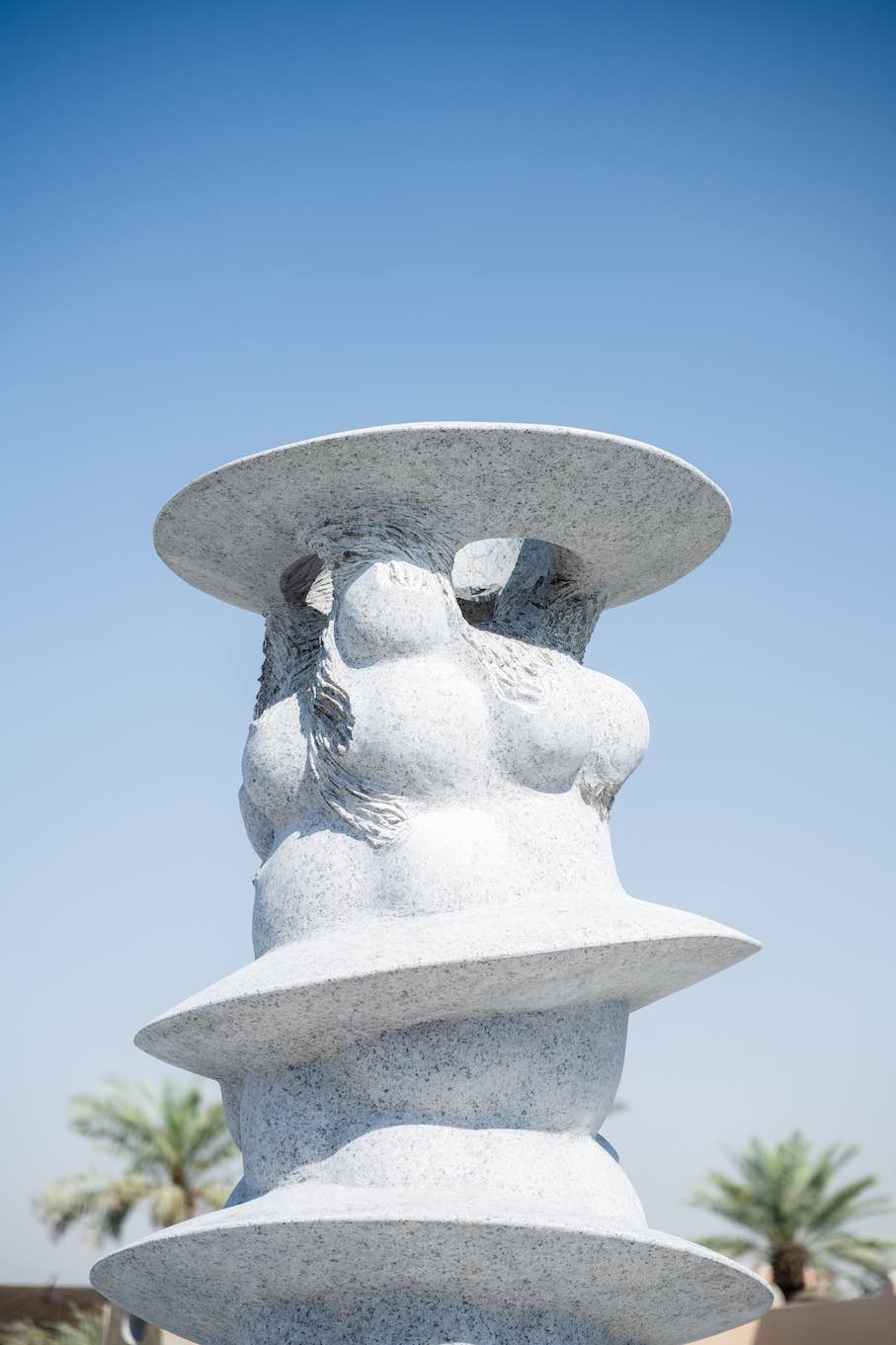 Yasushi Hori: “Sublimation“ is a granite sculpture carved from Royal Gold granite that gives material form to a set of philosophical questions using the structure of the spiral to propose that history does not progress in a straight line but evolves through recurring cycles of experience and recognition. The concept of sublimation for Hori is not a chemical process but a philosophical one: the capacity of human beings to transform suffering into knowledge, and through that knowledge to rise toward a higher understanding of their place within a larger order. The sculpture uses the durability of granite to anchor this concept in material permanence, creating a tension between the fleeting nature of individual experience and the endurance of the structures, geological, civilizational, and cosmic, within which that experience takes place. The work invites its viewers to locate themselves within this larger frame, and to consider their own moment as part of a continuous process of elevation and refinement.
Yasushi Hori (b. 1960, Japan) graduated from Tama Art University. His work is characterized by a philosophical orientation toward elemental forces, earth, fire, water, wind, and sky, which he arranges in spiraling compositions to express the concept of sublimation: the process by which humanity rises through the acknowledgement of suffering and universal truth.
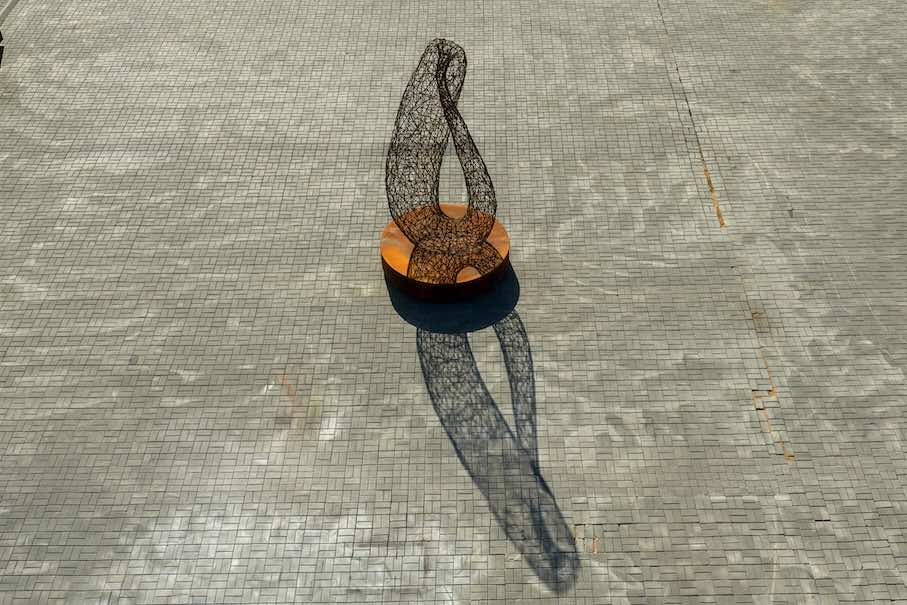
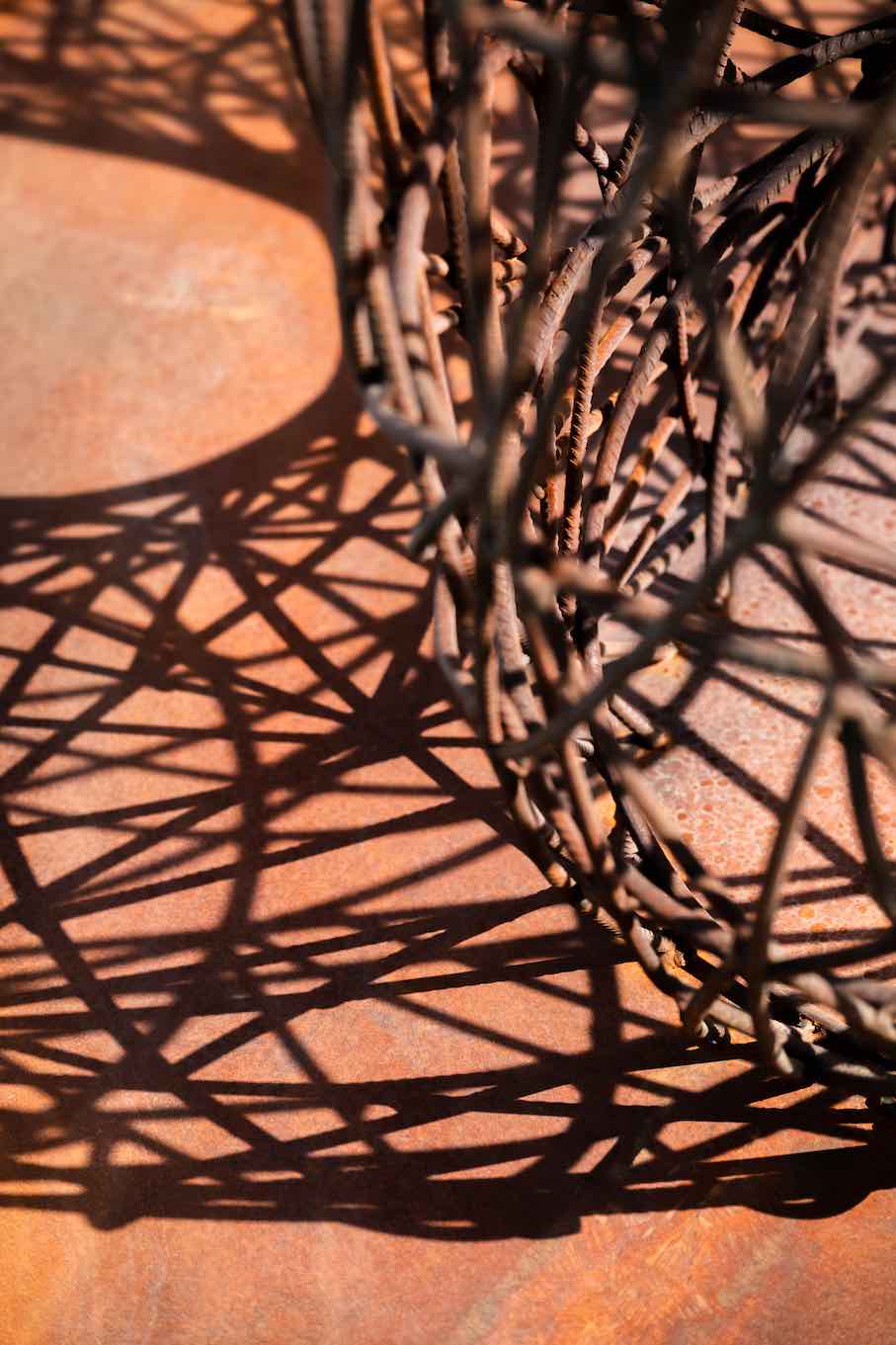 Elparo: “IN FINITY“ is a site-specific sculpture using accumulated rebar to construct a form derived from the Klein bottle, a non-orientable topological surface in which the distinction between interior and exterior is absent. This mathematical structure serves as the work’s central metaphor: a form without end or origin, which the artist applies to the concept of the water cycle and the regenerative potential of discarded materials. The sculpture references Tahlia Street’s historical function as the location of Riyadh’s first desalination plant, drawing a correspondence between the recycling of water and the transformation of waste material into art. IN FINITY is not linear but recursive, and suggests that both natural and human systems are governed by cycles of use, discard, and regeneration.
Elparo (b. 1987, France) developed his artistic practice through urban graffiti before experimenting with sculpture and installation. His early work evolved across studio spaces, workshops, and disused sites throughout Europe, Oceania, and North Africa. In 2013, he produced his first three-dimensional piece, using discarded furniture, crates, pallets, and reclaimed metal, a shift that established the material logic central to his subsequent practice.
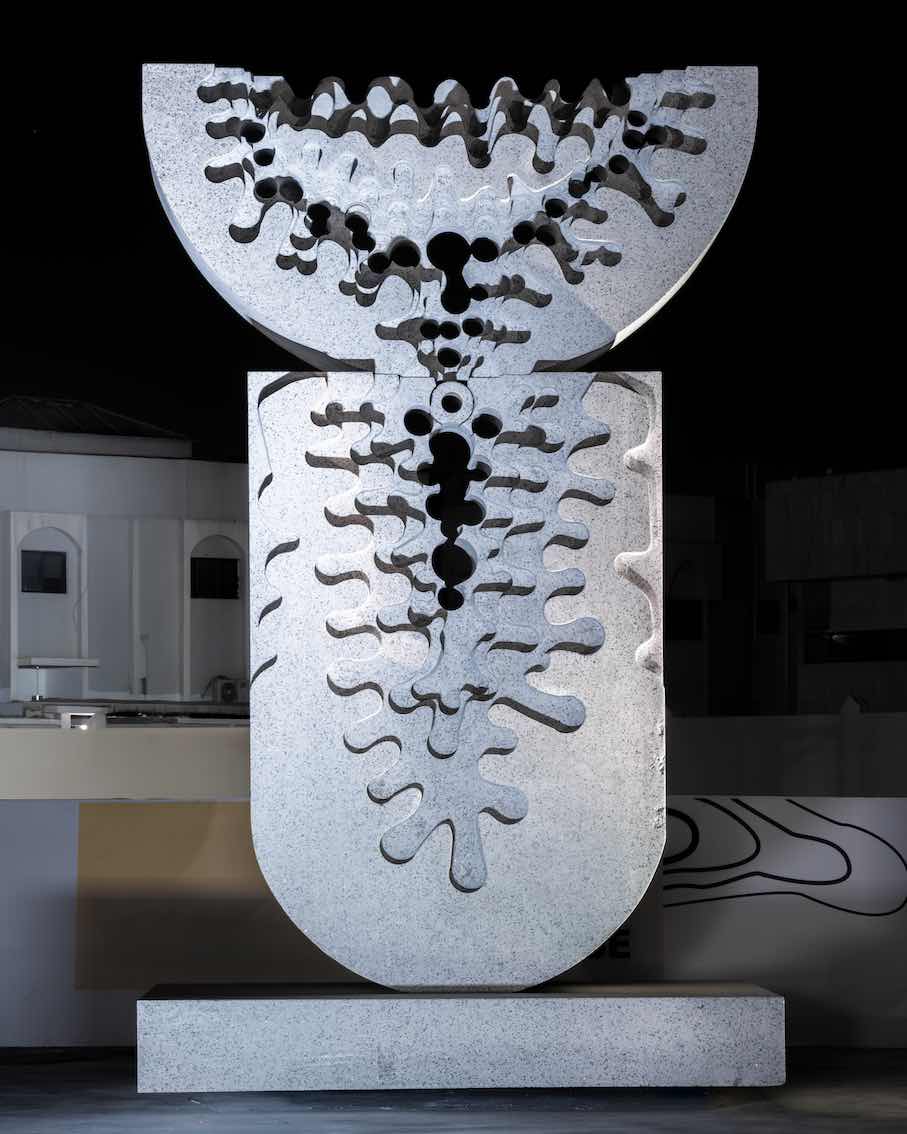
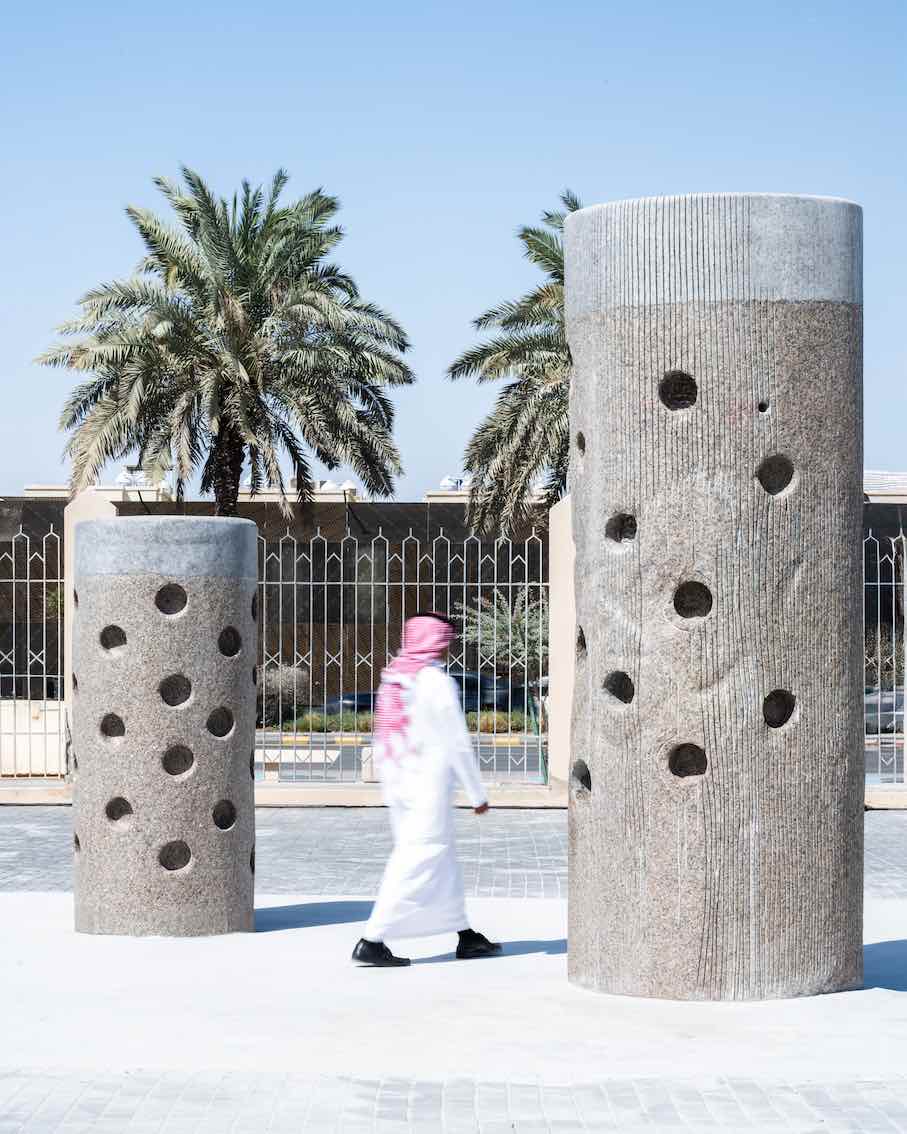
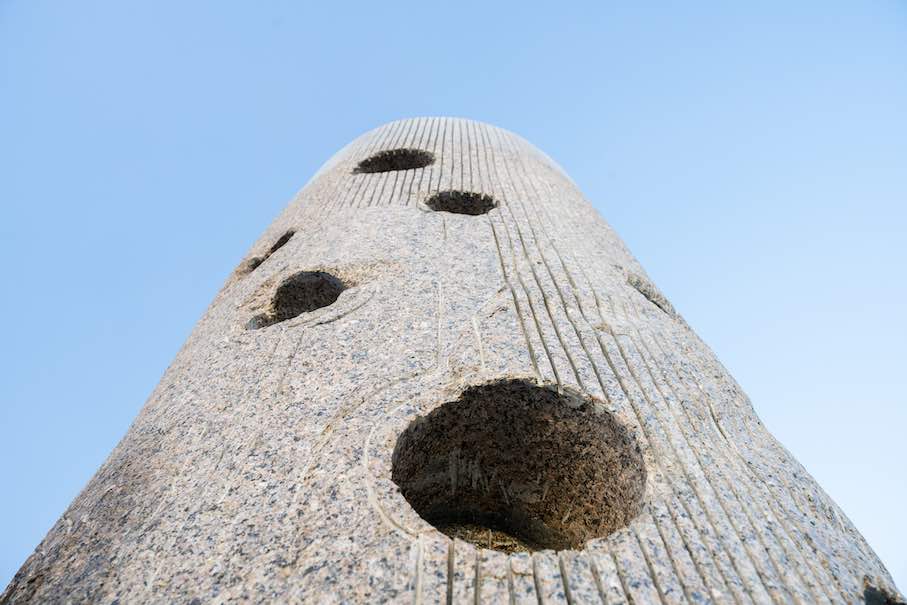
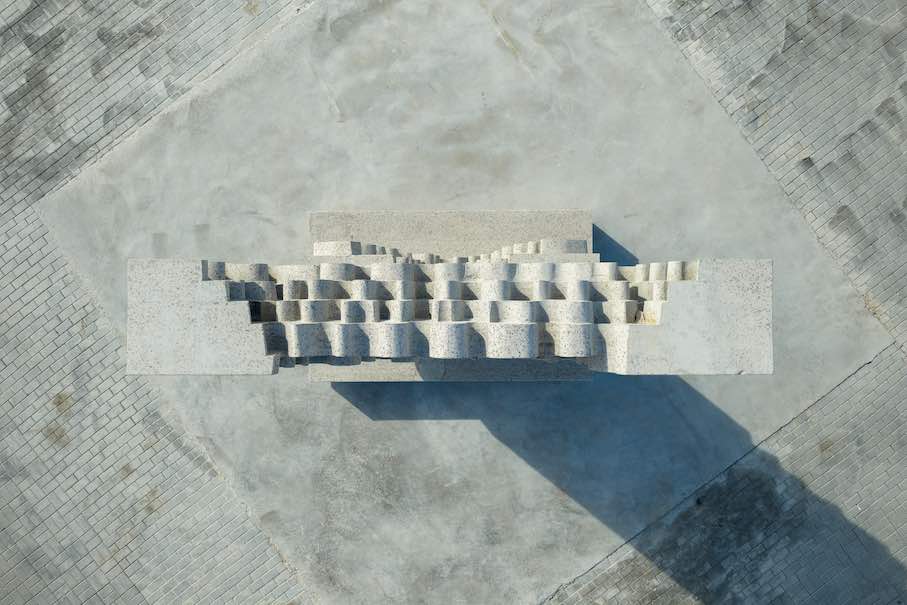 Wiktor Kopacz: “Traces of the Future“ is a vertical sculpture, suggesting a portal in which past and future are held in a material relationship. The sculpture is defined by carved voids within the stone. As these forms rise through the stone toward the sculpture’s upper register, they become progressively less defined, appearing to dissolve into the light above. The work engages specifically with the history of Tahlia Street, reading the historic desalination of saltwater as a model of human ingenuity. The sculpture is designed to respond to the sun’s movement throughout the day, with light activating the interior silhouettes, causing them to shift, merge, and disappear.
Wiktor Kopacz (b. 1970, Belarusian Polish) trained at the Minsk State Art College and the Belarusian State Academy of Arts before developing a practice encompassing monumental public art in stone and bronze. Over more than three decades, he has moved away from strict figurative realism toward a formal language in which solid volumes are deconstructed into repeated marks, or “molecules”, developing a sculptural language that addresses time, memory, and spatial experience.
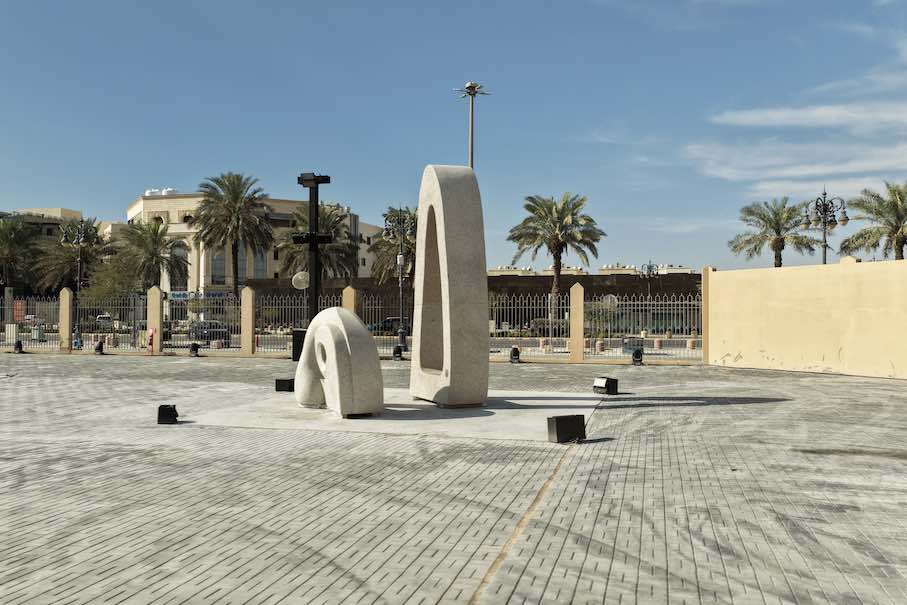
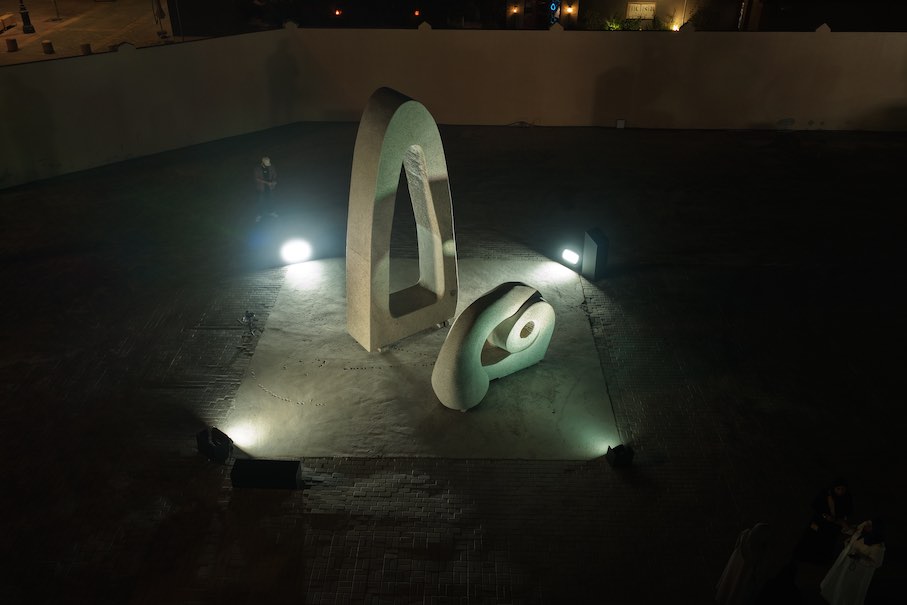 Azza Alqubaisi: “Between the Lines“ is Royal Gold granite work that explores the transformation hidden within desalination. The void at the center represents clarity achieved through struggle, while the materials contrast permanence (granite) with reflection and release (steel). Inspired by the artist’s childhood visits to desalination plants, the work symbolizes the journey from scarcity to purity, echoing the human and environmental struggle for survival.
Azza Alqubaisi (b. 1978, United Arab Emirates) began her career as a jewelry designer before expanding her practice to encompass large-scale sculpture and public installation. She is recognized as the first Emirati jewelry artist and has developed a practice that uses local materials such as palm fronds and oxidized metals to reinterpret regional craft traditions, including weaving and metalwork, within a contemporary fine art context.
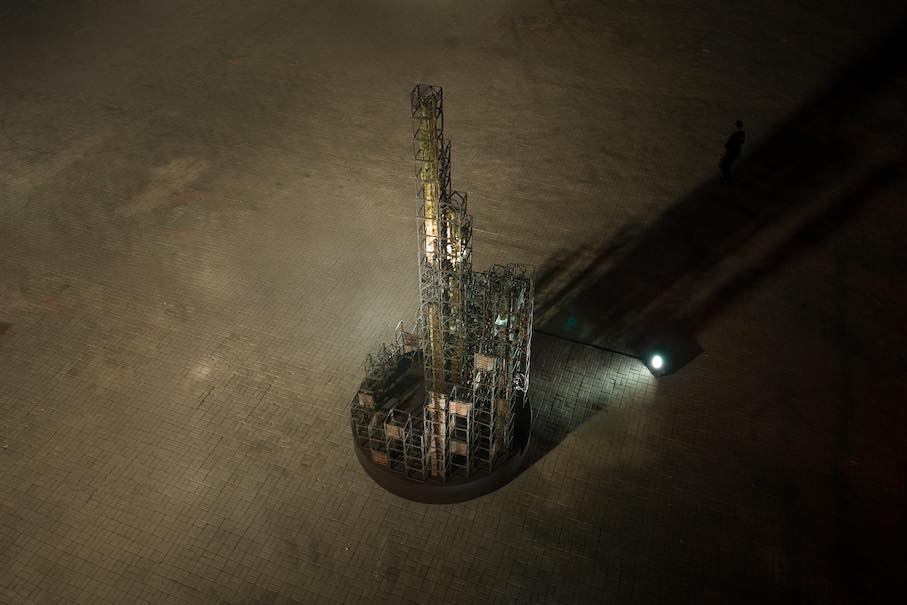
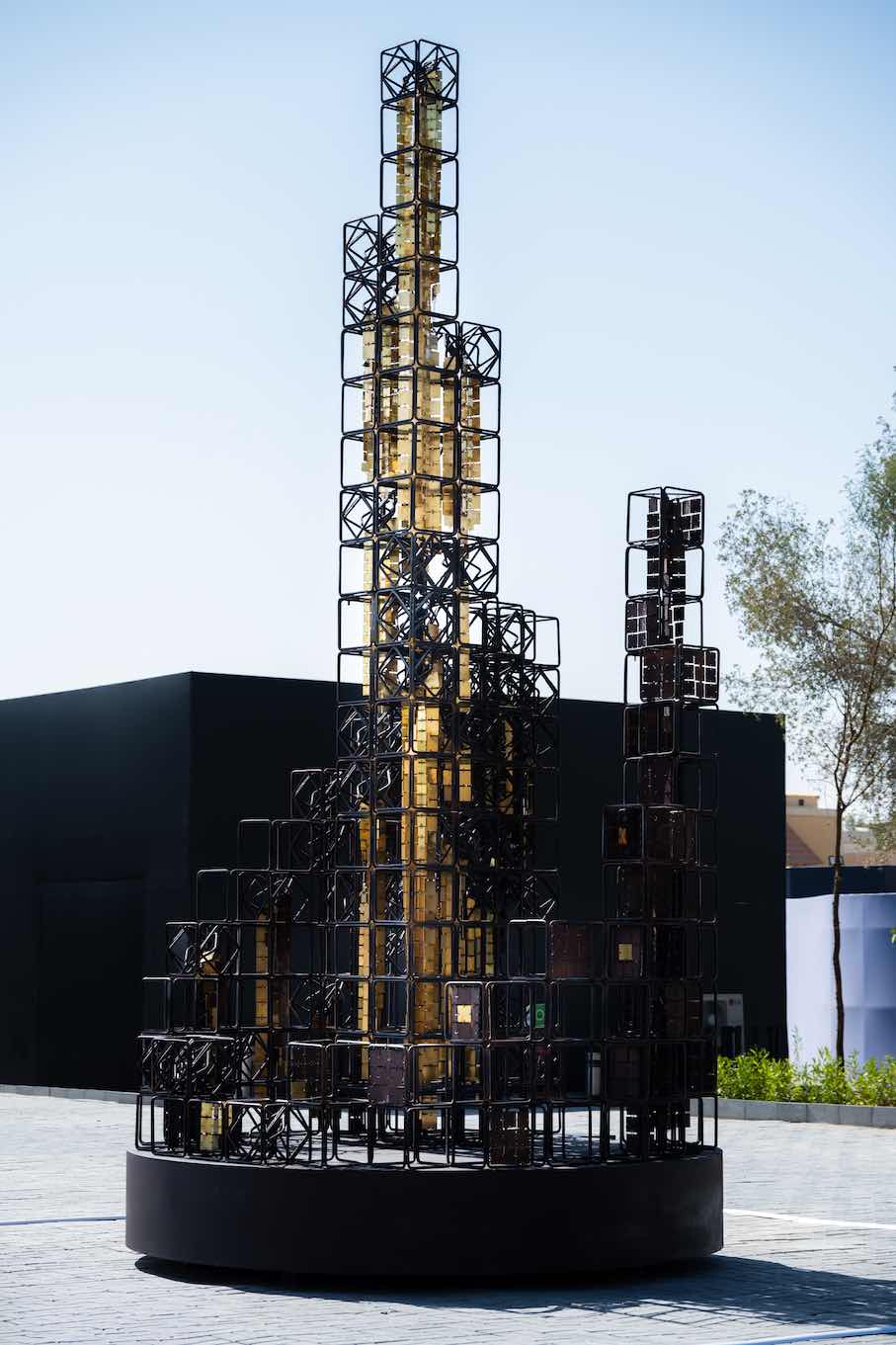 Maisa Shaldan: “Essence of the Earth“ is a sculpture constructed from hundreds of steel rebar columns arranged into a dense cube and bound with steel ties rather than welded together. This structural decision is central to the work’s meaning: the cohesion of the form is achieved through connection rather than fusion, proposing a model of collective strength in which elements retain their individual character while functioning as part of a unified whole. The conceptual framework of the work draws a parallel between two acts of transformation: Noah’s Ark, understood as a vessel that converted the threat of flood into an occasion for renewal, and the modern desalination plant, which converts the salinity of seawater into potable water. Both are framed as systems of salvation, structures that take a threatening substance and transform it into a condition for sustained life. The sculpture invites the audience to explore its center and chimes with the sound of the wind echoing through the city.
Maisa Shaldan (b. 1975, Kingdom of Saudi Arabia) is a visual artist and researcher of Palestinian origin whose practice is rooted in the intersection of art therapy, Islamic studies, and material investigation. She holds a Professional Doctorate in Art Therapy and brings this interdisciplinary formation to bear on questions of memory, geological time, and the psychological dimensions of matter. Shaldan works with iron, palm fronds, natural pigments, henna, and rust, materials she understands not as passive substances.
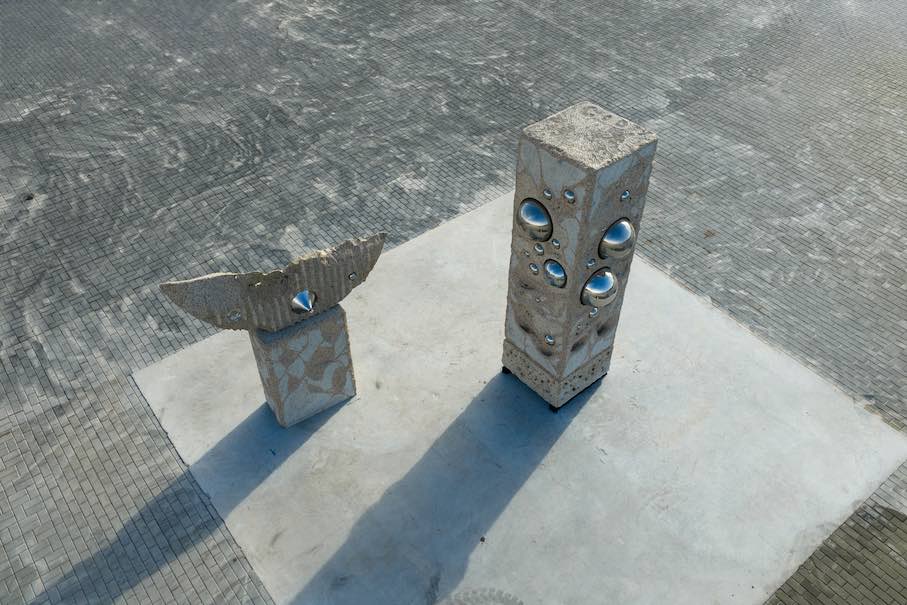
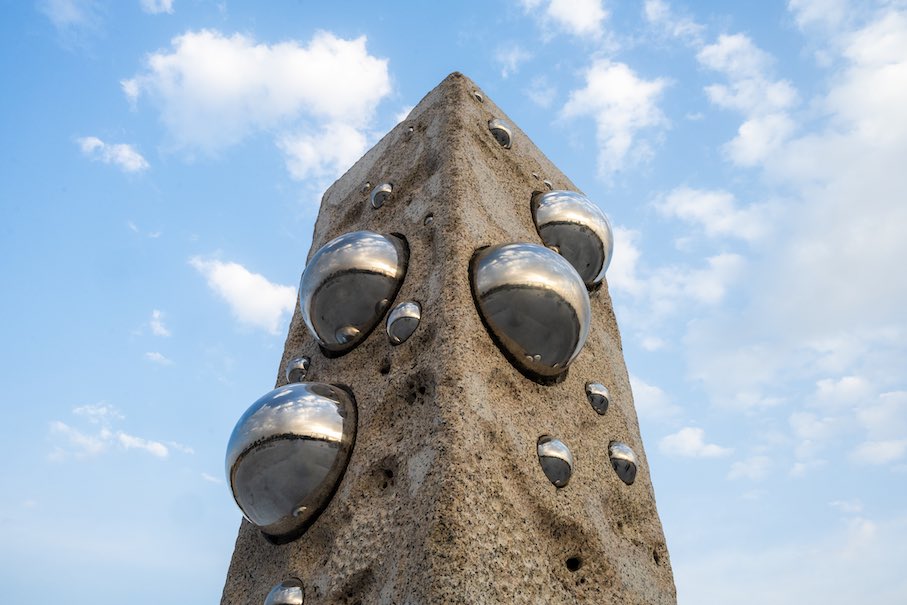 Žilvinas Balkevičius: “Drops of Life“ is a sculpture carved from a solid block of Royal Gold granite into which spheres of varying sizes are integrated, appearing to penetrate the stone’s surface and extend into the surrounding space. The rough, warm texture of the granite carries associations of geological deep time, the ancient, enduring character of the earth’s crust. The spheres, by contrast, are finished to a high polish, their surfaces functioning as mirrors that capture and return the sky, landscape, and viewers who stand before them. Balkevičius uses this formal pairing to explore the relationship between geological permanence and the fluid, essential quality of water.
Žilvinas Balkevičius (b. 1975, Lithuania) holds degrees in Metal Design and Sculpture from the Vilnius Academy of Arts. Since 2007, he has lived and worked in Iceland, where the landscape’s elemental character, volcanic activity, glacial mass, and geothermal systems, has become a sustained source of formal and conceptual reference. Balkevičius creates sculptures that function as points of contact between subjective experience and the material world, drawing on phenomenology and existentialism to frame his engagement with stone and metal.
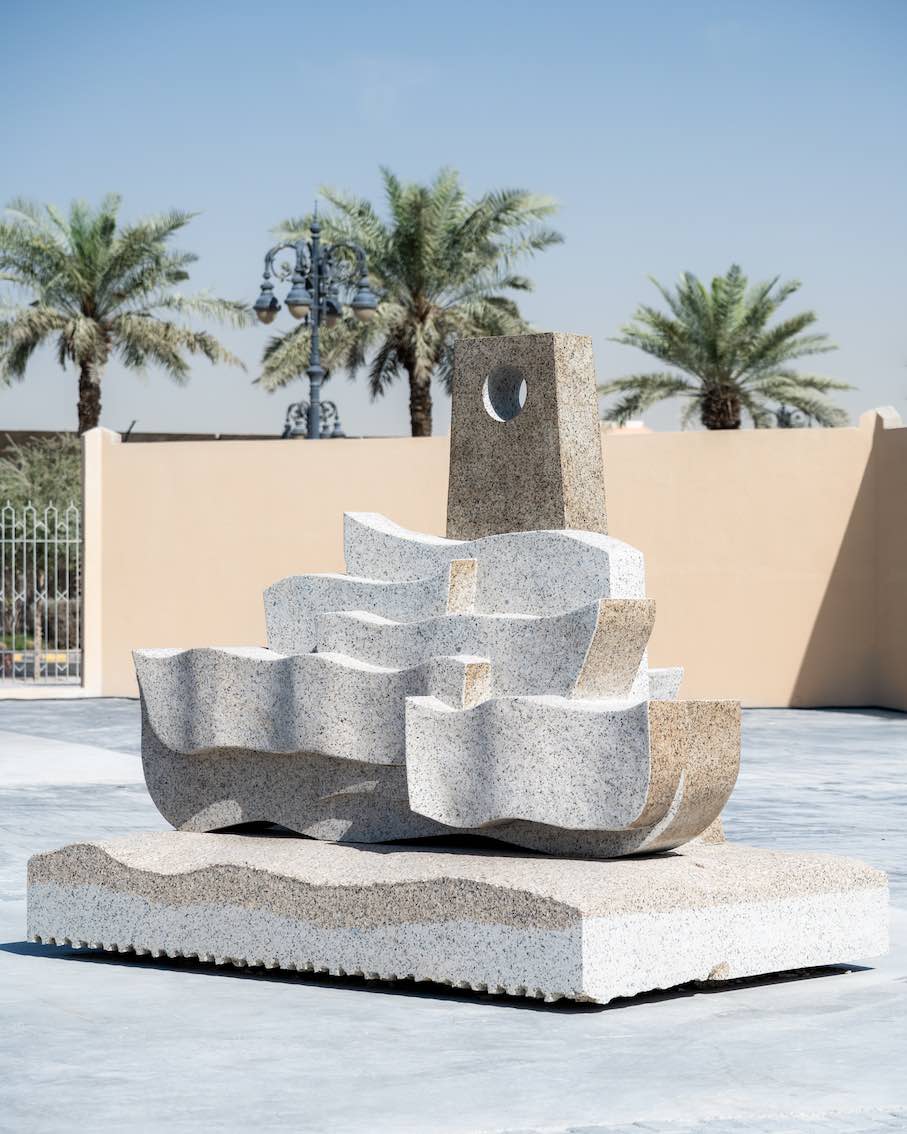
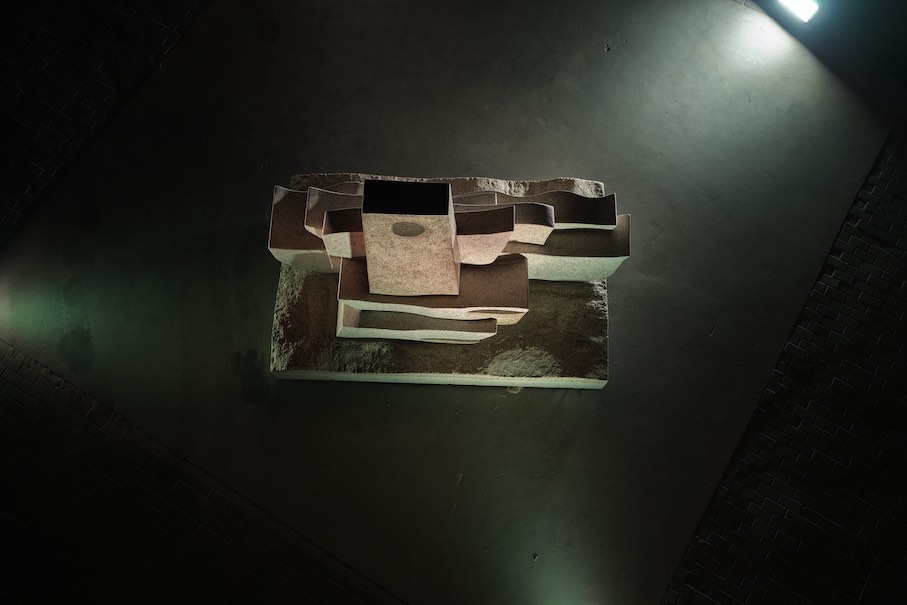 Jasem Shuman: “Navigating Memory“ is carved from granite and uses stacked stone masses to create a sense of undulation, a formal movement that Shuman associates with the transformation of water from salinity to sustenance. The work is rooted in the artist’s direct experience: he spent his childhood in Riyadh during the 1980s, a period of significant urban expansion, and witnessed the transformation of the city from a condition of material scarcity to one of abundance. By situating the sculpture on Tahlia Street, the site of its original inspiration, the work closes a circuit between memory and place, using stone’s durability to hold the record of what was while opening toward what continues to be shaped. Shuman has described the work as a visual discourse of the spirit: an expression of gratitude to a place whose capacity for transformation taught him the possibility of change.
Jasem Shuman (b. 1983, Ramallah and Al-Bireh Governorate) graduated from the Faculty of Fine Arts at Al-Quds University and holds a Master’sdegree in Contemporary Visual Arts from Dar Al-Kalima University in Bethlehem. He works as a visual artist, sculptor, and poet, selecting his medium in relation to the specific demands of each subject: sculpture for works that address physical presence and material accumulation, poetry for explorations of language and emotional layering.
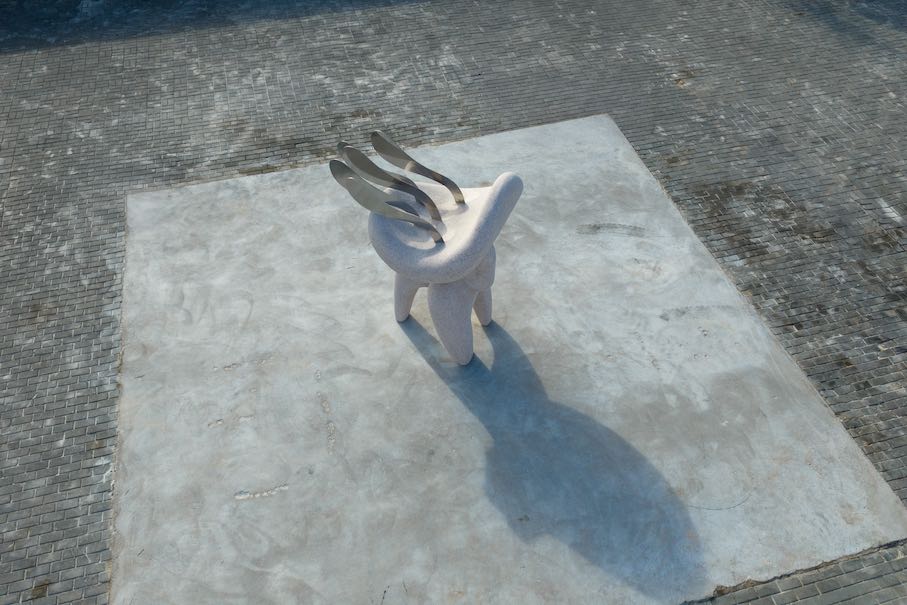
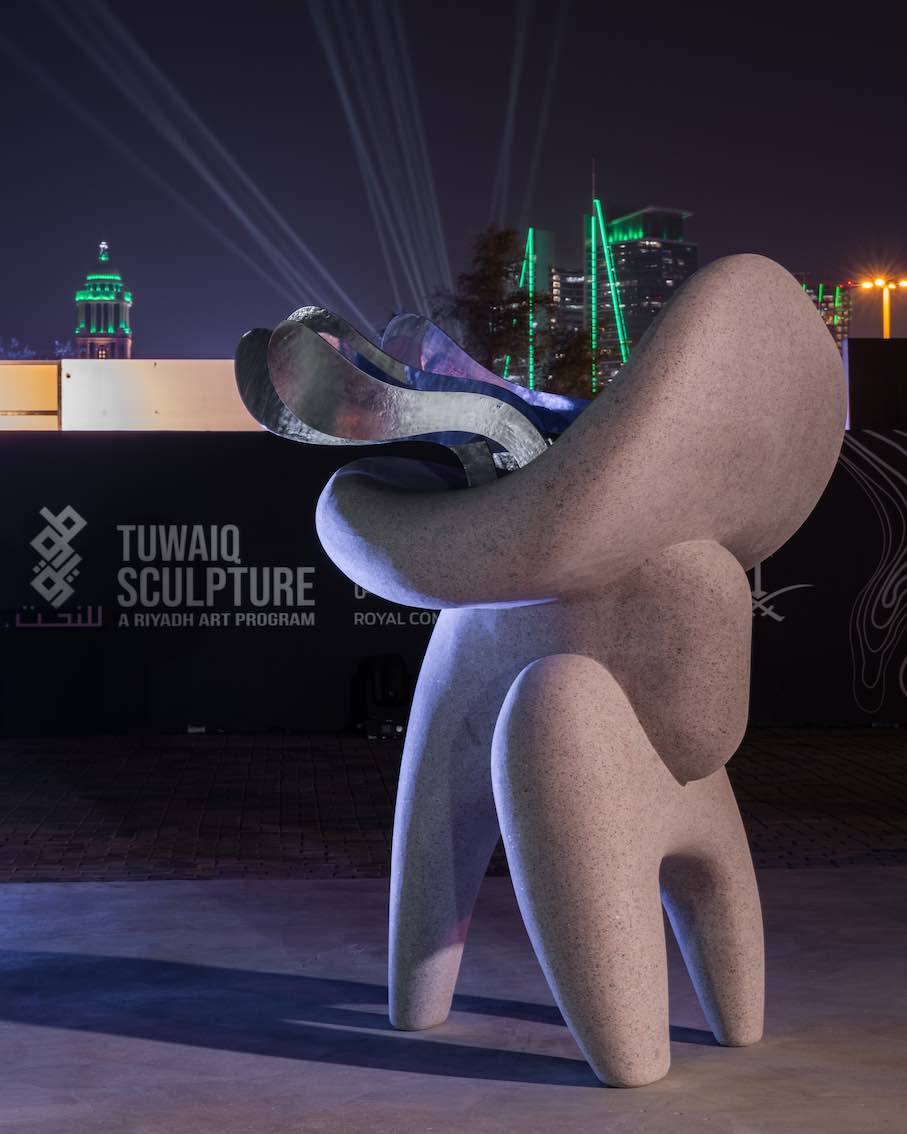 Zahra Rahimi: “Flow“ is a sculpture constructed from Rose granite and laser-cut metal that examines the formal and conceptual relationship between stillness and motion. Rahimi works against the inherent density of stone by introducing metal elements that introduce rhythm and directionality into the composition. The work creates a formal negotiation in which neither material dominates: the stone begins to read as fluid, and the metal as responsive to organic forces. This exchange of properties is the sculpture’s central concern. Flow uses the tension between opposing material logics to create a moment of suspension, in which both the ancient rootedness of the natural world and the velocity of contemporary life are held simultaneously. The work was conceived in direct response to Riyadh’s dual character: a city defined equally by historical depth and continuous transformation.
Zahra Rahimi (b. 1980, Iran) studied at the Faculty of Fine Arts at the University of Tehran, where she developed a sculptural practice focused on the relationship between natural forms and contemporary material processes. Her work is shaped by close observation of landscapes and organic flows, which she translates into abstract compositions that use stone to evoke grounded, geological time and metal to address the speed and tension of modern life. Rahimi has participated in international symposia and festivals across multiple countries, including the Tehran Sculpture Biennial and the Silk Road International Festival in China. Her philosophical approach centers on the idea that nature provides a model of continuous regeneration, while modernity is defined by technological acceleration.
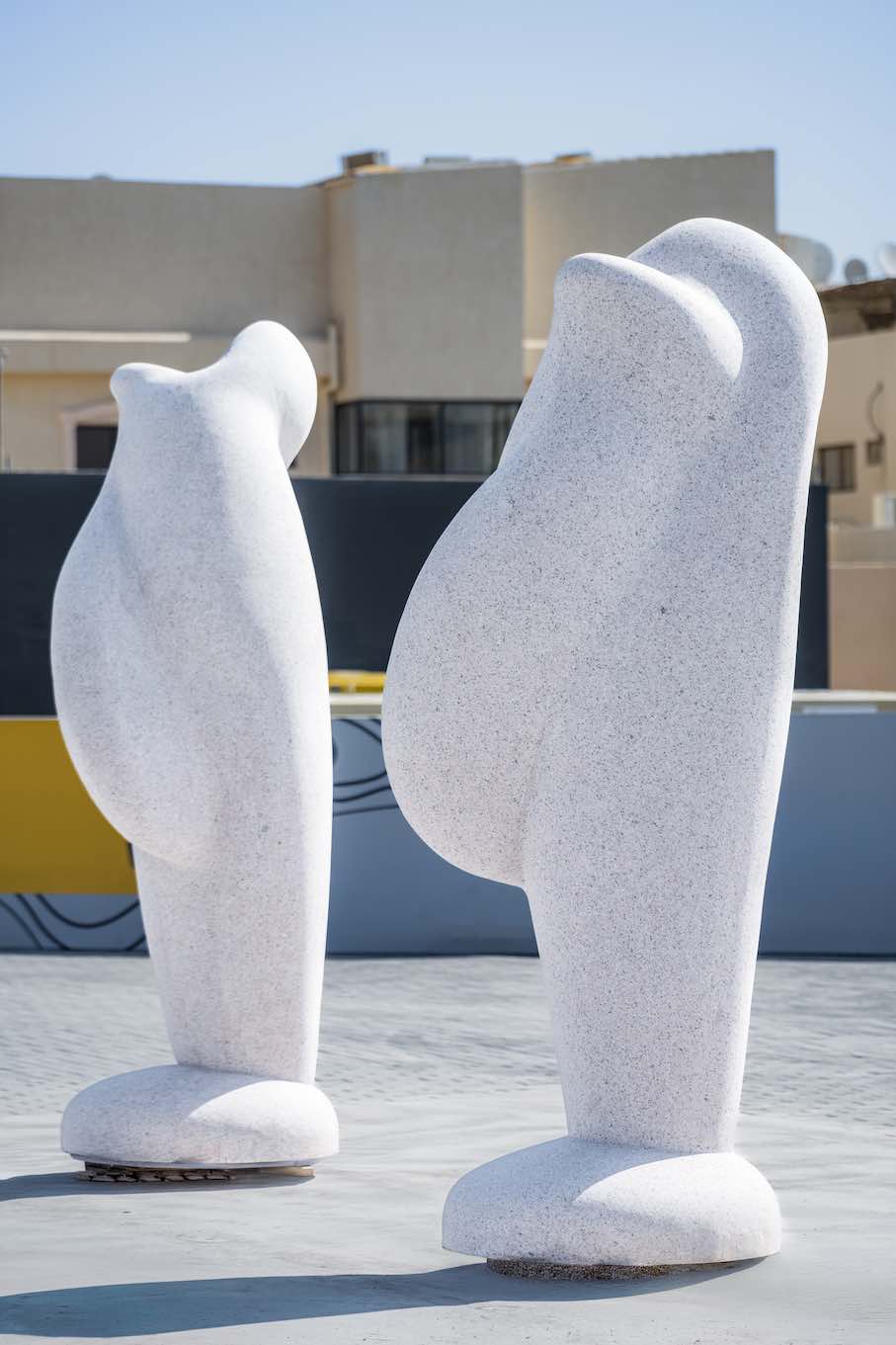
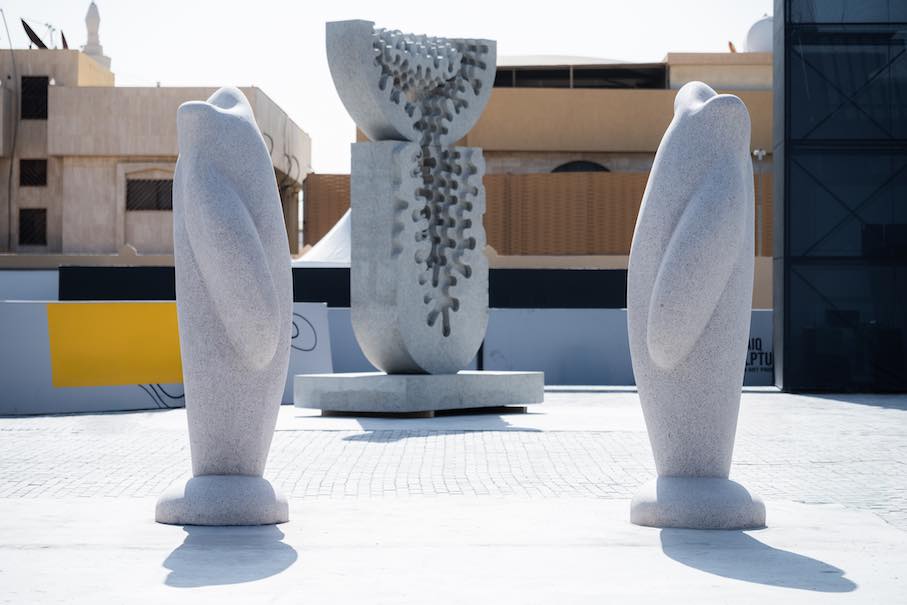 Nicola Fucci: “Beyond“ is a monumental sculpture carved from pink granite, composed of two mirrored vertical elements that together suggest the form of a portal. This threshold structure is both spatial and conceptual: it marks a point of passage between the present and a horizon of unrealized possibility. The work was conceived in direct relationship to the curatorial theme of Traces of What Will Be, and to the specific history of Tahlia Street as a site shaped by long-term urban vision. Fucci dedicates the sculpture to the individuals who planted the conditions for transformation without living to observe the outcome, an act of imagination that required patience, investment, and a particular relationship to time. The mirrored granite elements create a dialogue between what has been and what remains open: the symmetry of the form is precise, but the space between the two elements is unresolved, extending outward and upward without closure. This formal openness is the work’s primary statement: that the future is not a fixed destination but afield that remains available to those willing to move toward it.
Nicola Fucci (b. 1990, Italy) was formed by an early environment of craft, growing up in a family workshop and pursuing formal training in both sculpture and digital sculpture in Carrara, a city with deep institutional ties to the history of stone carving. His practice treats stone not as a passive medium but as a collaborator in the process of making: a material with its own history, rhythm, and formal intelligence. Fucci is concerned with the points of contact between matter and being, exploring sculpture as a means of articulating suspension, moments of stillness between an ancient past and an unresolved future.
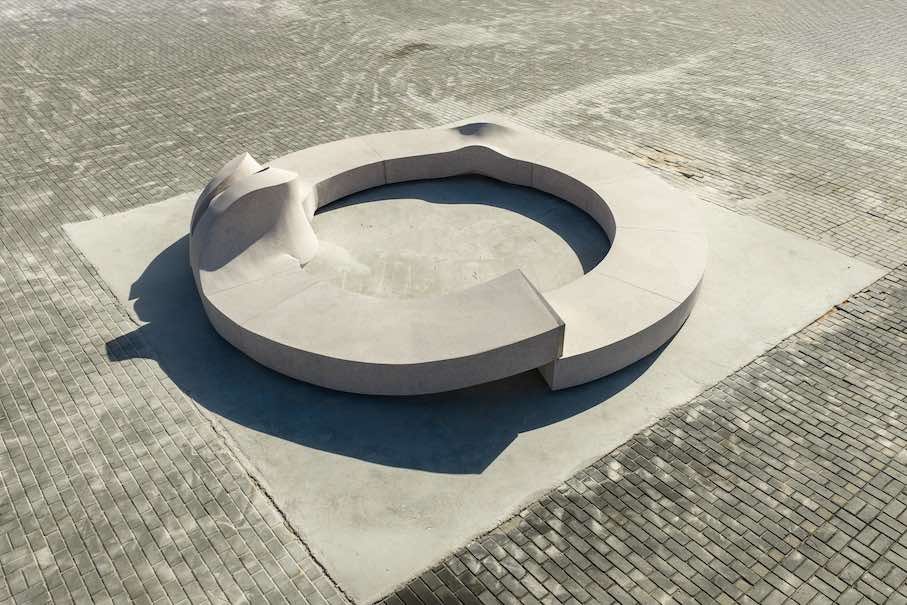
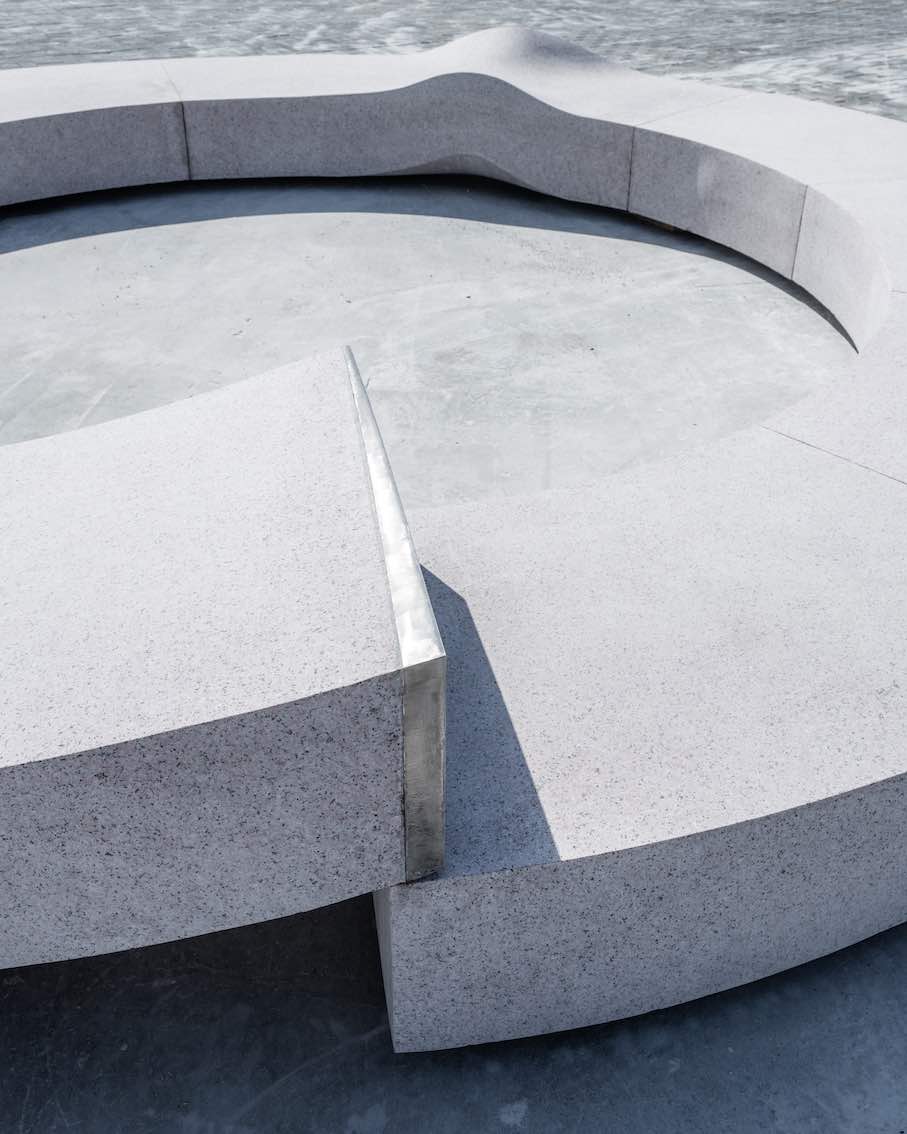 Shahryar Rezaei: “361°“ is a sculpture in Rose Gold granite and stainless steel that abstracts the gesture of an embrace or a closing arc. Its form references the ouroboros, a symbol of cyclical return, but departs from that closed logic by breaking the loop at a precise point. This rupture is the work’s conceptual core: by extending beyond 360 degrees to reach the361st degree, Rezaei proposes the possibility of exit from predetermined cycles of birth, repetition, and return. The additional degree represents the threshold between repetition and agency, the space in which a new set of conditions becomes possible. Functionally, the sculpture is designed as urban seating, integrated into the public space of Tahlia Street as an invitation for people to rest, gather, and converse within its curve. This participatory dimension is central to Rezaei’s practice: the work is not a passive monument but an active social structure. By combining the symbolic language of geometry with the practical grammar of street furniture, 361° operates simultaneously as a poetic statement and a tool for generating human connection.
Shahryar Rezaei (b. 1978, Iran) trained in the restoration of historical monuments and landscape architecture before developing an independent practice in public sculpture. His academic background in spatial history and material conservation informs a body of work that engages with the city as a site of lived exchange rather than monumental display.
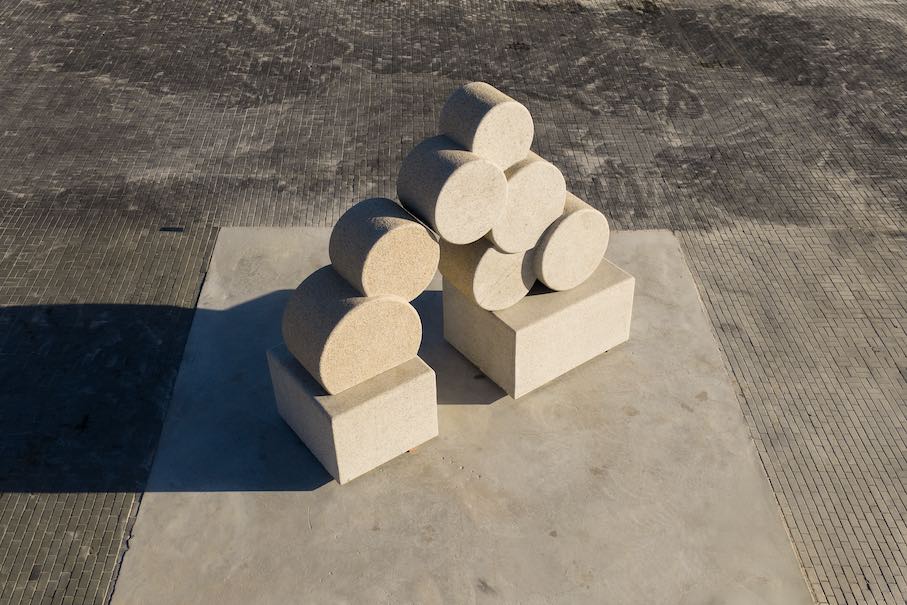
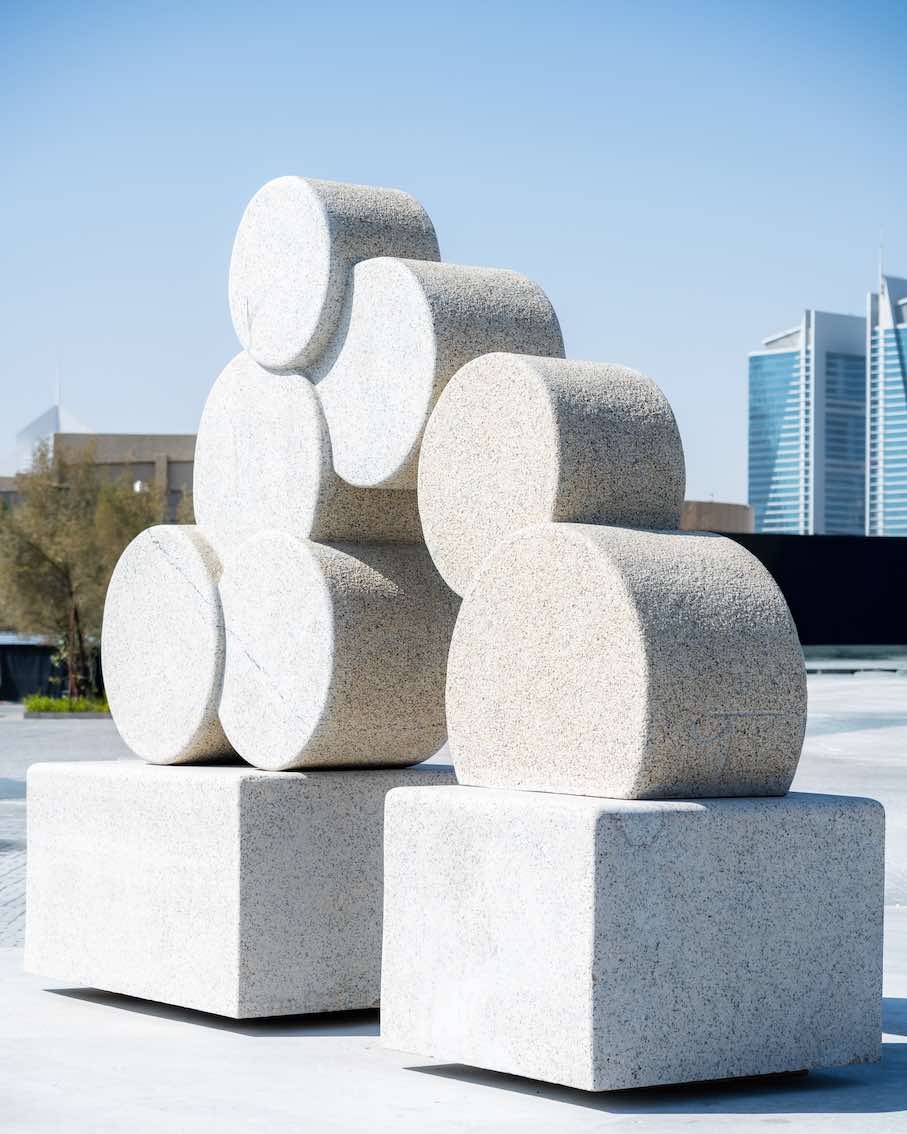 Carole Turner: “New Future“ is a monumental stone sculpture carved from granite, composed of two distinct masses shaped into clusters of vertical cylinders that rise from the ground and incline toward one another. The forms are derived from the visual logic of water bubbles in motion, spherical shapes stretched by their upward movement, and their convergence at a precise, narrow point near the top of the sculpture represents the filtration membrane central to the reverse osmosis process: the moment at which salt water is separated from its mineral content and becomes potable. This point of contact creates a large asymmetric void between the two masses, a space that generates visual tension and produces different compositional readings as the viewer moves around the work.
Carole Turner (b. 1957, United States of America) is based in Istanbul and works primarily in stone for large-scale public commissions. Her practice employs what she describes as “unchained geometry,” a formal language in which abstract, figurative, and architectural elements converge within structures defined by volume, mass, and formal restraint.
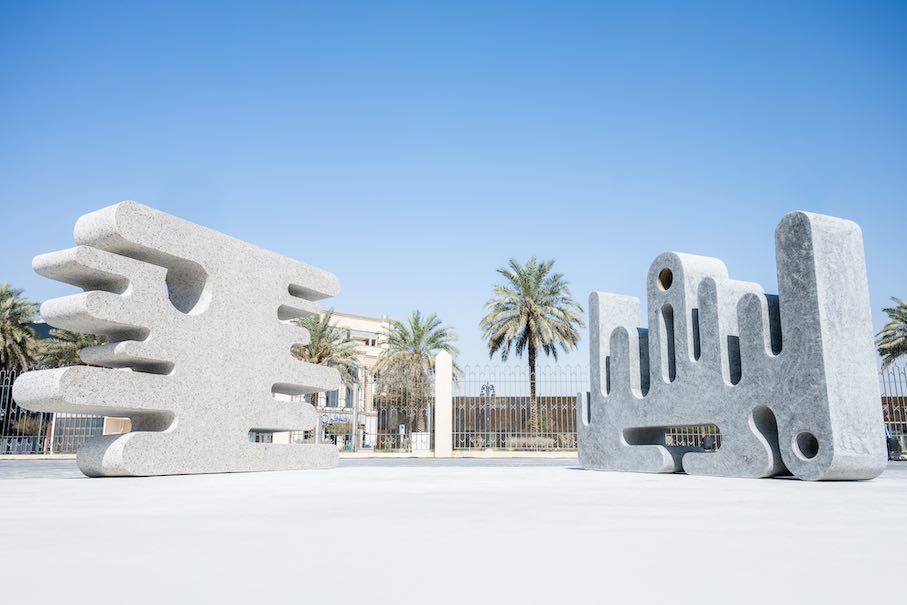
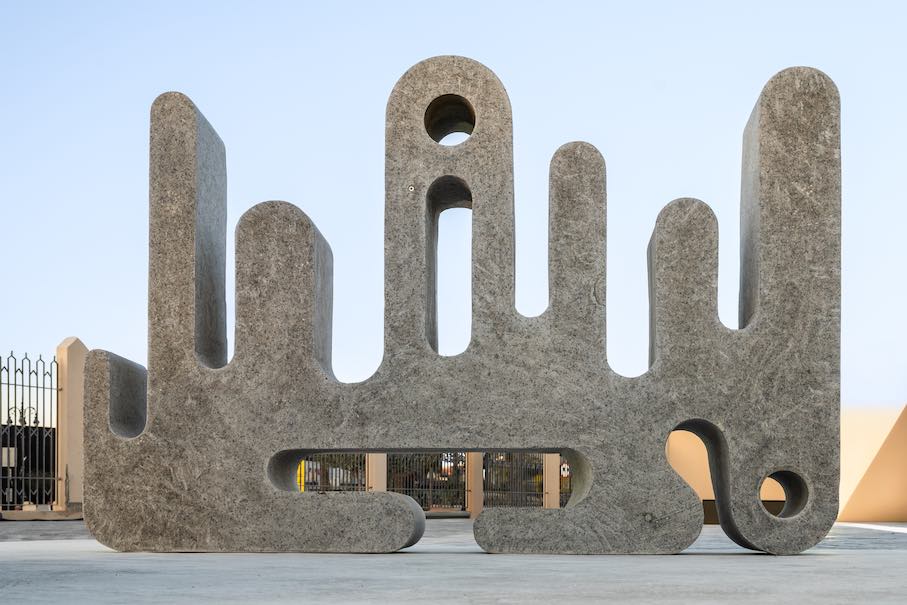 Hassan Qureshi: “Azm / Samu“ is a pair of granite sculptures that together constitute a sustained engagement with the relationship between cultural heritage and urban futurity. Azm, carved from Royal Rose granite, takes its formal inspiration directly from the decorative language of Pakistani Truck Art, a folk tradition characterized by its rhythmic patterning, chromatic intensity, and structural complexity. By translating these ephemeral motifs into the permanent medium of stone, Qureshi produces a monumental form that asserts the continuity of vernacular tradition within a contemporary public context. Samu, carved from Royal Gold granite, reinterprets traditional decorative forms through a modernist architectural lens, producing a soaring structure whose expanded form and vertical orientation are designed to register as a marker of vision and direction. Together, the two works propose cultural heritage not as a static inheritance but as a resource for generating new meaning in contemporary public space.
Hassan Qureshi (b. 1984, Pakistan) holds an MA(Hons.) from the National College of Arts, Lahore. He works as an artist, professor, and creative consultant, dedicating over a decade to the research of vernacular aesthetics in Pakistan, specifically the decorative traditions of Truck Art and the intricate camel hair trimming practices of the Cholistan Desert. Qureshi employs vernacular modernism and contextual design to translate these indigenous visual languages into large-scale contemporary sculpture.
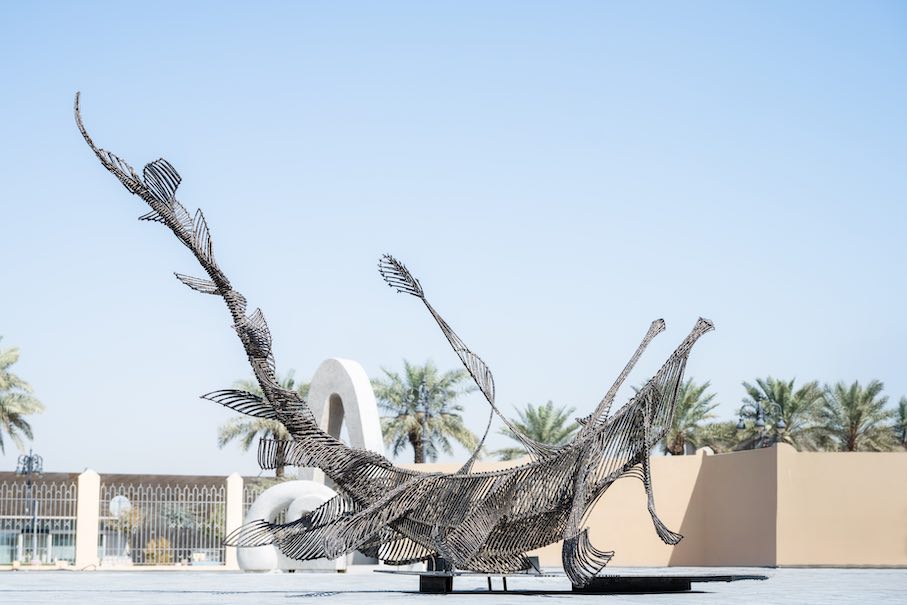
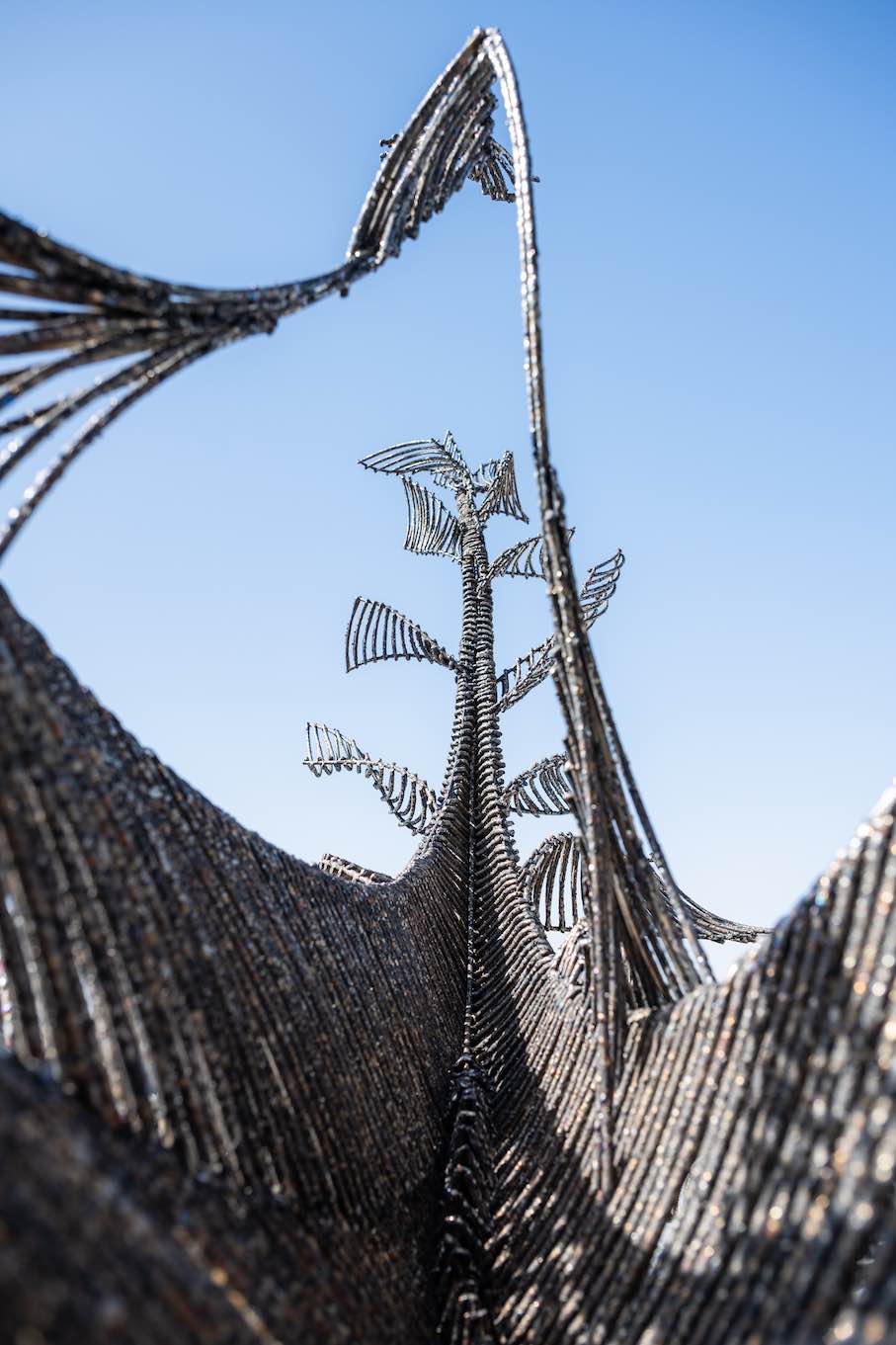 Nilhan Sesalan: “Reef“ is a large-scale stainless-steel sculpture that takes its form from the conceptual merging of two objects: a ship and a leaf. The ship represents the logic of navigation, protection, and human mobility; the leaf represents the organic network of natural systems, growth, and photosynthetic exchange. Their convergence in a single form produces a structure that is simultaneously skeletal and protective. The work draws on a specific historical reference to a ship discovered in Jeddah, dated to 1907, which is understood to have carried materials related to early water purification. Sesalan uses this object as a point of departure for a broader meditation on the intersection of destruction and continuity: the ship, itself a ruin, carried within it knowledge that contributed to sustaining life. The sculpture also draws on the biological function of coral reefs as hidden ecosystems, structures that support extraordinary biodiversity while themselves being highly vulnerable.
Nilhan Sesalan (b. 1968, Türkiye) studied Sculpture at Mimar Sinan University Faculty of Fine Arts, where she completed both her BA and MA degrees. She is the founder of the Tesisart artist initiative and has spent four decades working across an extensive range of materials, including ice, straw, bronze, stone, and stainless steel.
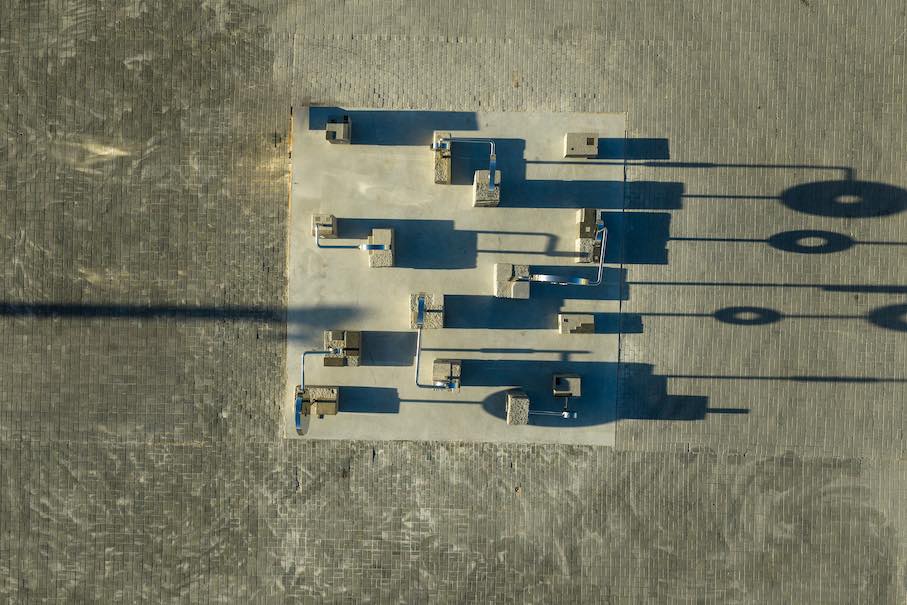
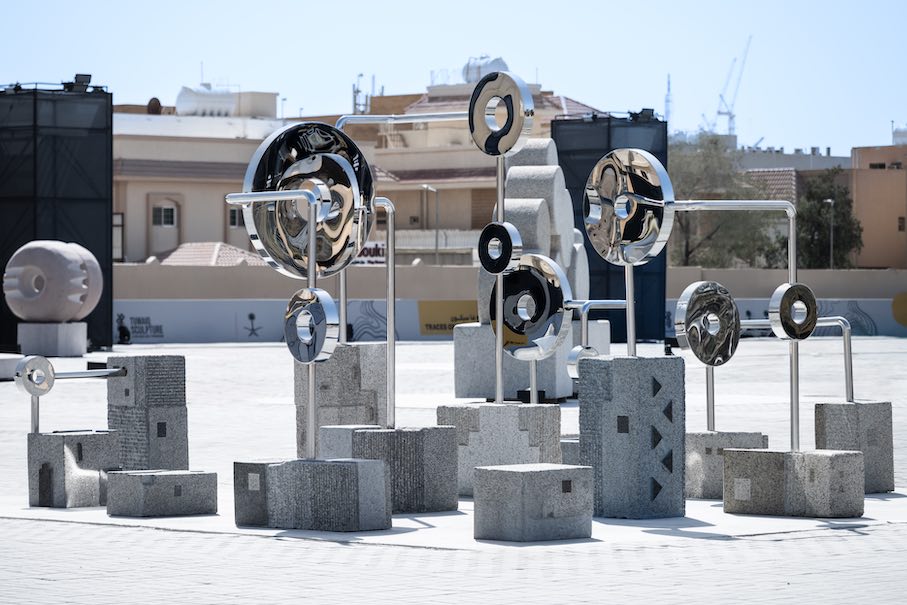 Maryam Turkey: “The Planets are Watching“ is a sculpture that structures a meditation on ethical becoming through the formal relationship between three distinct elements: granite cubes, stainless steel branches, and reflective spheres. The granite cubes serve as material carriers of geological memory, dense, ancient, and foundational. From these bases, stainless steel branches extend upward, tracing the directional logic of human intention and the pathways through which resources are channeled. At the ends of these branches, polished discs are suspended, their mirror surfaces reflecting the sky, the landscape, and the viewer. These spheres function as witnesses: passive, watchful presences that register the world around them. The work critiques a historical pattern of extraction, the use of natural resources without consideration for consequence, and proposes in its place an architecture of care: a mode of building that serves the conditions from which it emerges. By visually binding the grounded stone with the reflective disc, the sculpture imagines alignment with the planet as a structural necessity rather than an aspiration.
Maryam Turkey (b. 1994, Iraq) relocated to the United States as a refugee and studied at the Baltimore School for the Arts before earning a Bachelor of Industrial Design from Pratt Institute in New York, where she is currently based. Her practice is informed by her direct experience of the destruction of cultural heritage in Baghdad and her parallel observation of the construction and urban expansion of the United States.
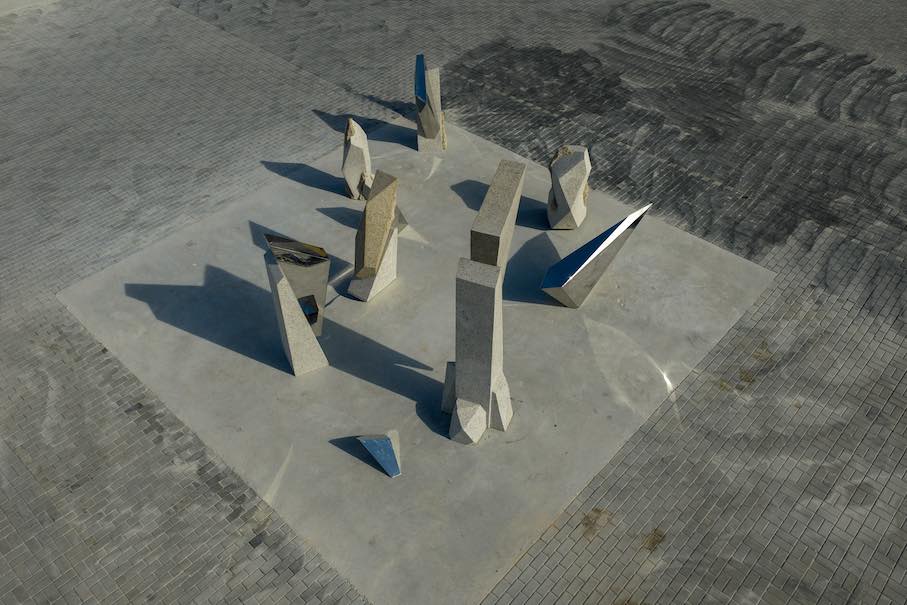
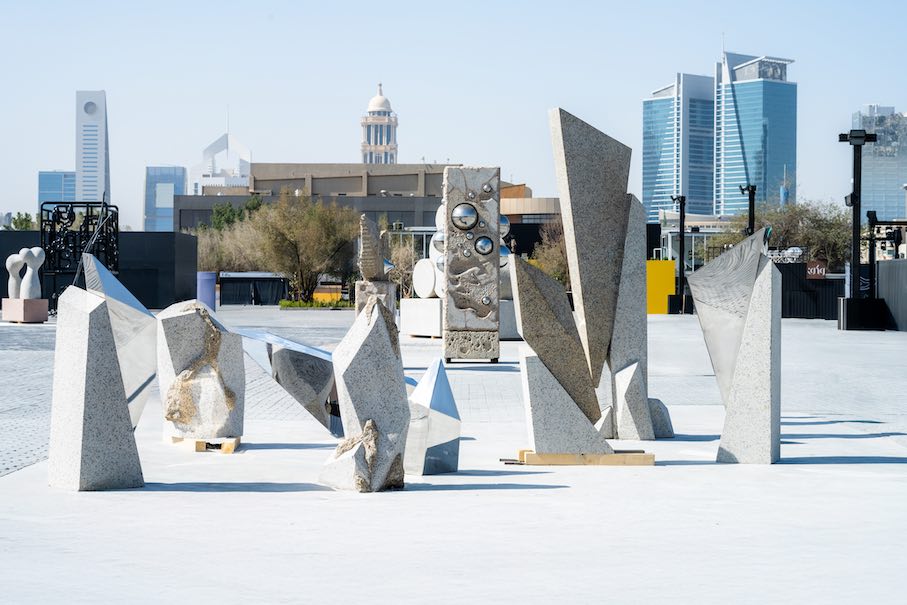 Mohammed Althagafi: “Coexistence“ is a sculpture that uses the material relationship between green granite and polished steel to examine the conditions of urban life. The granite elements, which vary in scale and orientation, carry associations of grounded identity and accumulated history, the deep roots of a place shaped by centuries of habitation and cultural formation. The polished steel components, by contrast, reflect the surrounding environment and introduce qualities of mobility, transparency, and openness to the external world. Coexistence engages with Riyadh as a site of negotiation, a city in which diverse histories, communities, and ambitions coexist in a shared urban space. The sculpture suggests that diversity does not require resolution into uniformity: it is itself the condition from which a more complex and durable harmony can be constructed.
Mohammed Althagafi (b. 1975, Kingdom of Saudi Arabia) holds a Master’s degree in Sculpture and works as an artist, curator, and member of cultural committees in Taif. His practice spans sculpture, metal forming, and contemporary visual art, and is rooted in a sustained engagement with the natural landscape of mountains and valleys as a source of formal and spiritual inquiry.
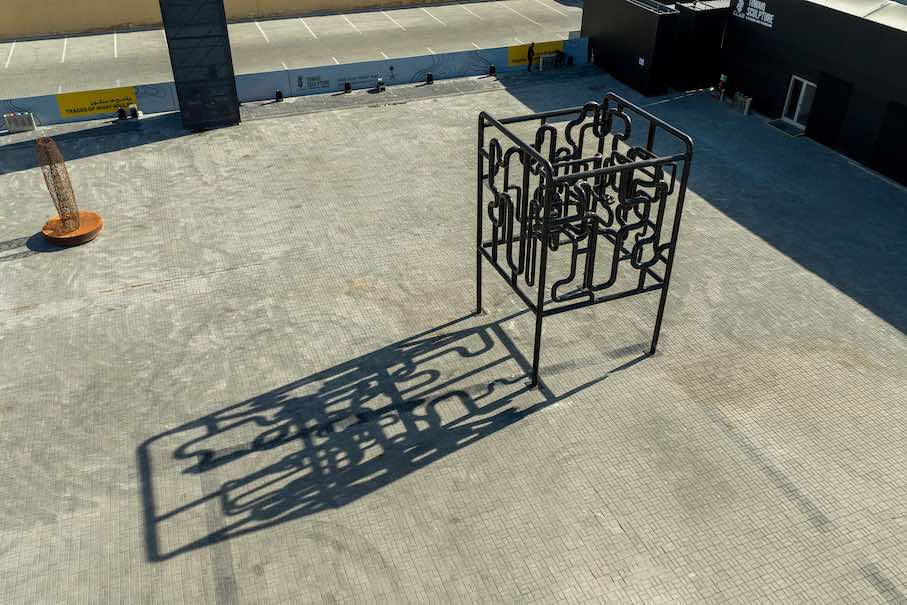
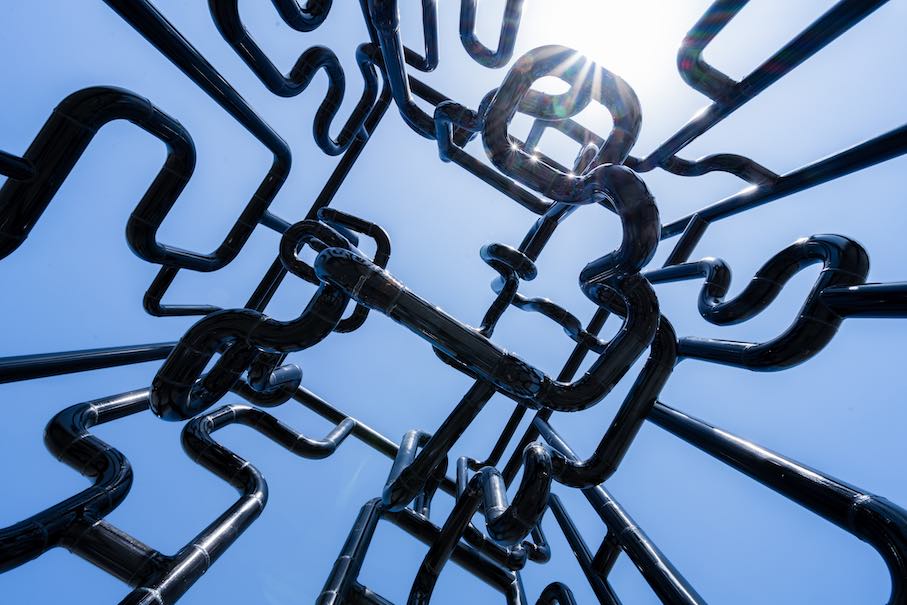 Saeed Gamhawi: “Veins of Life“ is an immersive installation in which steel pipes emerge from the ground and extend through the surrounding environment, creating a dense, interconnected web of structural forms. The work explores the parallel between urban infrastructure, water distribution systems, utility networks, and the biological organization of the human body, in which veins carry the substances necessary for life to every part of the organism. Gamhawi uses this structural correspondence to make visible the systems that normally operate below public awareness: the unseen networks of pipes and conduits through which water, energy, and connectivity are distributed across the city. The interlocking steel pipes create a visual metaphor for the interdependence of human communities and the natural systems from which they draw their resources.
Saeed Gamhawi (b. 1972, Kingdom of Saudi Arabia) graduated from the Institute of Fine Arts in Riyadh in 1990 and spent two decades in art education before transitioning to full-time artistic practice. He is a founding member of the Tasami Center for Visual Art sand a member of the House of Artists in Jeddah and has established Raseef Studio in Riyadh as a base for his practice.
 Abdulhameed Altukhaes: “Enriching Life“ is a sculptural concept composed of two related forms that draw their formal vocabulary from the intricate architecture of coral, underwater organisms whose branching, accumulative growth patterns constitute some of the most structurally complex formations in the natural world. Altukhaes uses this subject to engage with the relationship between human beings and their environment, proposing that the natural world offers not only material resources but a model of formal organization and beauty that can be translated into sculptural form. The work introduces a visual language connected to the memory of the sea: the layers, structures, and concealed dimensions of an underwater environment that holds its own systems of life and growth. By working with coral as a conceptual and formal reference, the sculpture creates a bridge between the human-constructed world above the surface and the largely unseen natural world below it.
Abdulhameed Altukhaes (b. 1988, Kingdom of Saudi Arabia) comes from an artistic family and began his practice in 2008. His practice is characterized by material experimentation and form-driven inquiry, guided by a philosophy that centers on the relationship between humanity and the surrounding environment.
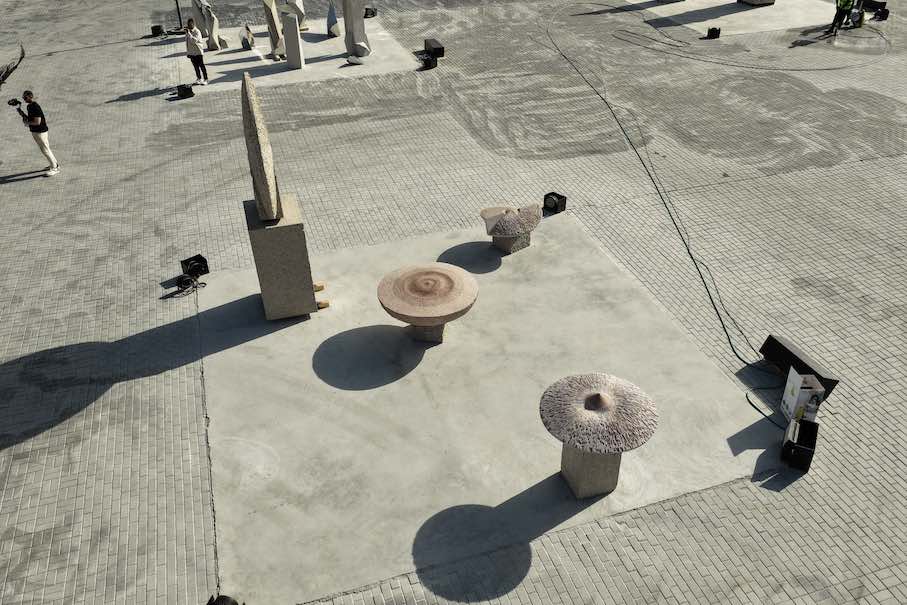
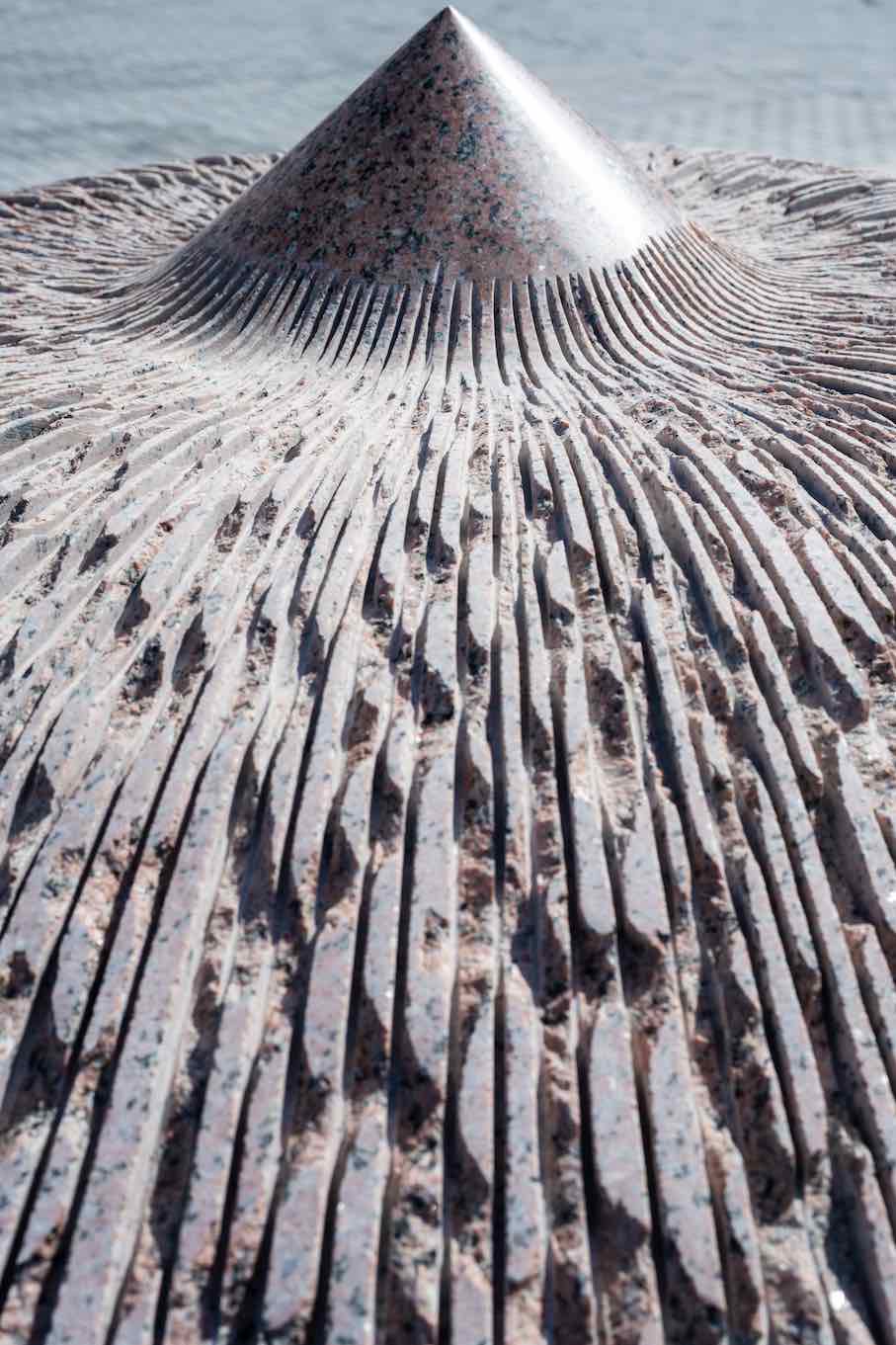 Jamal Abdulrahim: “The Sun and The Water Drop” is a stone sculpture that renders a transient natural event in permanent material. The work focuses on the precise moment of a single drop of water: its fall, its rebound, and the concentric circles it produces on a surface. The sculpture presents movement as a form of visible time, suggesting that the trace left by an action carries as much significance as the action itself. The work is characteristic of the artist’s broader approach to stone carving, in which hard material is shaped to suggest fluidity and internal rhythm.
Jamal Abdulrahim (b. 1965, Bahrain) adopts a practice that encompasses painting, printmaking, and stone carving. His career began in 1987 with a group exhibition at Al Hala Club and expanded through solo exhibitions at Bahrain Arts Society and Abu Dhabi Cultural Foundation. Abdulrahim is the founder of one of the Gulf’s most significant printmaking workshops and has represented Bahrain innumerous international cultural initiatives, including the Arab – Chinese Friendship Park.
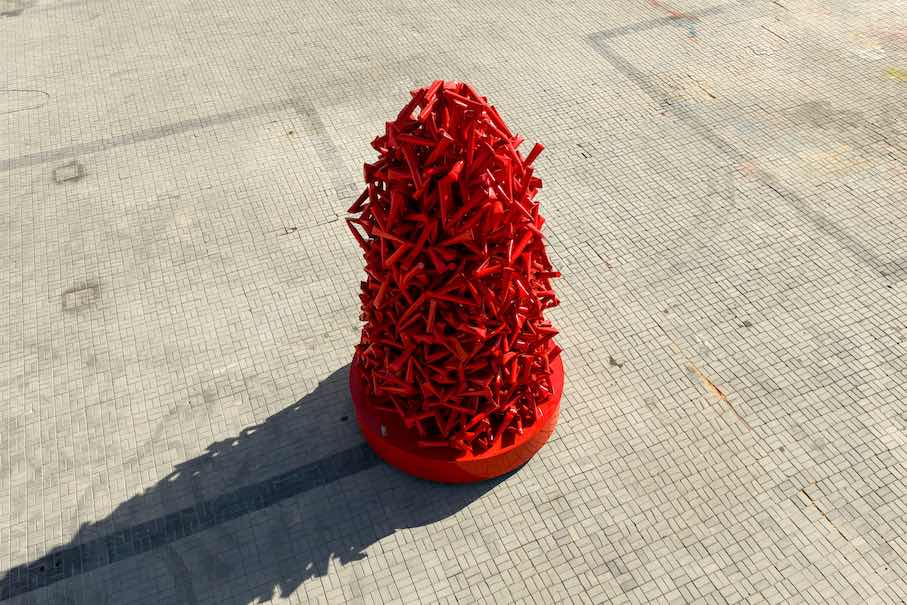
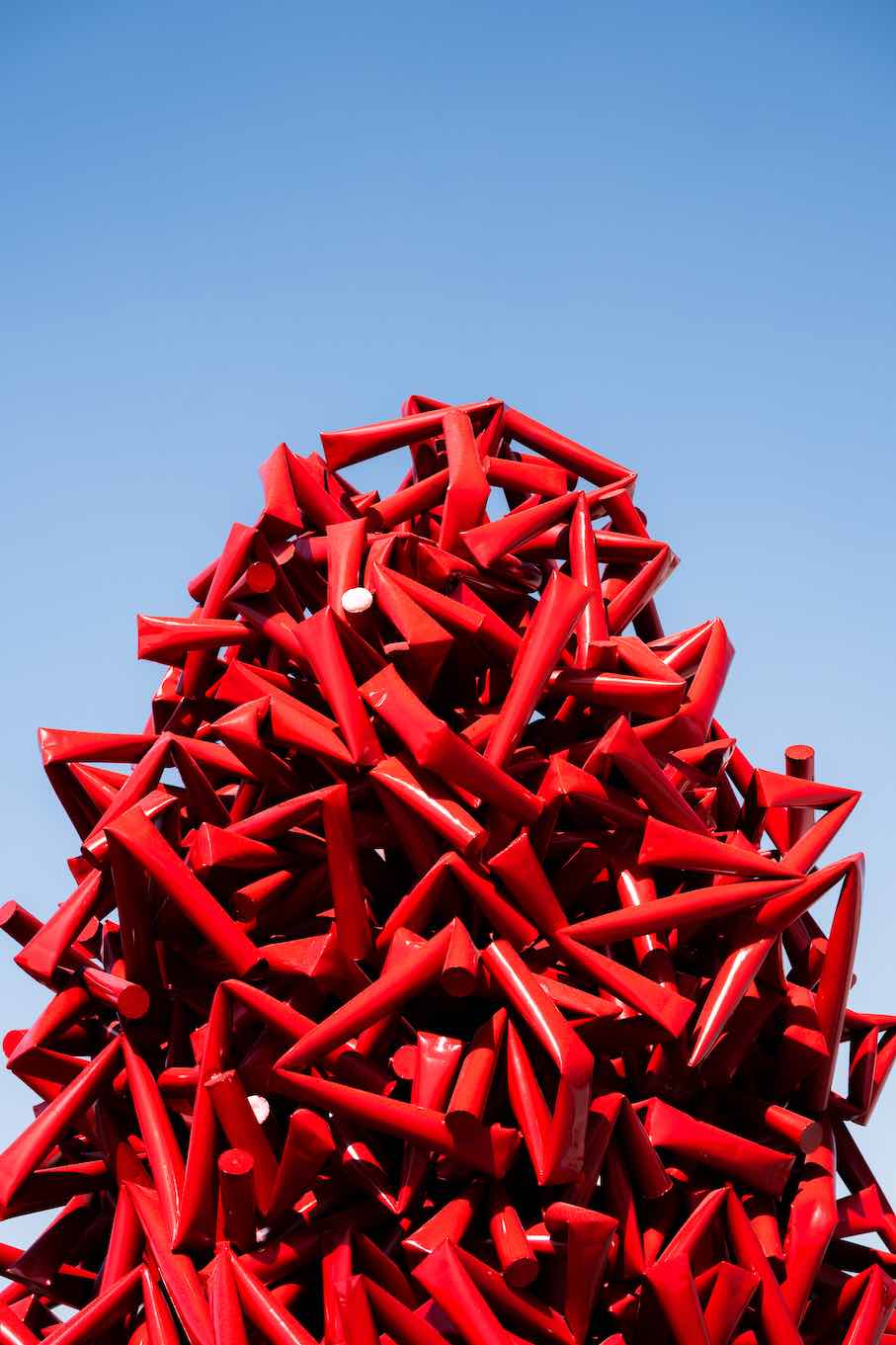 Saddiek Wasill: “Glory“ is a sculpture that uses accumulated metal and industrial materials to explore the relationship between the human figure and the physical residue of industrial activity. It addresses the question of what remains when the productive function of materials has been exhausted: the forms that accumulate in the margins of industrial systems, and the human presence that continues to inhabit and navigate those margins. Wasill brings to this subject an attentiveness to the properties of matter and to the processes through which substances are used, transformed, and left behind. The work engages with ecological and social dimensions simultaneously, proposing that the accumulation of industrial waste is not a peripheral concern but a condition that shapes the environments and opportunities available to human life.
Saddiek Wasill (b. 1973, Kingdom of Saudi Arabia) holds a Master’s degree in Soil Science from King Abdulaziz University. He serves as Head of Initiatives at the Holy Capital Municipality in Makkah, combining institutional responsibility with a prolific artistic practice spanning over three decades. Wasill is a significant figure in the development of metal and scrap art in the region, working with iron pipes, industrial debris, and metal offcuts as primary materials.