 Stone-Ideas.com


On the plateau of Dossone della Melia in Calabria, a more than 2000-year-old fortification with weapon remains was discovered
A line of stones, thickly overgrown with moss and located at the southern tip of Italy, is probably a remnant from the military battles during the slave revolt of Spartacus more than 2000 years ago. It is located in a dense forest on the plateau of Dossone della Melia and was built by the Roman commander Marcus Licinius Crassus to cut off the rebels from supplies and force them to make a militarily disadvantageous maneuver.
Researchers from the University of Kentucky have found remains of Roman weapons along the stones in the forest that suggest a battle in 71 BC. This is consistent with the history books.
The discovery of the stone line was pure coincidence. Paolo Visonà, Ph.D., archaeologist and adjunct associate professor, reports on the website of the University of Kentucky,
that he had given a lecture in a Calabrian town and that afterwards two environmentalists came to him and showed him cell phone photos of the strange structure in a nearby forest: “They had no idea what it was, but they said it was at least 100 meters long. When I saw the photos, I immediately recognized the significance.” They had no idea what it was, but they said that it was at least 100 meters long. When I saw the photos, I immediately realized their potential.”
The Greek historians Plutarch and Appian both reported on such a fortification. It consisted of a rampart of stones and a ditch in front of it.
Plutarch even spoke admiringly of the achievements of the Roman pioneers in terms of the short construction time and the enormous strength, as mentioned on a page of the Italian Ministry of Culture.
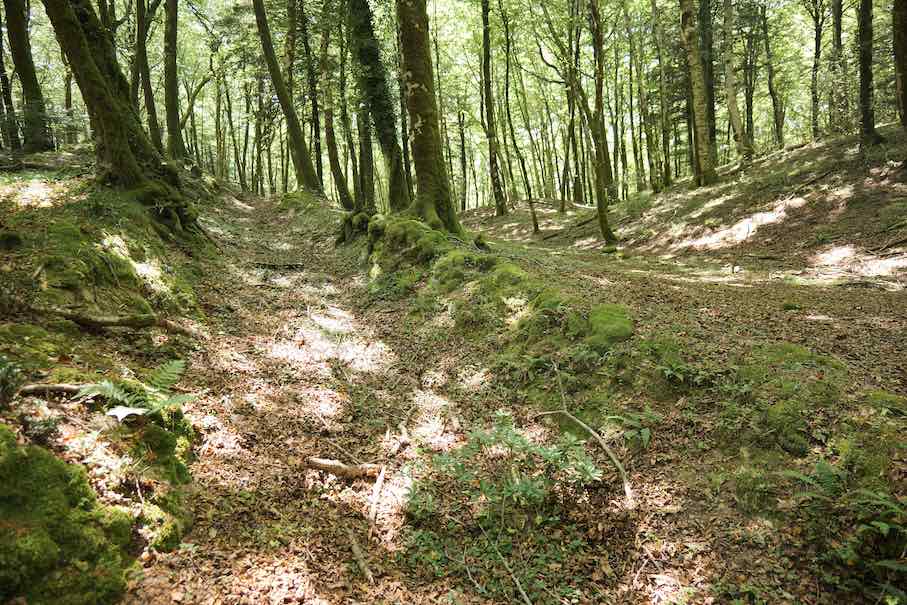
The stone line is now 2.7 km long. Investigations with ground-penetrating radar and other modern methods show what it once was.
Spartacus had tried to reach Sicily with several thousand rebels. Winter was approaching and the island was one of Rome‘s granaries.
However, the plan failed: the pirates who were supposed to ferry the rebels across the Strait of Messina took the agreed pay, but then made off.
It was not possible for the rebels to simply march north along the Calabrian coastal road and find supplies there. The coast had remained in the hands of the Roman troops.
A breakthrough to the north was only possible via the Aspromonte Mountains, nowadays a national park in the center of Calabria. Our screenshot of the national park gives a rough idea:
Back then, this was not a remote area like it is today. The important land connection from the Adriatic Sea on the east side of Italy to the Tyrrhenian Sea on the west side and vice versa ran over the passes.
From the plateau of Dossone della Melia there were connections to the north.
In record time, Crassus had his troops set up a blockade of the possible escape route or supply corridor to the north.
“The wall is a barrier due to its topographical position and other factors, such as the lack of gates,” Andrea Di Gennaro, archaeological director of the excavations on the Italian side, is quoted.
Apparently, the rebels‘ situation was already so bad that they ran up against the rampart and ditch. “It is a quiet place today, except for an occasional cuckoo bird,” says George Crothers, associate professor in the Department of Anthropology of Kentucky University, “but it is easy to imagine Spartacus’ army of slaves clashing with Roman legionaries in their desperate attempt to break through the Roman lines.”
The chroniclers report on the further course of events after the decisive battle further north in Campania: Crassus had 6,000 wooden crosses erected along the road to Rome, where the captured rebels were executed.
Ministry of Culture, Italy (Italian)
Photos: Ministry of Culture, Italy
(30.07.2024, USA: 07.30.2024)