Stone-Ideas.com


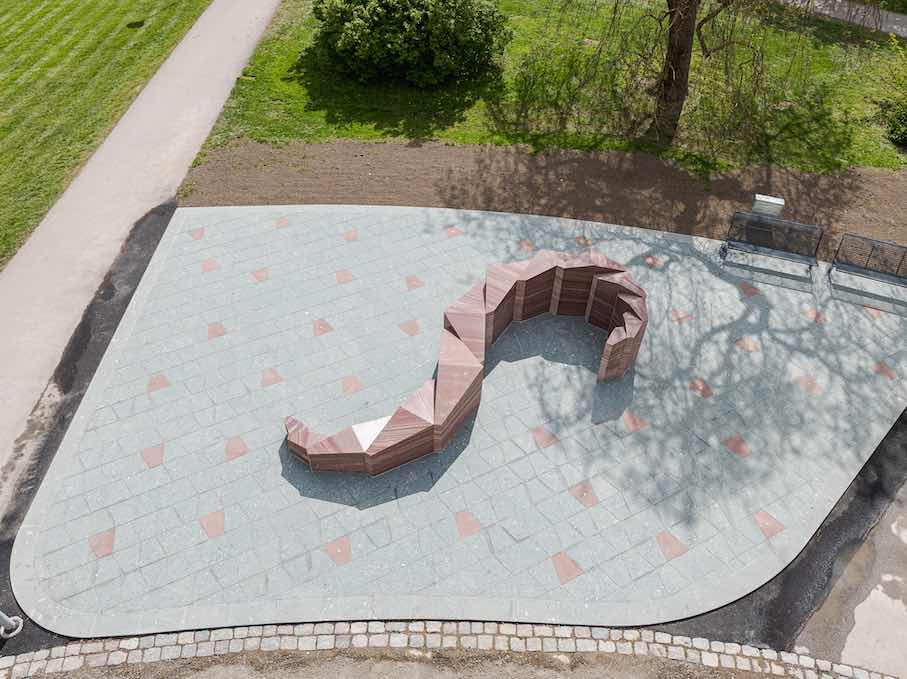
To commemorate the end of the Second World War II 80 years ago and civic engagement in Sweden against the ideas of the National Socialists, a striking monument made of bright red stone will be inaugurated in the city of Norrköping on May 08, 2025. It was created by the artist Maria Miesenberger, her father is from Austria, and its shape symbolizes movement and resistance which ultimately leads to protection for all.
At the heart of the commemoration are three little-known citizens from the city who stood up against totalitarianism and for democratic values during World War II. Sweden was neutral at that time and was under great pressure from the overpowering Germans. The historian Johan Perwe had recorded the work of these people in a book, which the sponsor of the artwork learned about, and so his donation to the municipality was implemented in the memorial entitled “Memory Unfold – Turning Point for Tolerance” (Från glömska till minne – vändpunkt för tolerans).
It is about the writer and politician Elsa Alkman, the women‘s rights and peace activist Betty Olsson, and the priest Sam Thysell. They lived from around 1870 until the 1950s, were active in helping refugees and fighting for women‘s rights, also were close to the resistance in the country and were characterized by great social commitment.
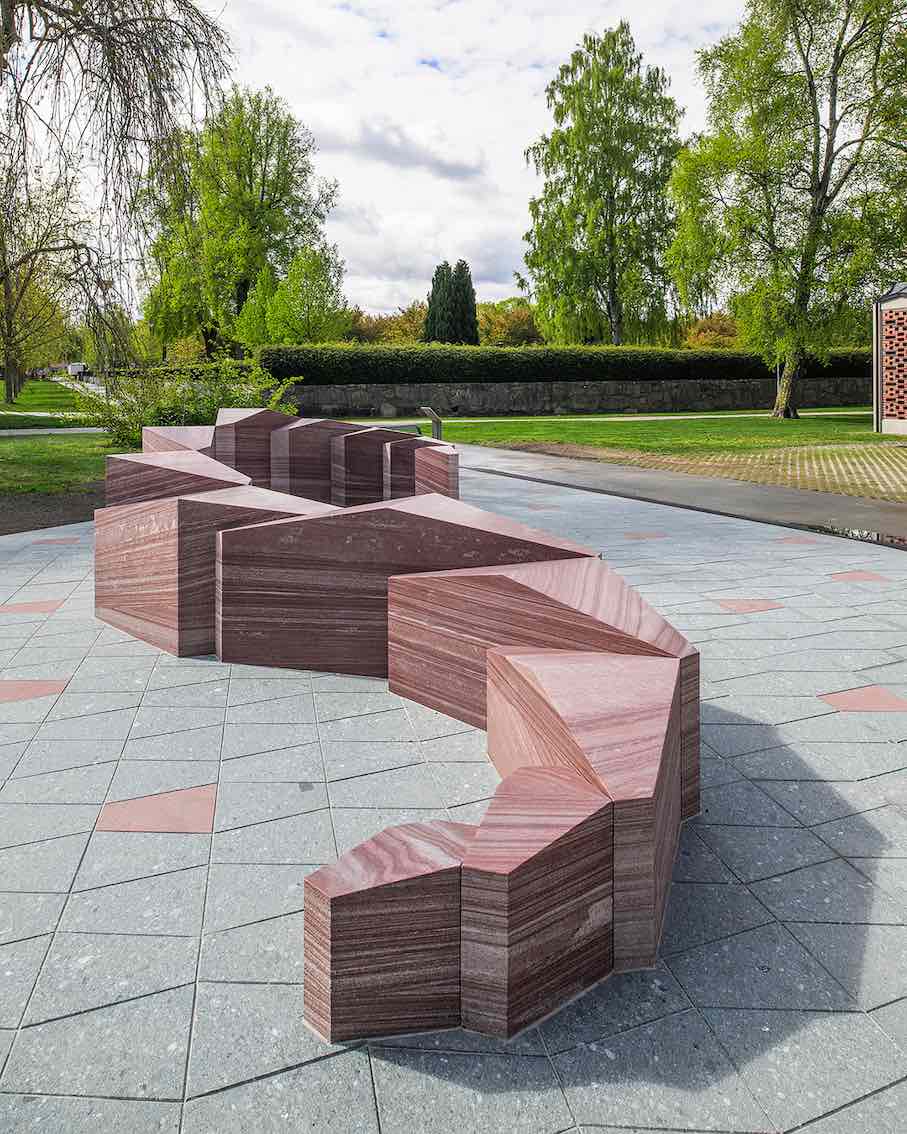 The artwork consists of 13 individual parts with the same geometric shape: They begin small and close to the ground as a wiggly line, grow and suddenly seem to turn all their strength in one direction. They grow taller and more massive until they finally form a semicircle and wrap themselves protectively around 120 luminous dots on the ground.
The stone is Älvdal quartzite from Sweden with a striking red color. The surfaces of the stones are finished differently, so each has a different touch or, for example, reflects the light points from the surrounding terrain individually. The distinctive veins in the material also make the pieces stand out clearly from one another.
The artist comments: “I think we are all the same, even if we may be different on the surface, so to speak.” She hopes that the sheer mass of the stone blocks will act as a force for the viewer: “The monument should be a place of encounter, contemplation, inspiration, play and reflection.”
The paving with green Salvan gneiss from Switzerland gives the memorial a clear distance to the surroundings in the Volkspark (Folkparken) next to St. Matthew’s Church.
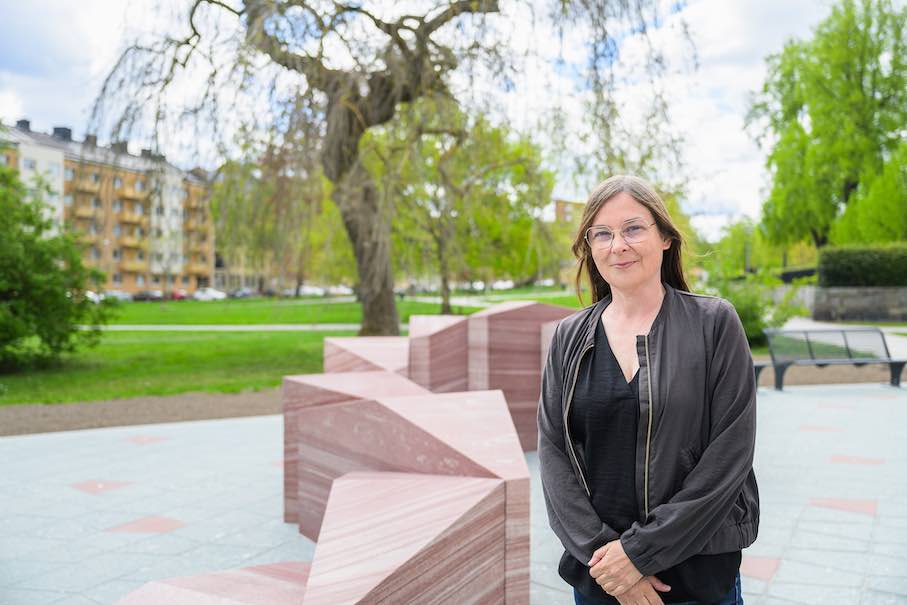
Incidentally, sponsor Michael Cocozza, whose parents came to Norrköping from Italy in the late 1940s, grew up nearby. Now 64 years old, he is a building contractor, city politician and philanthropist, for example with one of the highest donations ever received by a Swedish university.
A report in the daily newspaper “Norrköpings Tidningar” (Norrköping Times) informs that in Sweden, too, the costs have to be calculated before a city council accepts such a donation: “The sculpture costs the municipality between 5,000 and 10,000 Swedish kronor (just under €500 and €1,000) a year to operate, which also includes the removal of graffiti and other maintenance work.”
The chair of the city council, Anna Sotkasiira Wik, is quoted in a press release: “Democratic values should not be taken for granted, as we worldwide see a trend in an opposite direction. This sculpture reminds us to take nothing for granted and never to give up.”
Norrköping (Swedish)
Älvdal-Quartzite, Wasasten
Salvan-Gneiss, Capinat SA
Photos: Anders Ristenstrand