Stone-Ideas.com


“ROADto2050 – Roteiro para a Descarbonização do Setor da Pedra Natural” is the name of the Portuguese natural stone sector’s major climate project. Translated, it is about the decarbonization of the country’s stone companies, which have a long tradition and whose companies also compete on the global market with high-quality designer end products or large-scale projects. The program is organized by the national association Assimagra and funded with €500,000 from the European Union’s PRR program.
The term “decarbonization“ here means switching to environmentally friendly energy sources and reducing energy consumption in the process. This requires many companies to undergo fundamental technological modernization – this is also explicitly stated as an objective in the EU program descriptions, for example: “The green transition should also strengthen the international competitiveness of companies; it should also achieve a just and fair transition to the climate-neutral economy of the future.“
Other EU objectives include economic growth and additional, high-quality jobs.
The Road to 2050 was launched in Portugal’s stone sector in October 2023. It began with an inventory – firstly, of the points where energy is consumed in quarries and factories, and secondly, how this can be improved. Events were held in various sector centers in April 2025, including Vila Viçosa, Porto de Mós, and Marco de Canavese. At the same time, a questionnaire was posted online to assist with the inventory.
The goal is to identify effective levers for change and provide companies with practical assistance.
The final results were presented in September 2025. At the heart of the project is a website (in Portuguese) that summarizes the available knowledge. Various materials for the job training of company employees can be downloaded, for example. Entrepreneurs will also find a digital tool that they can use to estimate the CO2 emissions of their business.
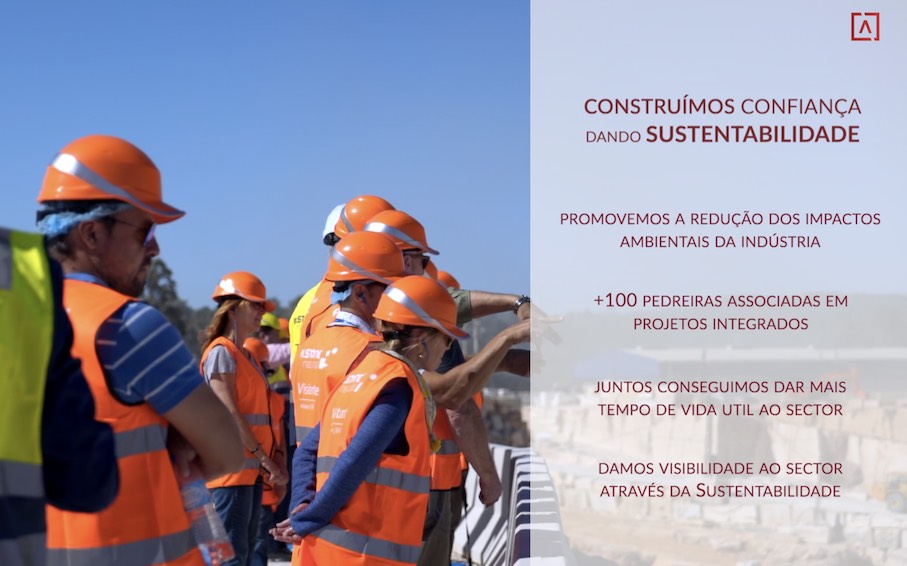
One example is the program for the rehabilitation of abandoned quarries, for which the Minister for the Environment and Energy has provided €3 million. Municipalities with such properties can apply for funding. As with decarbonization in general, this is not just about restoring ecological balance on degraded land.
The transformation of these problem areas is explicitly part of the program, as described on the Road to 2050 website: “Municipalities shall plan innovative solutions for reusing the land, whether for new industrial and commercial applications or for leisure and sustainable tourism.“
The push for climate neutrality can be traced back to the Paris Climate Conference in December 2015. At that summit, 195 countries, including all EU member states, committed themselves to tackling climate change by transforming their economies to achieve climate neutrality. The central goal was to limit global warming to well below two degrees Celsius, and ideally to just 1.5 degrees, compared with pre-industrial levels.
To put that into perspective: the long-term average global temperature difference between a warm period and an ice age is only about four degrees Celsius, making 1.5 degrees a far from trivial threshold.
In 2019, the European Commission introduced the “Green Deal,“ an ambitious roadmap for a climate-neutral Europe. By 2030, greenhouse gas emissions are to be cut by at least 55% compared with 1990 levels, with net-zero emissions targeted for 2050. Achieving “net-zero” means that unavoidable emissions in one sector can be offset by reductions in another, ensuring that the economy can continue to grow without being throttled by environmental constraints.
Road to 20250 (Portuguese)