 Stone-Ideas.com


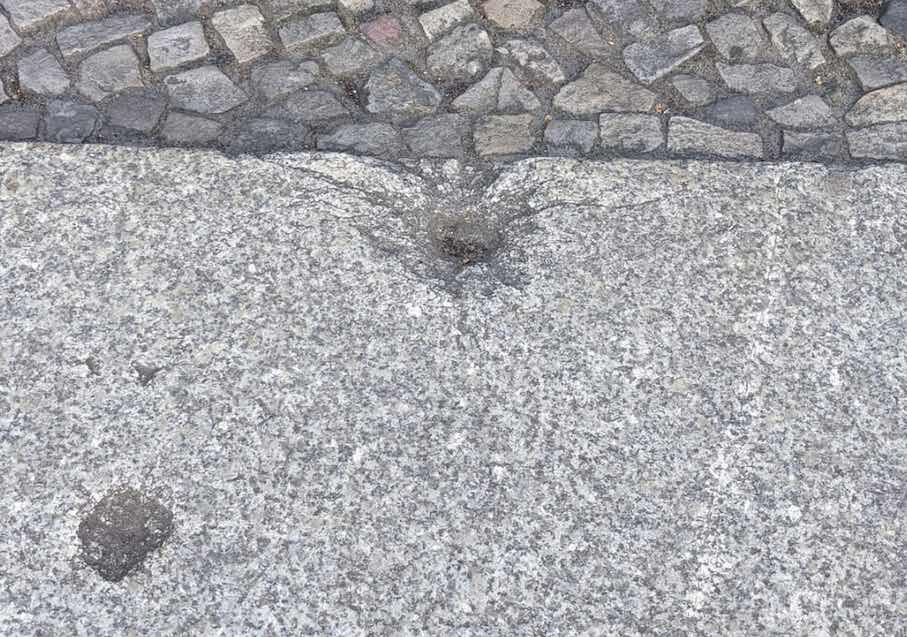
Granite is an extremely hard material and is synonymous with resilience. Therefore, the question of the origin of the numerous damages found in the large stone slabs on the sidewalks of European cities is a valid one. In Berlin, Hans Greiner has been investigating this question for several years with scientific rigor and a meticulous attention to detail.
The general answer to the origin of certain holes in the slabs is clear: They date back to World War II, at least most of them. Historically speaking, they are the last remnants of the mass slaughter: While the damage to building facades is now only visible in a few places, the holes on many sidewalks have gone unnoticed and remained intact.
Hans Greiner, a trained electrical engineer and most recently head of a software quality assurance company, is investigating the details. He has set high standards for his hobby: He sees his work as a kind of archaeology, but instead of digging for new insights, he reads them in the granite slabs on Berlin’s sidewalks.
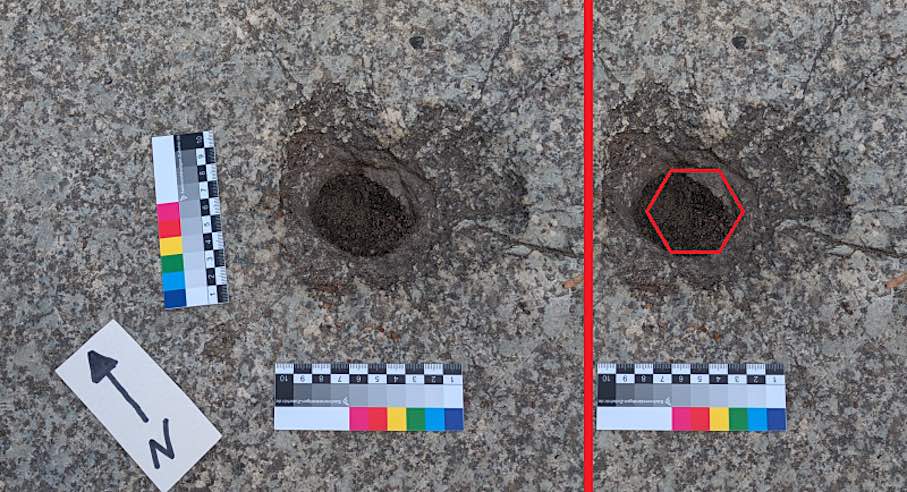
For example, for several years he has been preoccupied with the question of where the vertical holes in the slabs actually come from – did soldiers perhaps stand the thick blocks of stone upright during street fighting to take cover behind them?
And also: Where do the almost perfectly hexagonal edges of some of these holes at the top come from?
Hans Greiner’s answer is: These holes are from the stick-type incendiary bombs that were dropped in large numbers on cities in Nazi Germany toward the end of the war. Greiner researched the archives and, based on the 1943 air raid warning “Enemy dropping incendiary bombs,“ uncovered details: The bombs were intended to pierce the roofs of houses and set fire to the wooden attics. Presumably, a large number of them, falling vertically from above, struck the sidewalks.
These bombs were hexagonal, 54,5 cm high, and weighed only 1.7 kilograms. At the bottom, they had a solid steel head of the same shape, which stabilized the bomb as it fell and triggered the detonator upon impact.
Joseph Weizenbaum, the well-known computer science dissident at the Massachusetts Institute of Technology, once made a pertinent remark about such sophisticated military technology during a lecture at the Berlin Technical University: One can only shake one’s head at how much creativity and ingenuity people, both past and present, have invested in military equipment, only to use it to kill other people.
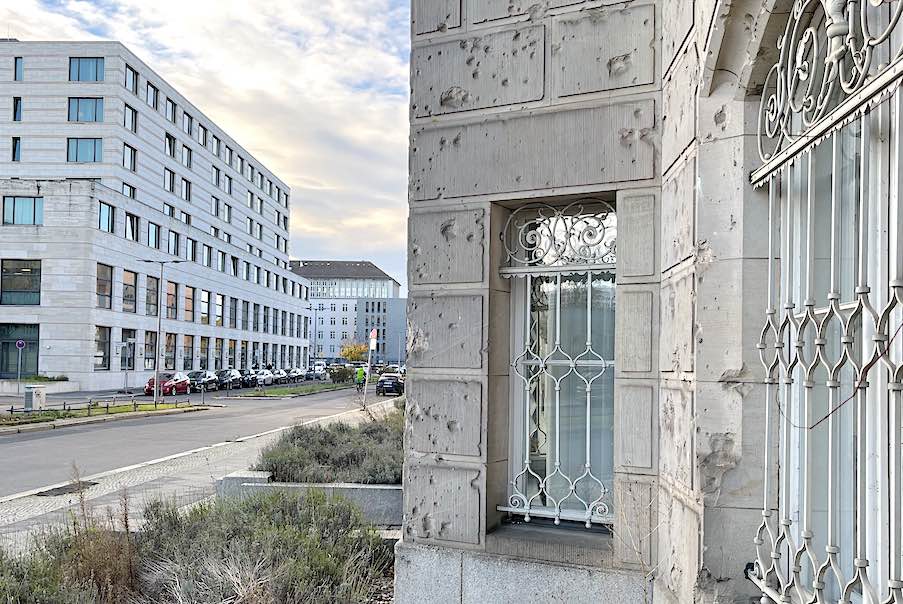
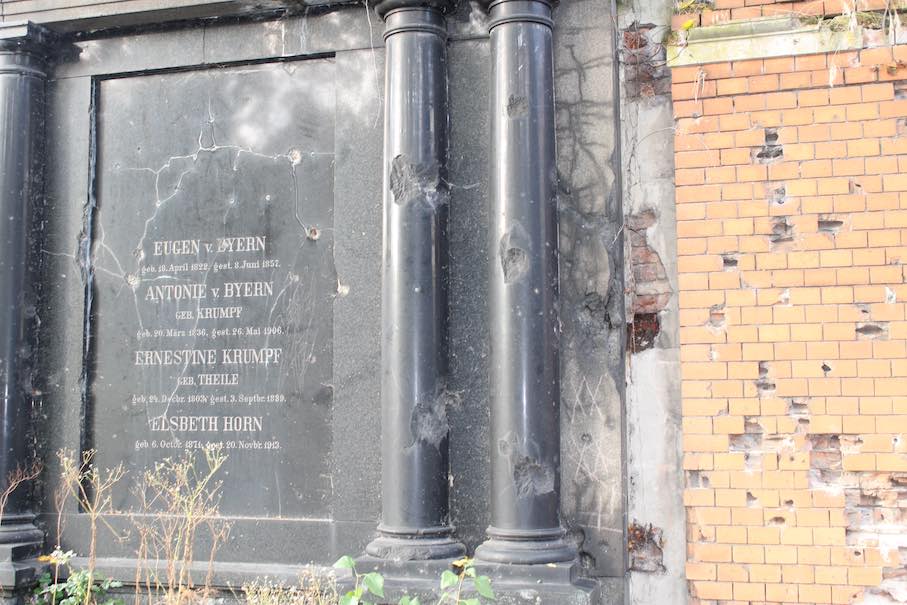
Greiner maintains a website in German about the traces found in the stones. There, the find sites in Berlin’s city center are marked on a map.
His analyses sometimes go into great detail: For example, he is also interested in a typical question archaeologists ask: whether an artifact is actually still in its original location.
One indicator for Greiner is so-called continuation damage: If a slab, for example, shows certain traces at its edge, these should actually continue onto the next slab.
He sometimes stumbles upon interesting things in the archives when researching such questions, for example, regarding everyday life after the war: There was a time when people moved the paving stones from side streets to the main streets – because they had nothing but what was still there and usable.
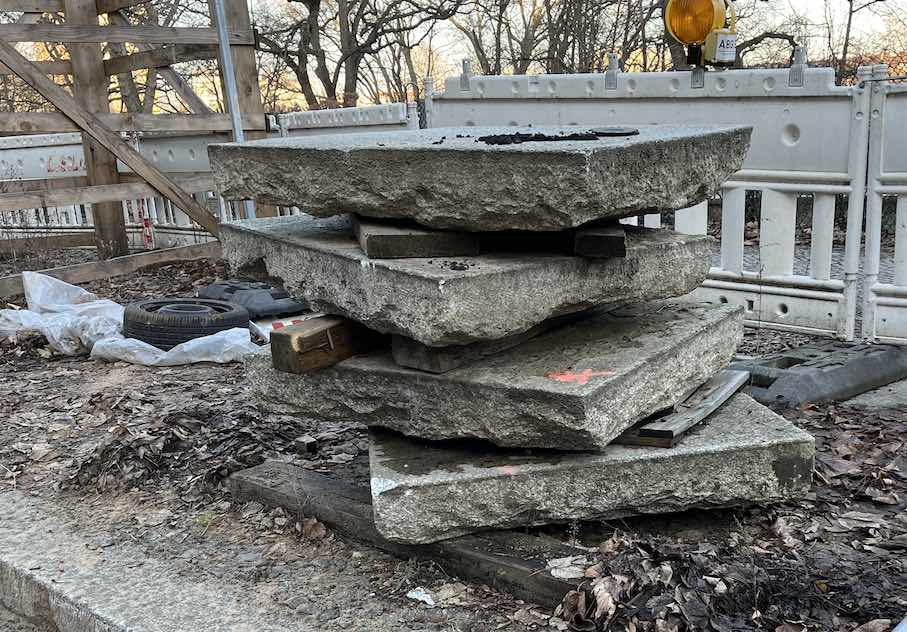
Greiner’s ability to pursue his observations is connected to a Prussian peculiarity, namely the “pig’s bellies“ (Schweinebäuche). This is the common term for those thick, large, and heavy granite slabs that have been discussed throughout. They get their name from their shape and laying pattern: They were’’t simply laid on sand but embedded in it – the easiest way to do this is to give them a curve on the underside, just like a pig’s belly.
This method of laying also ensures that the paving stones don’t slip and that they survive the winter in place: During frost, they rise up along with their bed, and in spring, everything settles back down. Greiner quotes Dr. Gerda Schirrmeister, geologist and city guide in Berlin, and a specialist in all matters relating to natural stone in German cities.
Want more stone stories?
The paving with pig bellies in Berlin is said to have originated when the Prussian king visited the wine merchants Lutter & Wegner, who had paved the courtyard in front of their shop with natural stone. He liked it and ordered other businesses to follow suit.
One can be sure there was an outcry about the cost, just as there would be today. The king’s solution was clever: he decreed that the money from the dog tax should be used for this type of beautification in his cities.
Hans Greiner (German)
Dr. Gerda Schirrmeister
(Mail)