 Stone-Ideas.com


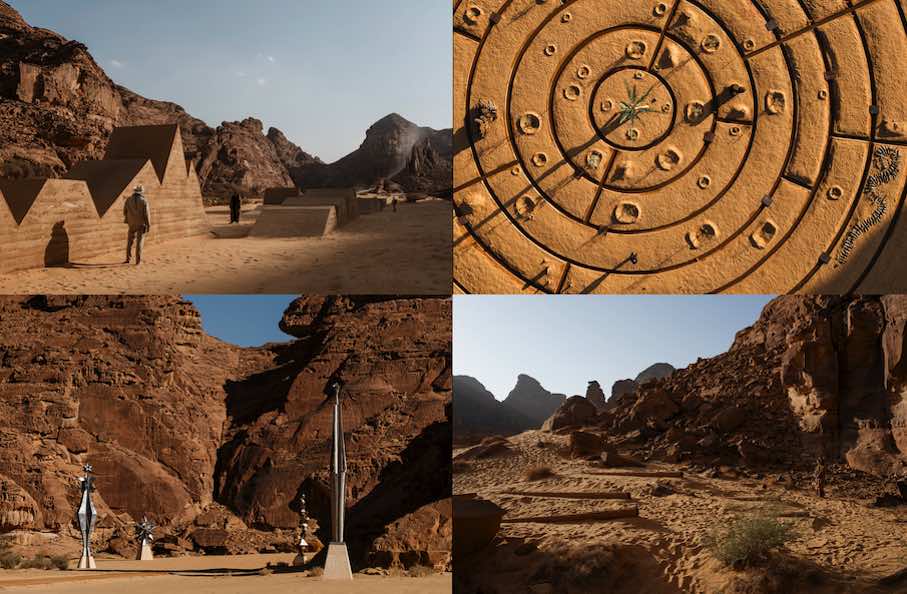
Desert X Al-Ula has opened its fourth edition, on view through February 28, 2026, with new commissions by leading multigenerational artists. The exhibition is curated by Wejdan Reda and Zoé Whitley, with founding Artistic Director Neville Wakefield and returning 2026 Artistic Director Raneem Farsi.
This landmark edition brings together eleven artists whose diverse and monumental works reflect a wide spectrum of ideas, materials, and traditions.
From monumental kinetic sculpture to sound-based explorations above and below ground, each commission is deeply rooted in relationships to Saudi-Arabian Al-Ula’s dynamic and distinctive environment. The participating artists are: Sara Abdu, Mohammad Alfaraj, Mohammed AlSaleem, Tarek Atoui, Bahraini-Danish, Maria Magdalena Campos-Pons, Agnes Denes, Ibrahim El-Salahi, Basmah Felemban, Vibha Galhotra, and Héctor Zamora.
 Mohammed AlSaleem: “The Thorn, AlShuruf Unit, The Triangles, Flower Bud, and Al Ahilla.” The artistic ambition of Saudi artist Mohammed AlSaleem extended beyond the two-dimensional surface of the canvas toward an exploration of the third dimension. Sculpture and monumental form became a central component of his artistic practice from the 1960s onward. During his early years, AlSaleem produced a number of sculptures in wood and white plaster, taking the form of figures and abstract compositions that reflected his early engagement with mass, form, and spatial construction through a modernist, environmentally rooted visual language…
The curators’ theme is inspired by the words of visionary Lebanese-American writer Kahlil Gibran, who once described dreams as “Space Without Measure.” Drawing on Gibran’s meditations on possibility, perception, and the boundless nature of the human spirit, Desert X Al-Ula 2026 invites visitors to contemplate the infinite horizons and soaring imagination that flourish when art responds to place.
Visitors will explore spaces shaped by light and shadow, ingenuity and memory.
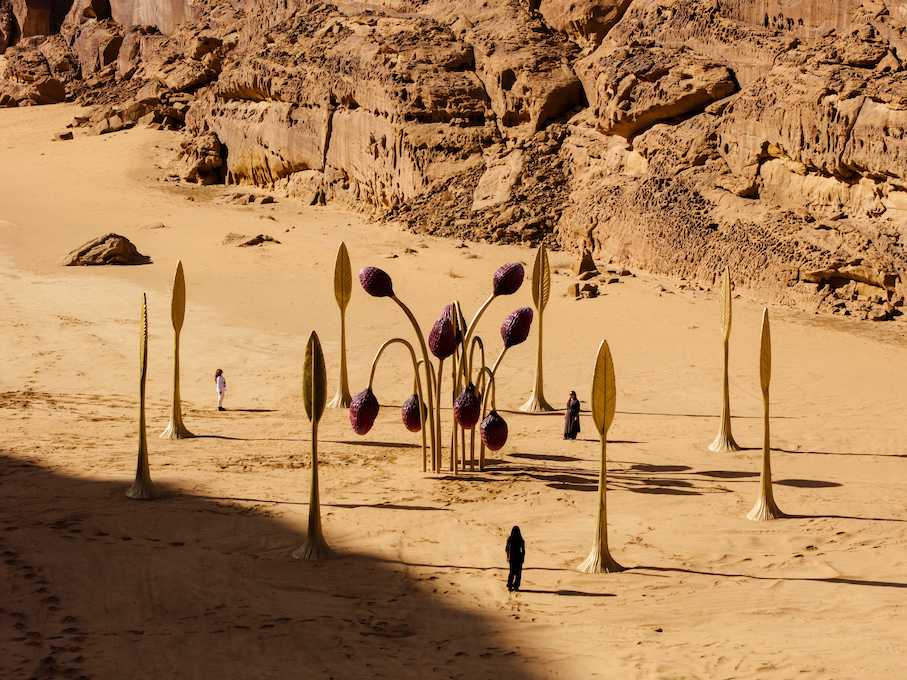 Maria Magdalena Campos-Pons: “Imole Red.” Initially, I started reading about the history of Al-Ula to familiarize myself with the social and horticultural topography, from afar. However, arriving here was a different story. This is a place where I feel full of mystical energy; it is a profound, spiritual place. This is a cathedral of the air. Imole Red in the North Canyon of Desert X Al-Ula 2026 is a gesture to reconnect with nature, an invitation to have a conversation with the colors and textures surrounding us. This canyon is a garden. The contours of the rock change chromatically in the sun, from yellow, ochre, red, to purple and blue…
Since its inaugural edition in 2020, Desert X AI-Ula has steadily built a rich legacy of site-specific artworks that respond to the desert’s extraordinary landscapes, producing 50 commissions while becoming an influential platform for both Saudi and international artists, contributing to the evolving artistic heritage of Al-Ula and the wider region.
About Al-Ula and Arts Al-Ula
Located 1,100 km from Riyadh, in North-West Saudi Arabia, Al-Ula (also: Al-Ula) is a place of extraordinary natural and human heritage. The vast area, covering 22,561 km², includes a lush oasis valley, towering sandstone mountains, and ancient cultural heritage sites dating back thousands of years to when the Lihyan and Nabataean kingdoms reigned.
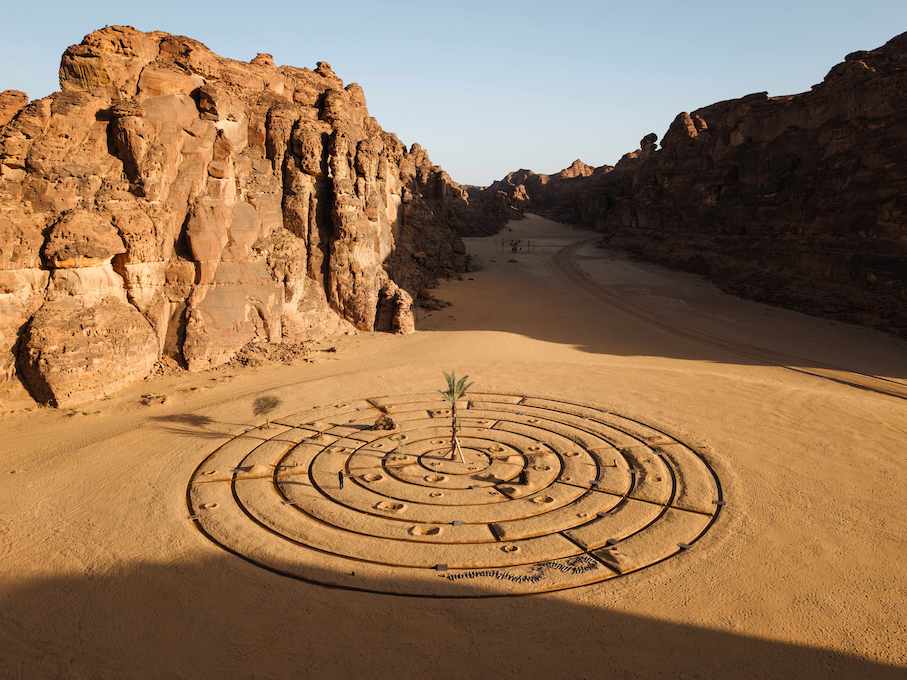 Mohammad AlFaraj: “What was the Question Again?” The work I try to make has long centered on ecology, memory, metaphor and poetry. Blooming from the landscapes of my childhood in Al-Ahsa, where palm trees, water channels, soil and dates are part of everyday life and hold so much meaning beyond the agricultural needs; to the cosmos and the rhythms of the universe. For me, these materials are not merely physical; they are vessels of care, endurance and the intimate relationships between people and their environment. A metaphor for empathy towards everything and everyone…
The most well-known and recognized site in Al-Ula is Hegra, the principal southern city of the Nabataean Kingdom and Saudi Arabia’s first Unesco World Heritage Site.
Al-Ula Old Town Village, a labyrinth of more than 900 mudbrick homes was developed from at least the 12th century and has been revitalized as the vibrant hub for visitors and residents.
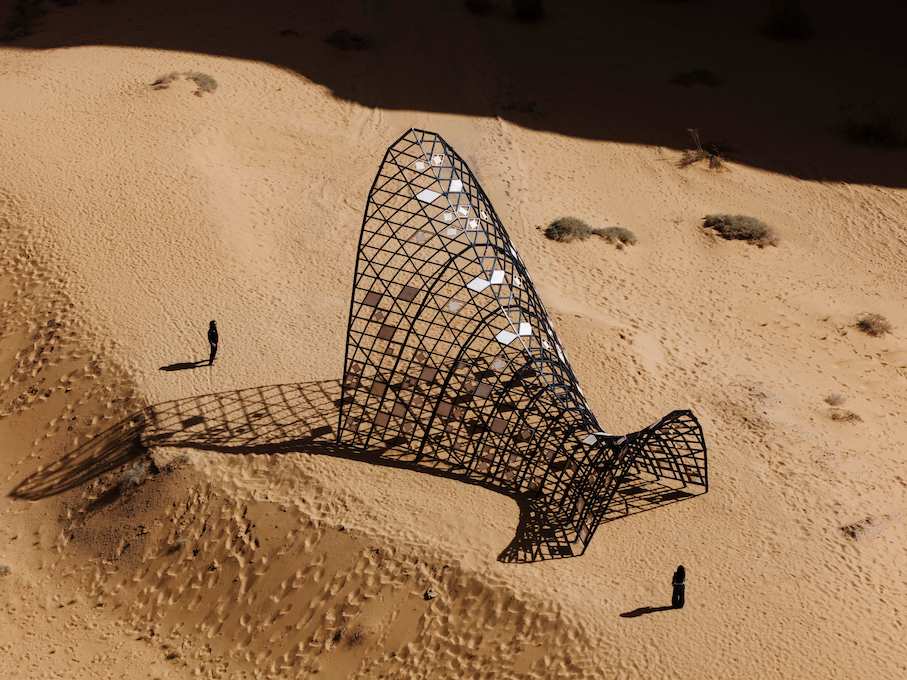 Hector Zamora: “Tar HyPar.” In December of ’22, I visited Al-Ula as part of the research for a proposal for a major work for Al-Ula. Being in this part of the world for the first time shocked me in a positive way, which I was not prepared for. It was a new reality in terms of nature and culture. My only request in that initial contact with the desert was solitude…
The creation of Arts Al-Ula within The Royal Commission for Al-Ula (RCU) is a commitment to crafting the next chapters in millennia of artistic creation – celebrating cultural inheritance and shaping a future inspired by artists built be artists. The work of Arts Al-Ula seeks to preserve this legacy: fuse the old with the new; the local with the international, keeping the arts central to the spirit of Al-Ula as a place of extraordinary natural and human heritage.
Wadi AlFann, meaning ‘Valley of the Arts’, will be a global cultural destination for land art, unveiling from 2028 onwards.
About Desert X
Desert X is produced by The Desert Biennial, a 501(c)(3) charitable organization, conceived to produce recurring international contemporary art exhibitions that activate desert locations through site-responsive installations by acclaimed international artists. Its guiding principles include presenting public exhibitions of art that are open and free to the public, and respond meaningfully to the conditions of desert locations, the environment, indigenous communities, and promoting cultural exchange. Desert X is committed to education and public programming with a robust series of initiatives that expand the breadth and depth of the organization’s engagement with the surrounding community. The exhibitions provide a platform for artists from around the world to address ecological, cultural, spiritual, and other existential themes.
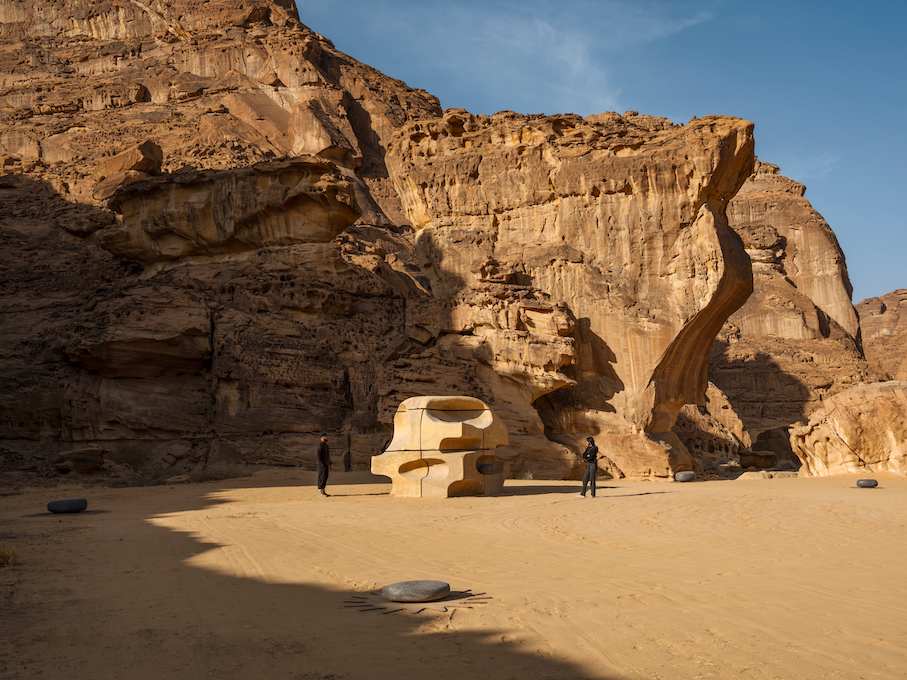 Basmah Felemban: “Murmur of Pebbles.” The valley and I had been calling for each other a long time before our first interaction. I came here surveying, much like the Jirry tribe of catfish I write about; wandering creatures that mine data from the land to guide their travels. Their elders teach that every pebble carries a memory of motion carved by floods, smoothed by collisions, and molded by the push and pull of time. From holding and rolling a single pebble in their hand, a Jirry can read the history of the valley’s waters and winds…
From its inception in 2017, Desert X has presented five exhibitions in the Coachella Valley. In 2020, the organization began to engage with exhibitions outside the United States and helped establish Desert X Al-Ula in the desert of Saudi Arabia. The exhibitions to date have explored new configurations of site-responsive work by more than 100 artists from North America, South America, South Asia, Europe, the Middle East, and Africa, creating a new paradigm for the presentation and experience of art and welcoming an audience of over two million.
Desert X is open to all and is funded by its board of directors and an international group of individual donors, foundations, and sponsors.
Source: Desert X
Photos: Lance Gerber
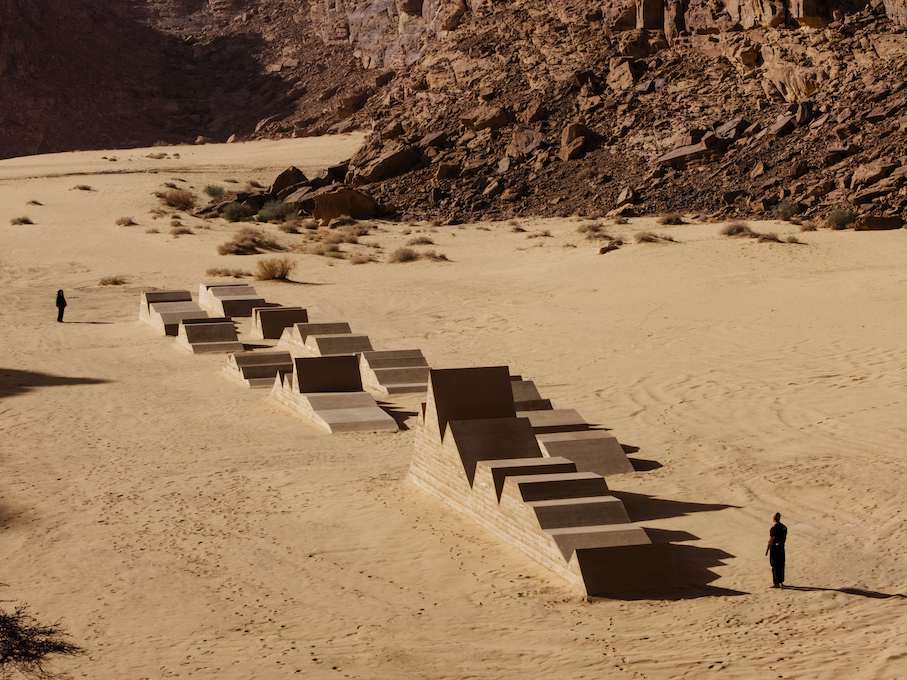 Sara Abdu: “A Kingdom Where No One Dies: Contours of Resonance.” Throughout my practice, I have returned to a recurring question: what constructs identity, and what shapes the sense of belonging? Being born and raised in Saudi Arabia to Yemeni parents has placed me between geographies, but I have never approached this duality as something to resolve. Instead, it has become an ongoing dialogue. One that shifts and expands through the work itself. In this space, notions of origin loosen, and a wider field of relation becomes possible. One that anyone can step into, even momentarily…
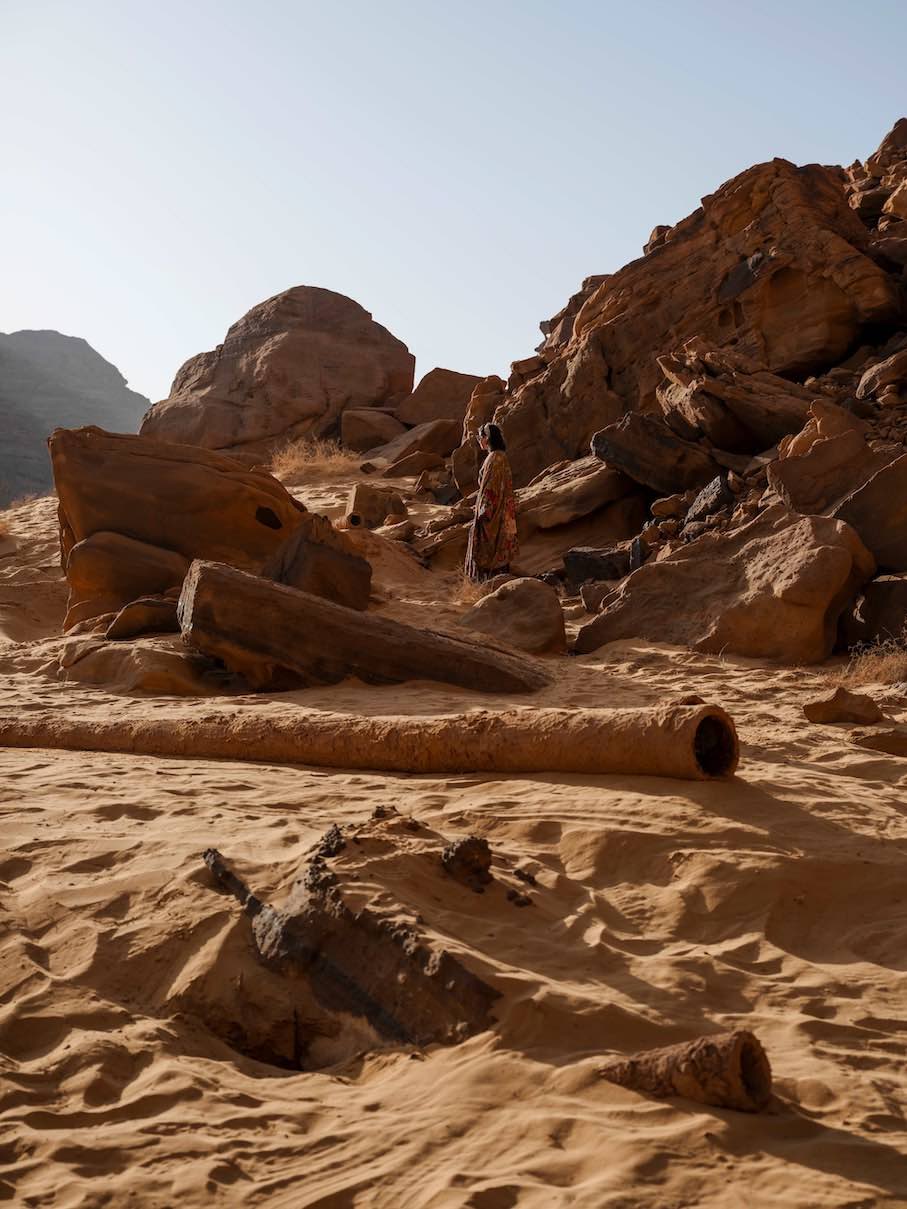 Tarek Atoui: “The Water Song.” When I received the invitation to Desert X Al-Ula, I thought of the desert kites, vast geometric traces stretching across the arid plateaus of northern Saudi Arabia that I saw in 2024. Their purpose remains uncertain after thousands of years. In the fascination they still hold for me, I’ve often wondered about archaeo-acoustics and whether sound might be the missing key to their meaning: perhaps these ancient shapes were not only to be seen but also heard?…
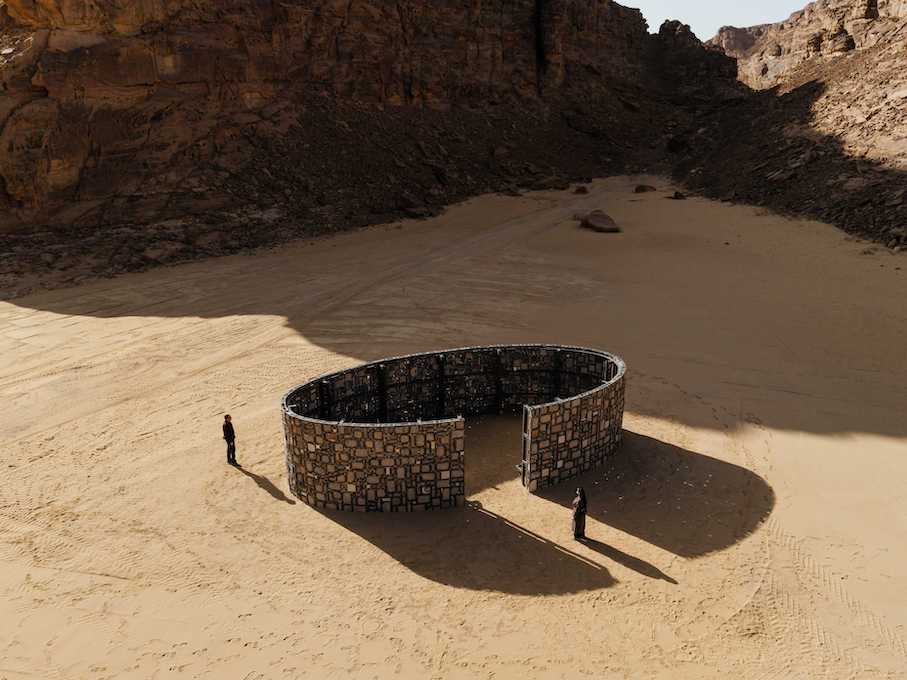 Vibha Galhotra: “Future Fables.” Future Fables emerges in continuation of my ongoing site-specific iterations that engage with new-age global phenomena and the repurposing of contemporary waste. The work extends a larger inquiry; how can the discarded matter of our time be transformed into monumental structures that compel us to think, remember and re-imagine? In this iteration, concrete debris becomes both material and metaphor: rubble of cities, ambitions turned residue, the bones of progress now stripped bare…
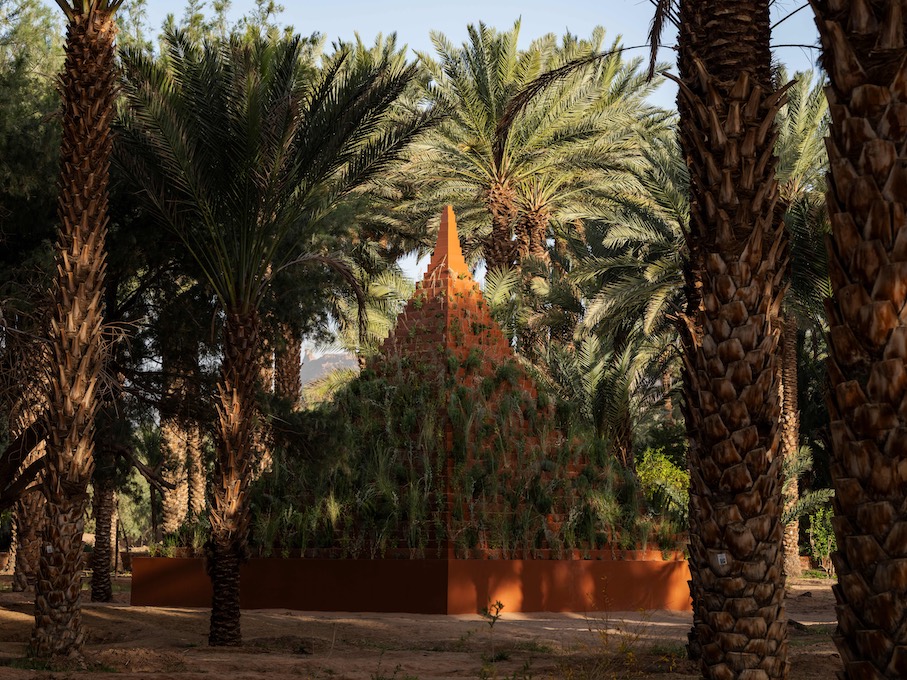 Agnes Denes: “The Living Pyramid.” Each Living Pyramid is different. The environment is different, the people are different. I’m very interested in the different societies that come together on something so simple. I create my work to be able to stand up to any circumstance, in any circumstance. In environmental situations, regardless of the interference it may encounter when exhibited. Like children, they have to respond. They have to be able to fend for themselves and boldly express their meaning, amplifying their relevance…
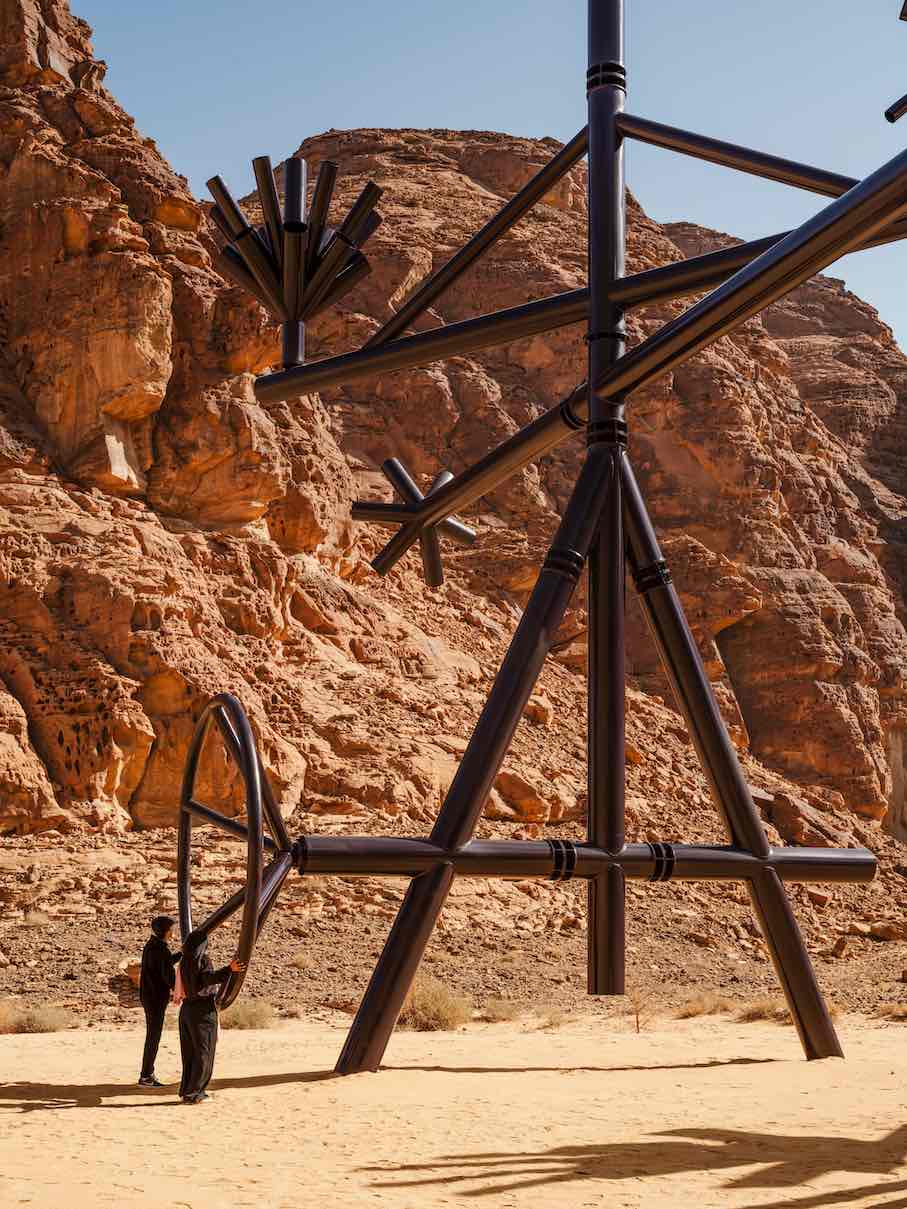 Bahraini-Danish: “Bloom.” Drawing inspiration from the resilient flora of the Al-Ula desert, we conceived our kinetic installation as a fictional desert blossom that transforms the landscape into a stage of play, movement and collective imagination. Over the course of our repeated visits to Al-Ula, we were struck by how the light moved across the rocks and how the flora revealed itself slowly throughout the day. Returning to the site, this encounter deepened into an understanding that the landscape holds both permanence and constant motion…
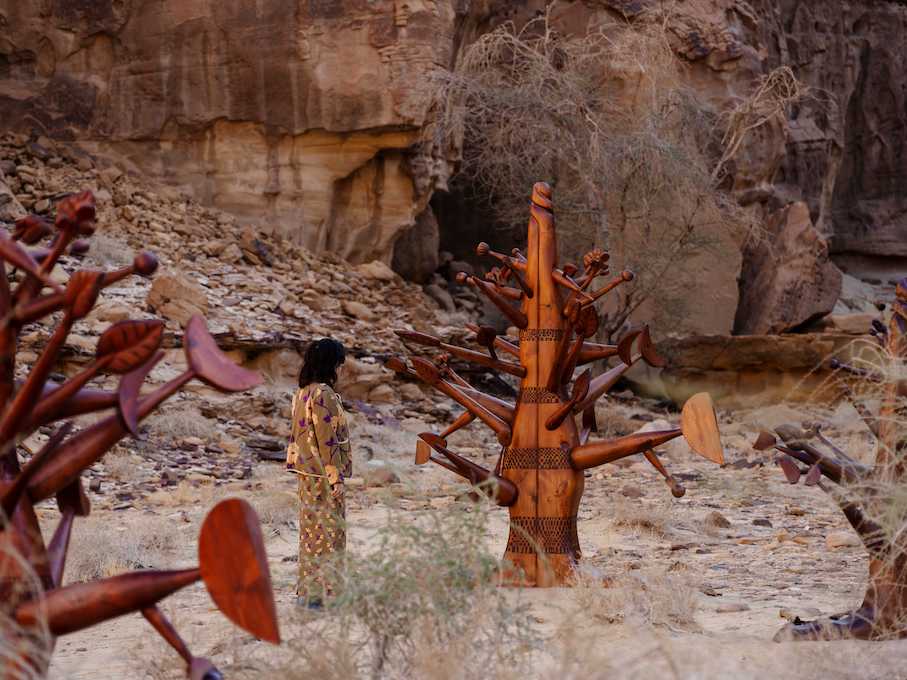 Ibrahim El-Salahi: “Haraza Tree.” My style changes, but I keep working on one particular theme inspired by a tree, an Acacia locally called the Haraza that grows on the banks of the Nile. During the rainy season, the tree is leafless, and it blossoms with freshly budding green leaves when the weather turns dry, and the river flows at its lowest towards the sea. Through all, the tree remains steadfast, silently watching over the passage of seasons and time…