 Stone-Ideas.com


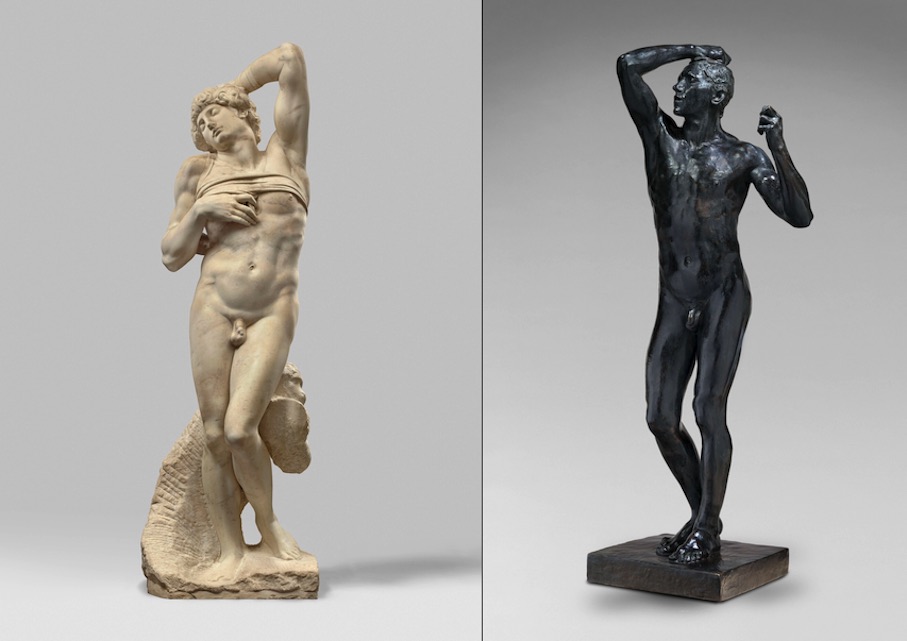
In the exhibition „Living Bodies“, through July 20, 2026, at the Louvre, Paris, Michelangelo (1475–1564) and Auguste Rodin (1840–1917), two unrivaled masters of Western sculpture, engage in a dialogue across the centuries. Their works, emblematic of the strength of the body and the depth of the soul, are brought together for the first time, revealing a continuum between the two artists, marked by clear divisions.
The more than 200 works in the exhibition highlight the issues of form and concept that drove the same ambition in both artists: to make manifest the body‘s inner energy. The body is thus revealed as the membrane that envelops the soul, a living thing weathering time and movement.
The show also explores the historic uses of motion in sculpture: how did the reinvention of antiquity and the ways bodies were used foreshadow the divisions of the 20th century?
The first section presents the myths around the two sculptors. Their place in the art world is evidenced through posthumous portraits and productions, artistic homages and even relics. A selection of pieces inspired by their body of work demonstrates their respective artistic lineages – and shows Rodin’s own debt to Michelangelo.
Nature and antiquity were the principal sources of inspiration for Michelangelo and Rodin – but models are meant to be surpassed. This section features numerous sketches and studies that demonstrate a careful observation of human bodies and a sophisticated understanding of anatomy, which Michelangelo acquired through the practice of dissection, and Rodin through long hours spent studying live models.
Non finito is central to the exhibition’s argument. This aesthetic, which characterized the works of Michelangelo and was harnessed by Rodin, consists in leaving evidence of the marks of artistic creation, as proof that the perceptible sculpture is only one step in an existing intangible form; in this, it uses the transient to make manifest the life that flows through bodies. On exceptional loan from the Casa Buonarotti, a small wooden crucifix illustrates the full power of Michelangelo’s non finito, in close proximity to the Louvre‘s Slaves.
Michelangelo and Rodin, in making the body the central subject of their artworks, showed that they both perceived it as animated by an intense inner life. Their figures were vessels for thought and dream, sometimes even in death. In Michelangelo‘s Saint Bartholomew, as in Rodin’s Balzac, psyche leaves its mark on the body, as the soul takes form in the mortal coil.
The bodies that Michelangelo and Rodin created are alive because they are full of energy. This concept lies at the heart of the artists’ sculptural concerns and forms the thrust of the exhibition’s final section. The figures’ flexibility imbues them with intense vitality, as demonstrated by Michelangelo‘s many serpentine figures, Pierino da Vinci’s Young River God in marble, and Rodin’s Inner Voice.
Source: Louvre
Exibition Curators: Chloé Ariot, Curator, Musée Rodin and Marc Bormand, Curator, Department of Sculptures, Musée du Louvre.
Catalogue: Michel-Ange Rodin. Corps vivants. Edited by Chloé Ariot, Curator, Musée Rodin and Marc Bormand, Curator, Department of Sculptures, musée du Louvre. Co-published by the Musée du Louvre and GALLIMARD. . French, 384 pages, 310 illustrations, hardcover, 21 × 28.5 cm. Price: 49 €.
Exhibition booklet.Michel-Ange Rodin. Corps vivants. Edited by Chloé Ariot, Curator, Musée Rodin and Marc Bormand, Curator, Department of Sculptures, Musée du Louvre. Co-published by the Musée du Louvre and GALLIMARD. French, 64 pages, 40 illustrations, hardcover, 12 × 17 cm. Price: 11,50 €.
Graphic novel: Sculpter l’éternité by Xavier Coste. Co-published by the Musée du Louvre and Rue de Sèvres. French, 208 pages, hardcover, 25 × 28 cm. Price: 26 €.
The exhibition is sponsored by Bank of America, main sponsor, as well as Kinoshita Group and the Fondation Placoplatre.