 Stone-Ideas.com


In April, the horse racing season began once again in the US state of Kentucky, and there is no doubt that the bluegrass is one of the reasons why the world centre of thoroughbred breeding has established itself there. It is also undisputed that the bluegrass is linked to the limestone subsoil – we mention this because when researching online, one usually comes across explanations to the contrary.
The area around the city of Lexington, in particular, has been famous for horse breeding for many generations. It serves as an example of how stones shape a region’s identity. The Kentucky Thoroughbred Association states that 60 professions there are linked to the horse industry and that these generate around 2.7 billion US dollars annually, both directly and indirectly. The number of horses is estimated at 238,000, which equates to one animal for every 18 residents in the state. Sales of these animals generate just under 764 million US dollars annually.
Bluegrass belongs to the family of pampas grass (Poa pratensis). The plant is found all over the world, and it is generally not popular with amateur gardeners because it is impossible to get rid of once the wind has carried its seeds onto their property.
In Kentucky, however, we are not talking about private vegetable gardens, but about the vast pastures that stretch seemingly endlessly across the rolling hills.
From the horses’ point of view, bluegrass must be a real treat: It is rich in nutrients (but not too rich, unlike some highly bred sweet grasses), is palatable to the animals (according to the breeders) and easily digestible (as you can see), which consequently leads to an ideal skeletal structure and strong muscle development in the animals.
In addition, the breeding farms are keen to point out that the gentle hills are ideal for the animals to frolic on in their younger years.
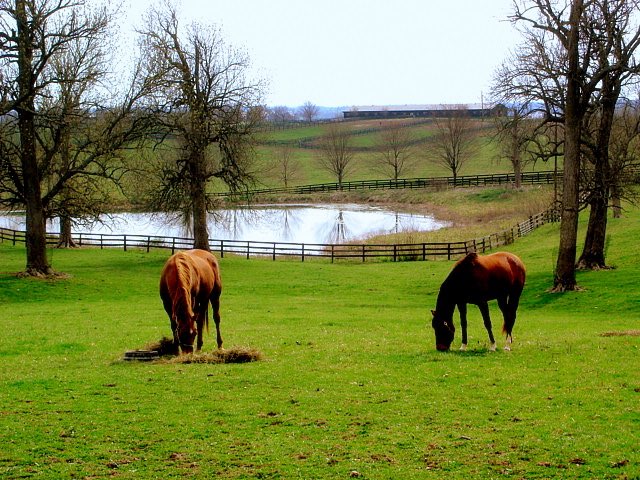
All of this is due to the limestone subsoil beneath Kentucky: the rain leaches calcium and phosphorus from the rock – these substances act as a fertiliser for the bluegrass.
Conversely, the rain also dissolves the rock itself, creating karst; over the millennia, parts of its many caves then collapse, and this, together with weathering, leads to the undulating landscape.
Furthermore, the water that emerges from the ground is rich in minerals and therefore beneficial to health.
At this point, reference is always made to Bourbon whiskey, which is distilled in Kentucky using the same water.
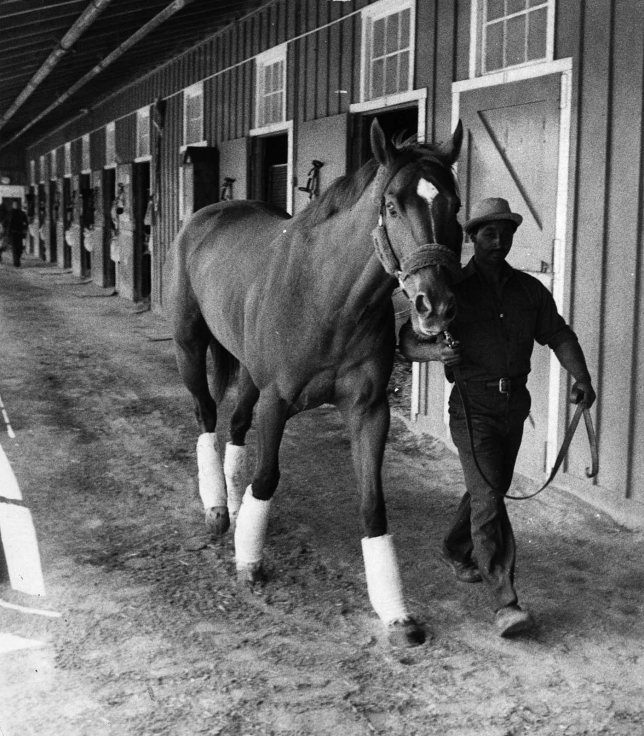
Stud farms can be found everywhere. Names such as ‘American Pharoah’, ‘Secretariat’ or ‘Seattle Slew’ are reminiscent of specific horses that have performed phenomenally in races. Behind this lies a multi-million-dollar industry where enthusiasts, investors and gamblers come together with breeders, vets and jockeys.
As in any other competitive sport, in the end it is just a few minutes that decide success or failure – and with it, entire careers.