 Stone-Ideas.com


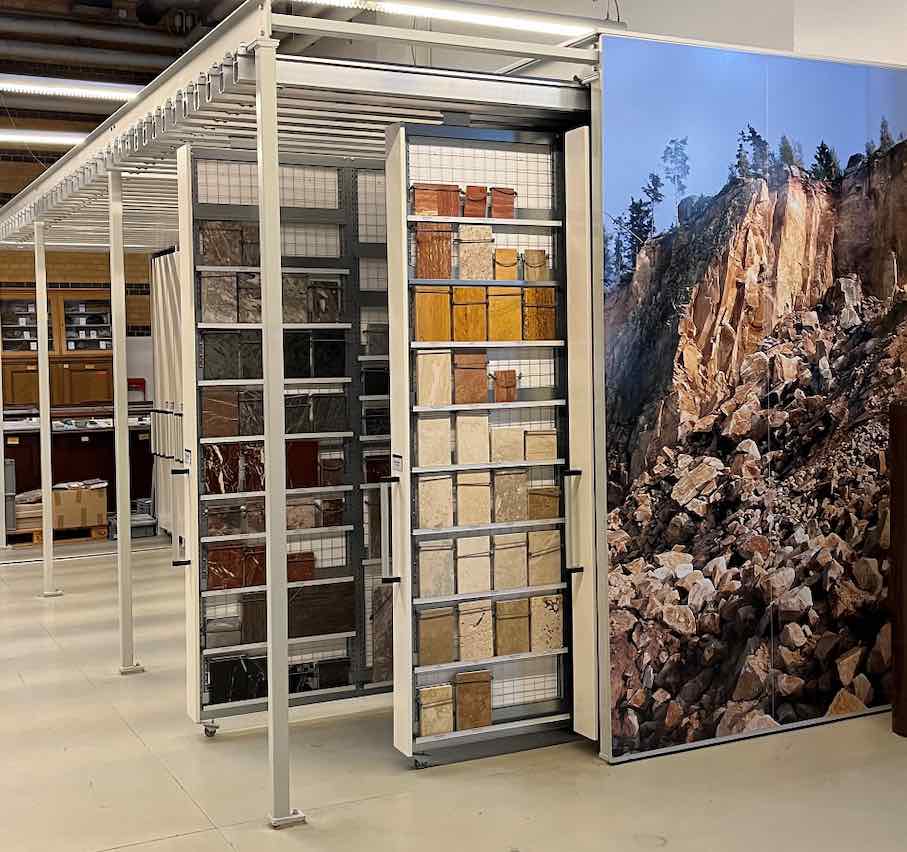
The natural stone collection of the Federal Institute for Geosciences and Natural Resources (BGR) is, alongside the German Natural Stone Archive in Wunsiedel, the largest and most comprehensive of its kind in Germany. The collection, which now comprises 9,500 slabs and specimens, reflects the scientific work of the BGR and its predecessor institutions on natural stones over the past 150 years.
Its origins date back to the late 19th century at the Prussian Geological Survey (PGLA), when the first systematic studies of natural stone began in Berlin (in collaboration with the MPA—now BAM). Among the oldest objects in this collection are 20 small cubes made of French limestone, which were likely added to the collection in the 1870s.
In the 1920s and 1930s, the collection grew considerably thanks to the work of Otto Burre and Wilhelm Dienemann, who conducted intensive research on building stones in Germany at the PGLA. As part of the development of the German Quarry Registry (DSK) by the Institute for Stones and Earths in Köthen, the PGLA, and the MPA in Berlin beginning in 1935, approximately 400 quarries were documented by 1942; their rocks were examined petrographically at the PGLA, and the samples were archived.
After 1945, the collection became part of the Central Geological Institute of the GDR and was expanded, among other things, with 150 slabs collected as part of a study on natural stone reserves oft he GDR (1975).
The collection has been part of the BGR since 1990 and has doubled in size since then: through the acquisition of slabs, at natural stone trade fairs, and through the transfer of other collections; however, this growth has been driven primarily by intensive research on natural stone, particularly building sandstone in Germany and neighboring countries (2,100 hand specimens and slabs, 1,500 thin sections). The building sandstone collection alone is the most comprehensive of its kind.
Today, as part of the BGR’s geoscience collections at the Berlin-Spandau branch, the slabs are presented very clearly in a modern pull-out system; they are organized primarily by rock type and secondarily by region. The hand specimens are stored in cabinets. The collection can be viewed and used by appointment.
Since 2025, the BGR’s natural stone collection has also been available online. The online application contains all information on the samples, photos (so far only of the slabs; all will be included by 2027), some petrographic descriptions, and/or attached publications or links to them. The 2,500 thin sections and the analyses of the mineralogy and geochemistry of the natural stone specimens in the collection, conducted at the BGR, will also be available online starting in 2028.
Geowissenschaftliche Sammlungen online (deutsch)