 Stone-Ideas.com


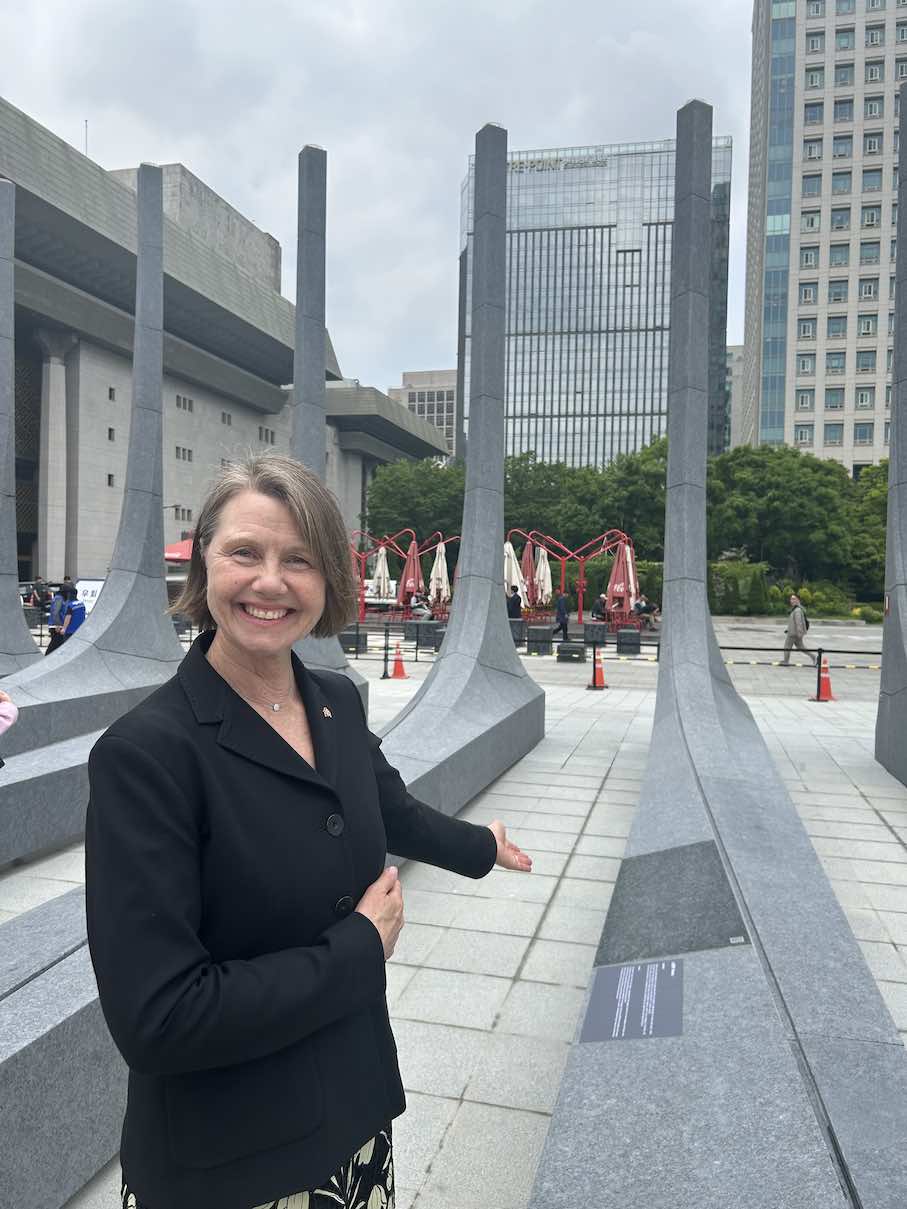
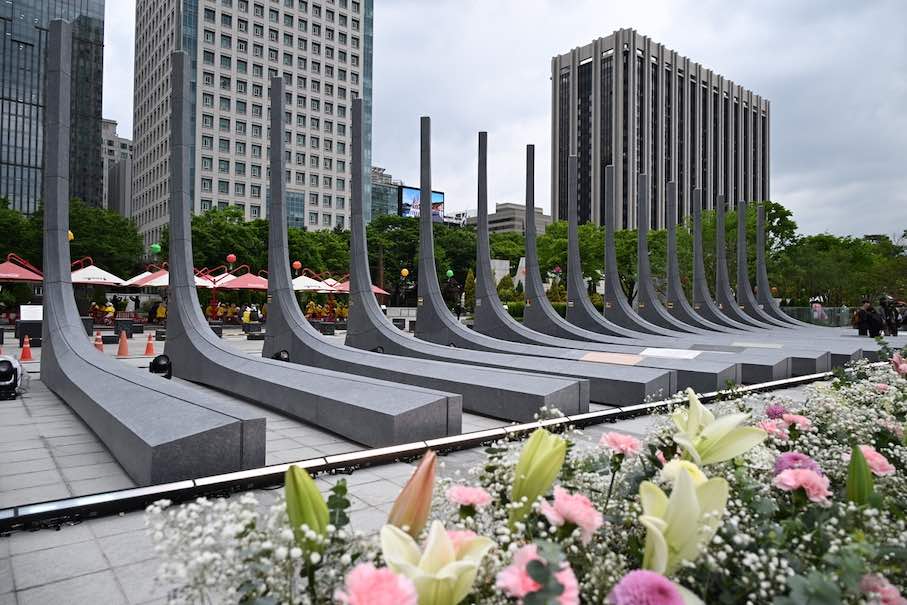
Twenty-three granite steles, each 6.25 meters tall, stand in the center of the Garden of Gratitude in South Korea’s capital, Seoul. They commemorate the nations that intervened in the Korean War in response to a United Nations appeal and sent either military, medical, or humanitarian aid. At certain hours at night, laser beams shoot into the sky from the tops of the steles. Below them is a center featuring multimedia tributes. The memorial was dedicated in May 2026.
The purpose of the complex is to express the Korean nation’s gratitude for the assistance received from abroad and, at the same time, to serve as a call for peace and freedom. Another theme is solidarity among nations.
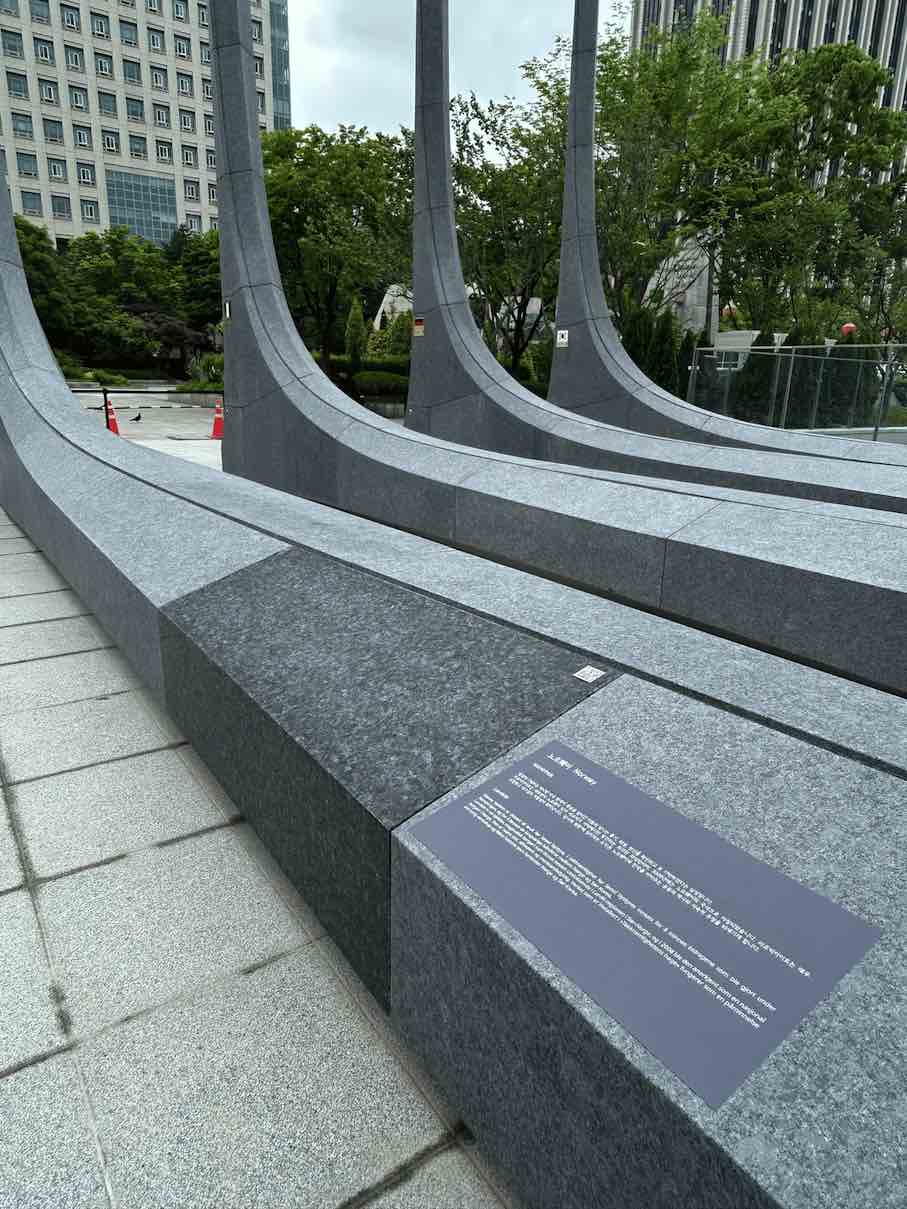
As a symbolic gesture, stones from the respective supporting countries have been incorporated into the granite of the steles. Currently, there are stones from seven countries: From Norway, for example, a block of Larvikite was supplied by the Lundhs company. Germany did not send stone, but rather a section of the Berlin Wall, intended to commemorate the end of the (Cold) War in 1989 and the reunification of East and West Germany. The Netherlands, lacking quarries, contributed a set of ceramic tiles.
After World War II, the occupying powers – the United States and the Soviet Union – divided the country along the 38th parallel. From 1948 onward, there were two Korean states. In 1950, the North invaded the South and overran nearly the entire country. The United Nations called on its members to support the South. In addition to the United States, Australia, Belgium, Canada, Colombia, Ethiopia, France, Greece, Luxembourg, the Netherlands, New Zealand, the Philippines, South Korea, Thailand, Turkey, and the United Kingdom sent military aid. Denmark, Germany, India, Italy, Norway, and Sweden sent medical or humanitarian aid.
It was one of the many proxy wars between communism and capitalism: North Korea was supported by the Soviet Union and China, while South Korea was backed by the United States. In 1953, hostilities were brought to an end; to this day, there is still no peace treaty between the two countries.
In the Garden of Gratitude on Gwanghwamun Square, the 23 steles are arranged in a straight line 50 meters long, each spaced 1.20 meters apart: at one end stands the stele representing South Korea, and at the other, that of the United States. In between are the steles of the supporting nations, arranged in the order in which they intervened in the war.
In the run-up to the unveiling, the memorial had faced fierce criticism. Some of the criticism was political in nature and directed at former Mayor Oh Se-hoon, who had initiated the project. Others felt the memorial was unnecessary because South Korea already has a memorial to the Korean War. Others criticized the design of the steles, saying it was bellicose and visually represented the command “Present arms.”
The idea of using light was selected through a public competition.
Earlier, there had been some discussion about erecting a 100-meter-tall flagpole flying the Korean national flag in the square.
The center below the square uses multimedia to convey this message. One of the installations is a waterfall of light cascading over sculptures. Photos enhanced with AI tell the stories of the soldiers and their heroic deeds and show their uniforms. Live images of Times Square in New York City are displayed on one wall.
For many decades, Gwanghwamun Square was a dilapidated urban wasteland with a 16-lane expressway running through its center. Since 2004, it has been redesigned at great expense.
To the left and right of the steles stand the monumental statues of King Sejong and Admiral Yi Sun-sin. Sejong the Great reigned in the 15th century; it was during his reign that the alphabet for the national language was created. Admiral Yi Sun-sin was a war hero of the 16th century.
Photos: Norwegian Embassy, Seoul