Stone-Ideas.com


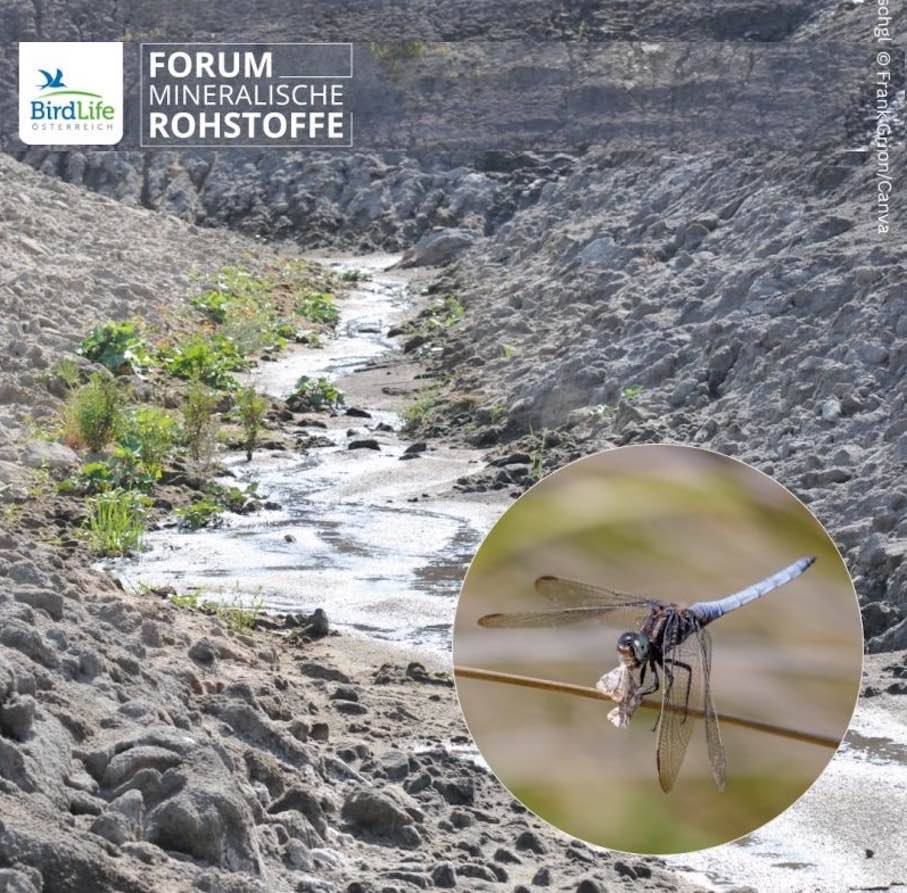
A few decades ago, the terms “biodiversity” and “raw material extraction” were considered opposites that were irreconcilable: quarries or gravel pits were seen as places of landscape destruction and as dead zones. In many places, operators, together with scientists and environmental activists, have now taken a closer look and realized that the opposite is the case: such places offer habitats, especially for so-called pioneer species, that they cannot find elsewhere in our intensively used landscape.
Consequently, the 2024 symposium of the Austrian Working Group Forum Raw Materials was entitled ”Biodiversity and mineral raw materials: A common future.” The emphasis was on the word ”common” and the topic was so important that two federal government ministers were present: Environment Minister Leonore Gewessler emphasized the importance of the topic in her keynote speech, and Finance Minister Magnus Brunner sent a video message in which he described mineral resources such as sand, gravel, crushed stone and natural stone as the backbone of prosperity in Austria.
In numerous presentations, the experts made it clear that even active quarries are now seen as habitats and breeding grounds. Spectacular examples are the eagle owl or numerous toad species, birds, or bats.
Research projects in various European countries have shown how well the animal species cope with the noise and disturbance of mining: We reported on a gravel quarry in Germany where the eagle owl understands the signal before a blasting and disappears without a trace for a short while. In a report from a quarry in Ireland, we told the story of how common martins build their nesting holes in sand heaps and how a pair of peregrine falcons apparently try to drive away weekend intruders.
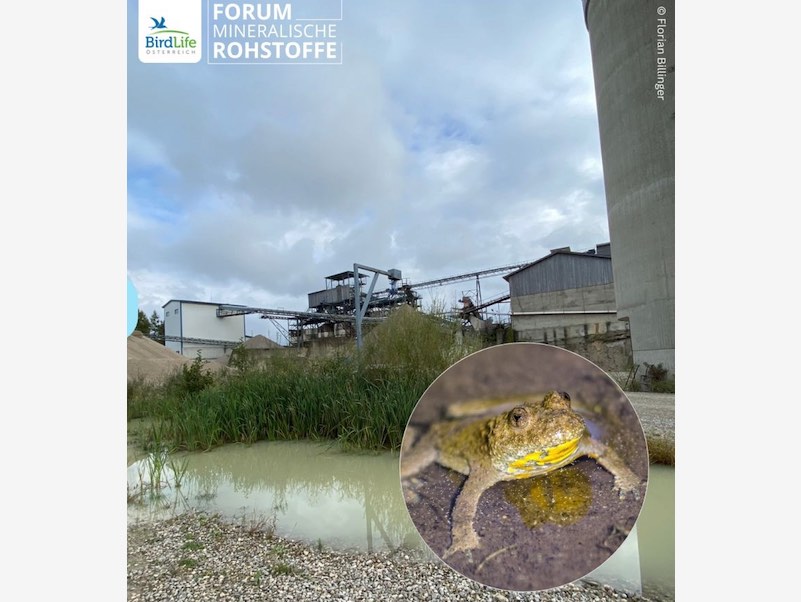
The adjustments that the companies have to make are minimal: they only have to respect the previously unused places that the animals have moved into. Support for breeding, for example by piling up sand heaps or securing holes in rocks, is gladly accepted by the newcomers.
The only thing that really matters is respecting the animals’ breeding seasons.
Nature does the rest itself. The wind offers rides for plant seeds, and eggs of aquatic animals travel in the birds’ plumage. Nature’s system is wasteful, but works when the conditions are right.
The research project ”Raw material extraction companies as stepping stone biotopes” was presented at the working group’s symposium. What this means is that an active quarry can never be a mini nature reserve, but can certainly serve as a connection between large protected areas. A constant flow of species can take place via corridors between the protected areas and the mining zones.
In this sense, the chairman of the Raw Materials Forum called for ”shorter approval procedures with more foresight” for new mining zones. He also called on the transport authorities to take environmental concerns more into account: if the loading weight of heavy trucks were increased by just 10%, ”900,000 vehicle journeys, 11,400 tons of CO2 emissions and almost 4 million liters of diesel could be saved” in Austria.
Forum Raw Materials (Forum Rohstoffe, German)
See also: