 Stone-Ideas.com



Update: Spanish company Pulycort has the trophy as marble foot for tables.
Football and its stadiums aren’t typically associated with natural stone. This elegant material, such as marble, is usually found in VIP lounges, or granite on the paved plazas surrounding the venues. For the 2022 World Cup in Qatar, for example, the Chinese company Huabaostone supplied the paving stones, not only for the World Cup Stadium but also for numerous other sports venues.
This year’s World Cup (June 11 – July 19) is being held in three countries for the first time. Sixteen stadiums have been selected:
* Eleven in the USA: Atlanta, Boston, Dallas, Houston, Kansas City, Los Angeles, Miami, New York/New Jersey, Philadelphia, San Francisco, and Seattle;
* Three in Mexico: Mexico City (Estadio Azteca), Guadalajara (Estadio Akron), and Monterrey (Estadio BBVA)
* Two in Canada: Toronto (BMO Field) and Vancouver (BC Place).
48 teams are participating and competing for the title. The tournament comprises 104 matches.
Natural stone is prominently featured, namely at the base of the FIFA World Cup Trophy. There, two green stripes of malachite adorn the base. The trophy was created in 1974 by the Italian artist Silvio Gazzaniga. It is hollow, made of 18-karat gold, and weighs approximately 6 kg. Two figures hold the globe aloft, and the two green stripes symbolize the grass of the playing field.
Incidentally, all host cities for the current World Cup are required to use natural grass on their pitches.

We haven’t found much else about stone in the tournament. It is only mentioned as a surface material at some venues. This is a familiar phenomenon from similar cases worldwide, such as the stadium in Braga, Portugal, which is built into a former quarry.
In Mexico City, the famous Estadio Azteca rests on a basalt plateau formed by the eruption of the Xitle volcano approximately 1,700 years ago. This had a significant impact on the stadium’s construction in the 1960s: not only did the volcanic rock prove extremely hard, causing the foundation work to consume a considerable portion of the budget, but groundwater also suddenly seeped in at a depth of 10 meters, forcing the entire structure to be built two stories above ground.
Some sources report that the excavated material was partially used for the wall cladding.
The stadium’s location is near the site believed to have been the site of the ancient city of Cuicuilco, which was destroyed along with large parts of the Vallée de México during the volcanic eruption. During construction, however, no archaeological finds were discovered; instead, mysterious caves appeared underground, formed as the lava cooled. These gave rise to numerous myths and speculations.
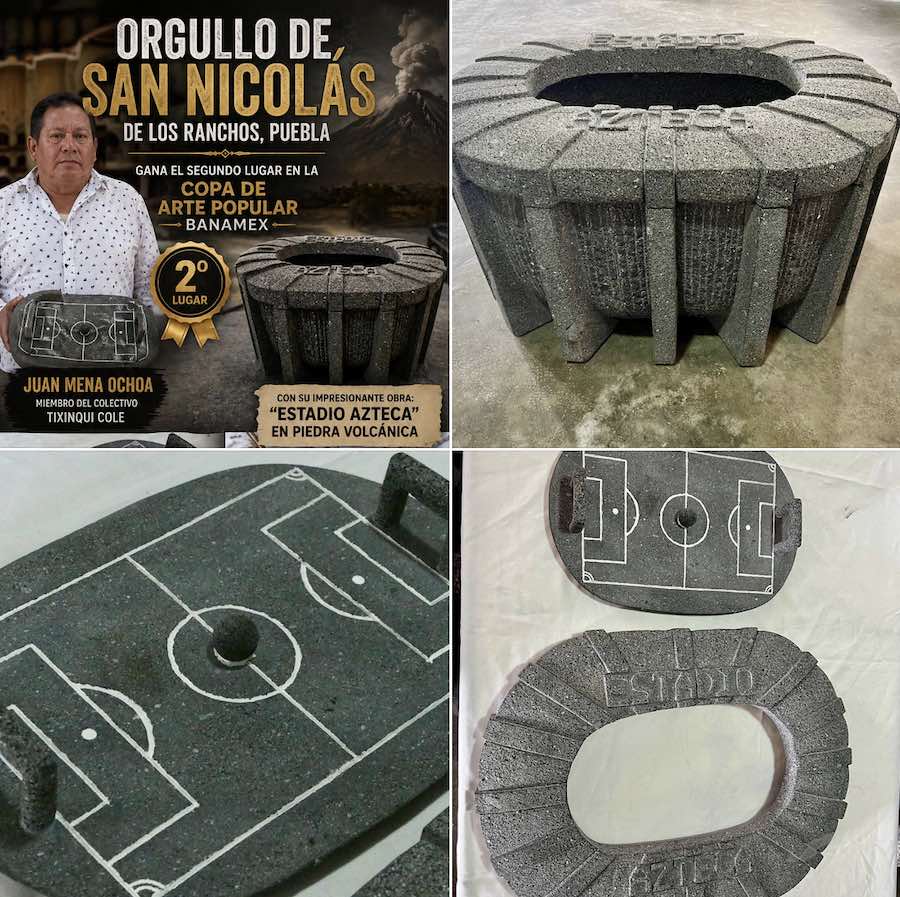
Recently, stonemason Juan Mena from the town of San Nicolás de los Ranchos won second prize in a national competition: He had recreated the stadium in lava.
The opening match between the USA and Paraguay will take place at the Estadio Azteca.
The geological conditions are still evident at Gillette Stadium in Foxborough, Massachusetts. The website of the construction company, now called Populous, states: “Taking advantage of the area’s naturally occurring granite outcroppings, the stadium’s design incorporates these formations to define the western concourse and field level, creating a split-level configuration.”
In front of the stadium, there’s another unique feature made of stone: an oversized statue of quarterback Tom Brady, who won six Super Bowls with the Patriots. The sculpture rests on a granite hexagon, which also represents the six states of the New England region.
