 Stone-Ideas.com


“Full/Empty” is another exhibtion at the The Plus Theatre held in Hall 10 of Marmomac 2024 (September 24 – 27). Curator is Italian product designer and artist Raffaello Galiotto, participants will be designers from international studios who will show their original works crafted from natural stone. The exhibition will be the focus of a talk attended by Giacomo Garziano, Vivian Cozer, Gramazio Jörgensen Kohler, Renee Cheng, Kinney Chan, Sylvia Xie, and Connie Huang of CCD Cheng Chung Design.
The starting point for the show was a quote by the famous 16th century Italian painter and architect Giorgio Vasari. He said: “Sculpture is an art that, by removing the superfluous from the material, reduces it to that form of body designed by the artist.” The designers were asked to reflect on the close relationship between material and superfluous – it defines the inseparable link between fullness and emptiness and is the fundamental concept of opposites that characterizes sculpture, architecture or design.
The exhibition explores the relationship between the two opposites in times of new digital tools and experiments with natural stones.
The shift from the manual techniques of the past to modern processes, such as numerically controlled abrasive milling or cutting with diamond tools and water jets, offers new opportunities today in terms of precision, technical reproducibility, and the utilization of waste. The selected designers freely explore this relationship in the light of these new capabilities.
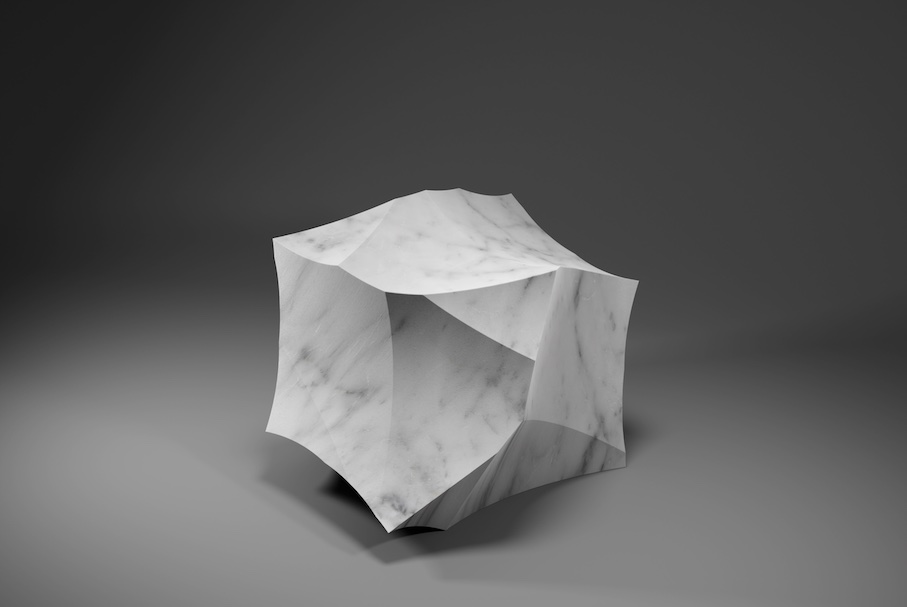
(photo above) BOLZA BOUNDARIES. Designer: Gramazio Jörgensen Kohler _ Gramazio Kolher Architects (Switzerland). Companies: Pellegrini Meccanica, Pellizzari Marmi e Graniti. Material: Bianco Carrara. At the core of the project lies the Bolza surface, a mathematical object exhibiting the highest symmetry possible for a double torus. Representing its higher-dimensional structure and hyperbolic curvature as a physical object is fundamentally impossible. This impossibility is even exacerbated by the choice of marble as ultimate “pièce de résistance”. The marble is sliced along twelve parallel pairs of curves from six directions, leveraging the inner symmetries of the Bolza surface to close in on its essence and give the object its unique and characteristic shape. The gentle curvature of the inward cuts competes with an assumed ideal tessellation of the block, generating complex and unexpected shifts in edges and corners, and exposing more of the marble block’s interior, its inherent material history, its inclusions, imperfections and defects. The resulting object oscillates between expressing design choice, deliberate submission to rules, and engagement with material and production realities.

 BO STOOL. Designer: Vivian Coser _ SETTE7 (Brazil). Company: Antolini. Material: Noirblanc by Antolini. Bo draws inspiration from the essence of the iconic SESC stool, designed by Lina Bo Bardi in 1977 for the SESC Pompeia center in São Paulo, and is infused with a contemporary and distinctive touch by Vivian Coser. This piece embodies a modern reinterpretation, seamlessly blending the minimalist aesthetic and functionality of brutalist architecture, drawing upon the versatility of stone fittings. The Bo’s design showcases sober and geometric lines, with a sturdy and imposing structure, emblematic features of the brutalist style. Each element of the stool is sculpted from natural stone and designed to fit precisely, eliminating the need for additional tools or fasteners. This approach allows for swift assembly and disassembly, making it suitable for temporary spaces. The use of natural stone aligns with the ethics of sustainable design, by employing a natural material that requires minimal processing.
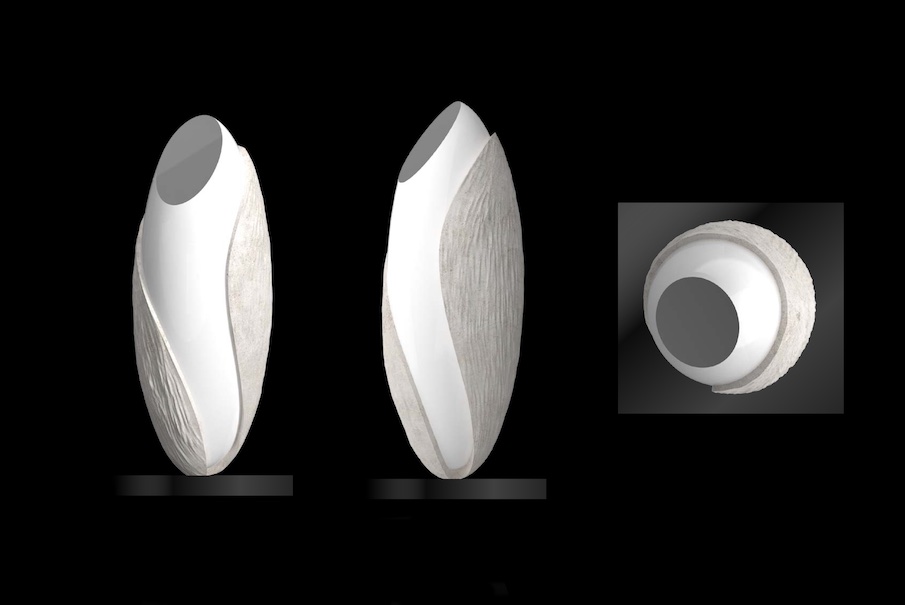
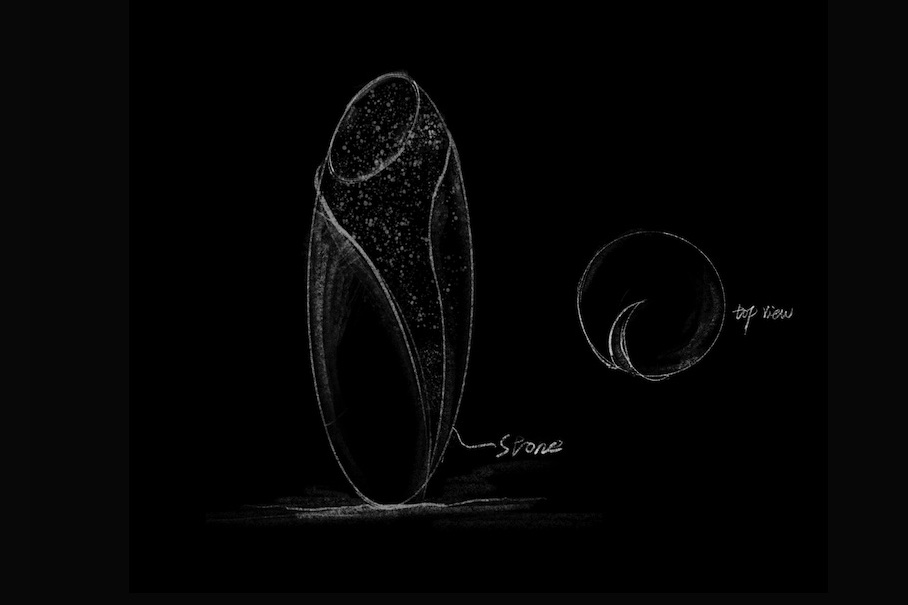 HARVEST GRAIN. Designers: Renee Cheng, Kinney Chan, Sylvia Xie, Connie Huang _ CCD CHENG CHUNG DESIGN (China). Company: Grassi Pietre. Material: Pietra Bianca di Vicenza qualità Bianco Avorio by Grassi Pietre. In art creation, “full” can refer to fullness or completeness, while “empty” refers to white space or unfilled space, which are opposing concepts. Empty, however, is not “empty”, but can also encompass everything, which is full. The work explores as much as possible the relationship between objects and blankness, and the relationship between the tangible and the intangible.
Conceptual Inspiration: Rice Symbol: rice grain represents harvest, abundance and vitality, and is a universally used symbol in culture for hard work, hope and prosperity. Connection between nature and mankind: the sculpture combines elements of nature (rice and stone) with human intelligence (sculpture art) to show the concept of harmonious coexistence between mankind and nature. Combining the purity of nature with human ingenuity, this stone and bronze sculpture in the form of a grain of rice is both artistically beautiful and full of cultural and symbolic meaning. Through the skillful design of material, form and presentation, it can be a striking work of art in both indoor and outdoor environments, while conveying the positive meaning of harvest, hope and vitality.
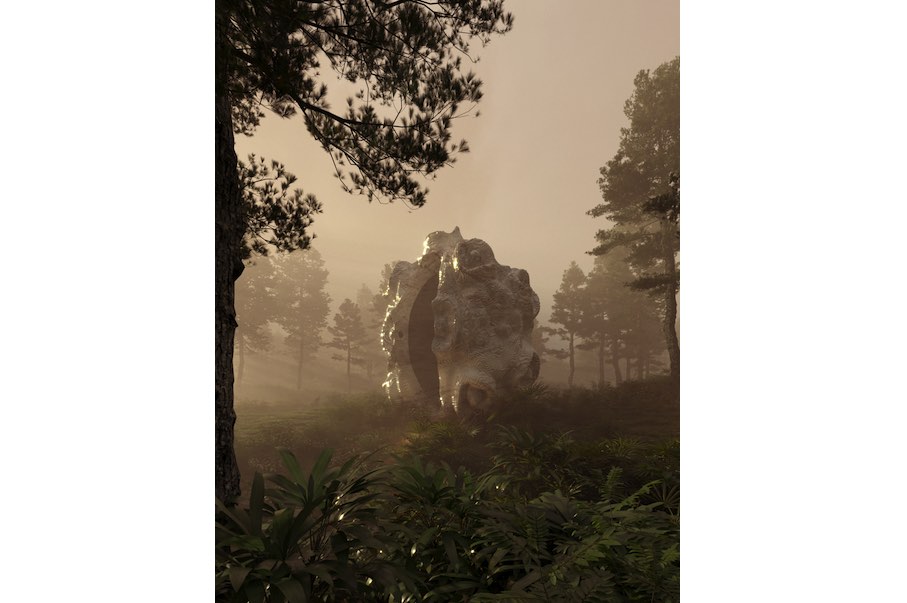
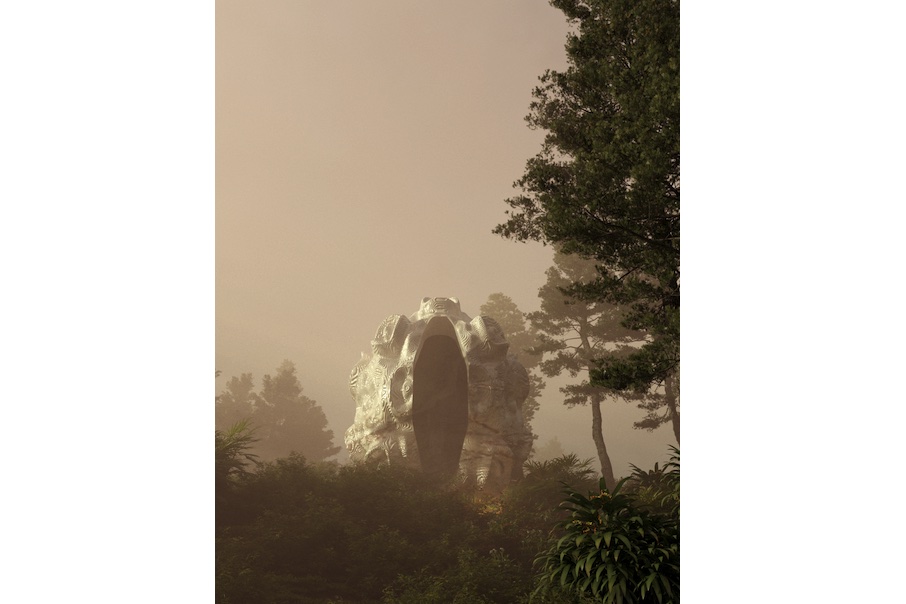 OMNE VIVUM. Designer: Giacomo Garziano _ GG-loop (The Netherlands). Company: Margraf. Material: Fior di Pesco Carnico by Margraf. Omne Vivum takes inspiration from the cosmic egg-a mysterious, timeless object symbolizing the essence of creation. The project features a protective, intricate outer shell that contrasts with its seamless, soft, and embracing interior curvature, echoing the dual aesthetics of an egg or cocoon.
The interior is a meditative space where you can withdraw from the outside world and immerse themselves in a timeless realm. This pavilion creates a sanctuary for introspection, symbolizing the universal essence of life and the cosmic egg’s role as a source of creation and connection.
(13.09.2024, USA: 09.13.2024)