Stone-Ideas.com


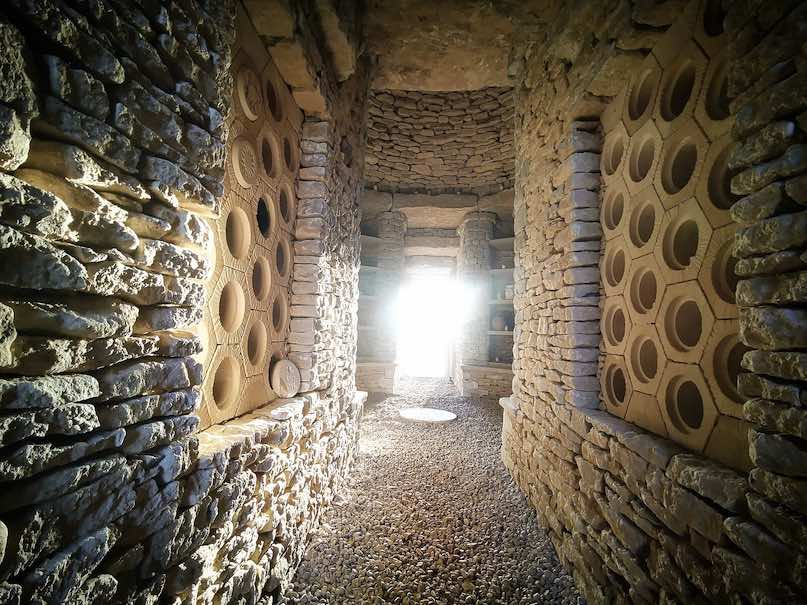
“Long Barrow“ is the technical term for an extraordinary stone structure that won the “Best Use of Stone“ award from the Scottish Dundee Institute of Architects (DIA) in 2024. In modern terms, it is a corbelled roof; a more descriptive description is that, in the style of ancient megalithic tombs, stone slabs were laid on top of each other without mortar to create an open space beneath them.
The award went to the stonemasonry company Davies Stone Creations, based in Bedfordshire, England. The company itself has several unique features: It is in its seventh generation, meaning it must have been founded before the French Revolution, and also passes on the ancient knowledge of the builders.
Most of the long barrows found today in the United Kingdom and on the continent were built in the Stone Age, estimated at 4,000 years ago. However, there is renewed interest from customers: The first such structure of recent date was built in 2014 by Davies Stone Creations in All Canings, Wiltshire, England, as a burial site for urns. This structure was unique in that it was aligned with the solstices; it served as a meeting place for adherents of ancient faiths.
The award-winning long barrow on the grounds of Fingask Castle in Perthshire, Scotland, also serves as a columbarium.
It consists of a central chamber measuring 11 m long and 6.5 m wide. Four smaller circular chambers with diameters of 2.5 m are grouped around it. These chambers contain niches for urns tailored to the individual needs of the deceased.

Atypical for a long barrow, it has round windows at the top that allow a view of the sky. “It’s probably the only corbelled vault of its kind with oculi,“ says James Davis, head of the stonemasonry firm.
He and a team of four specialists worked on the construction for twelve months. Essentially, it is just stacking stone slabs on top of each other, with each layer projecting further inward. Earth normally serves as an external abutment; however, Davies has also built long barrows without abutments.
The work requires no scaffolding: “The corbeled roofs are built using trammel points with dimensions at 200 mm increments on the vertical. For round chambers the trammel point is central. For the oval chambers two trammel points are used with the dimensions dissecting at the longest point. The courses are laid horizontally, so that every course when completed is structurally stable, hence no need for support work.”
Davies has also applied the ancient construction principle to other buildings, such as meditation rooms, music rooms, or wine cellars. He’s also received interest from conservation organizations: “One of our latest ventures is to use these structures within nature reserves alongside major infrastructure projects to mitigate environmental impact.”
James Davis outlines the company’s concept: “We promote traditional stonework alongside contemporary architecture, have an in-house design team that work alongside structural engineers and are always receptive to new innovations whilst using the knowledge passed on to us.”
And goes on: “Our heritage does not quite reach back to the time of the original long barrows but what has been passed down through the generations is an understanding of structure through form using the most basic of elements (unprocessed stone).”