 Stone-Ideas.com


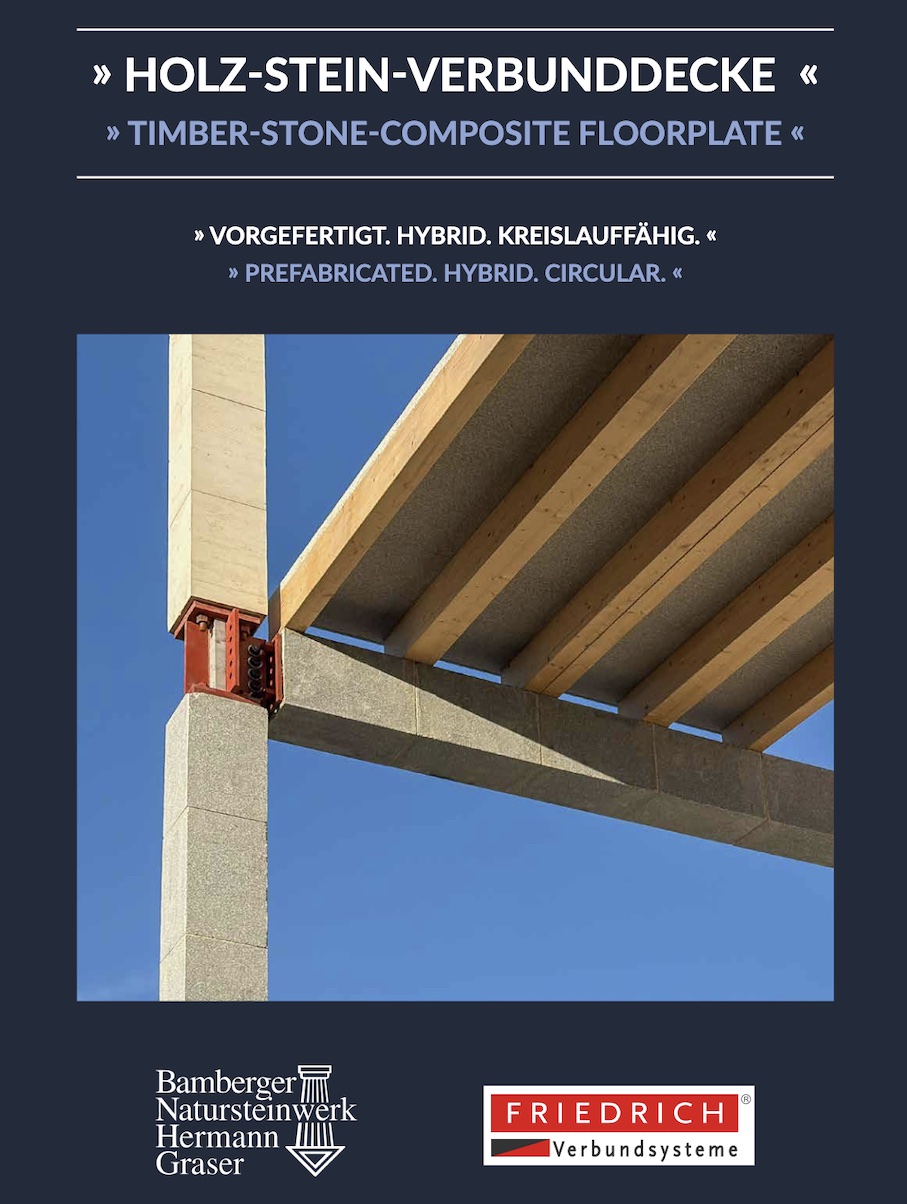
Germany urgently needs new construction, as an estimated 1.4 million homes are lacking, particularly affordable housing. These new buildings should be erected as quickly as possible while minimizing CO2 emissions. Serial construction using ecological building materials is the solution – and Bamberger Natursteinwerk Herman Graser, together with Friedrich Verbundsysteme Company, has presented a model for this. Their wood-stone composite floorplate leverages the strengths of both materials and their low ecological footprint.
In this composite floor, wooden beams support a layer of 6 cm thick natural stone slabs. The wood absorbs tensile forces, while the stone slabs absorb compressive forces.
It is known that both materials are also associated with low CO2 emissions during use, such as during extraction, cutting, transport, and installation.
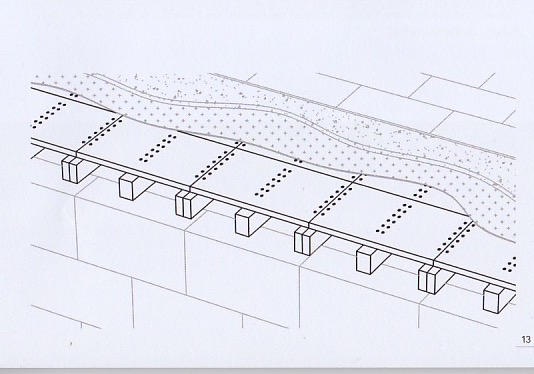
Another crucial advantage of the composite slab is its suitability for serial construction: The individual elements are cut to size at the factory, simply placed on the load-bearing walls at the construction site, and then connected using screw-in anchors.
Furthermore, the composite slab requires no formwork, drying time, etc., and can be loaded immediately after installation, which saves time and reduces costs.
Additional advantages, as described in a brochure from Bamberger Natursteinwerk:
* The increased mass of the prefabricated stone elements contributes to sound absorption and reduces sound transmission between floors. The non-combustible stone material acts as a natural fire barrier, thereby increasing the fire resistance duration of the structure. These technical qualities enhance both safety and living comfort in the completed building;
* material usage is significantly reduced: While a conventional 30 cm thick reinforced concrete slab weighs approximately 0,75 t/m², the timber-stone-composite floorplate with 6 cm thick stone panels and timber beams weighs around 0,17 t/m² – less than one quarter of the mass at comparable load-bearing capacity;
* the BiFRi composite-anchor made of non-hardened steel provides high ductility – even under overload conditions, it shows no brittle, sudden failure, but rather a resilient, predictable load-bearing behaviour.

What’s unusual compared to the currently common use of natural stone is that it’s generally not visible in the composite floor slab, because any type of flooring can be laid on top of it.
Looking under the slab, it’s clear that there’s plenty of space between the joists for pipes and building services.
The composite floorplate is entirely circular and reusable, as the connections can be released reversibly.
The composite ceiling is suitable not only for new buildings but also for reinforcing existing timber joist ceilings. It also has potential for earthquake-prone areas and is patent pending.
The ceiling was part of the Stone Demonstrator, which showcased various options for using natural stone as a load-bearing building material in London.
